
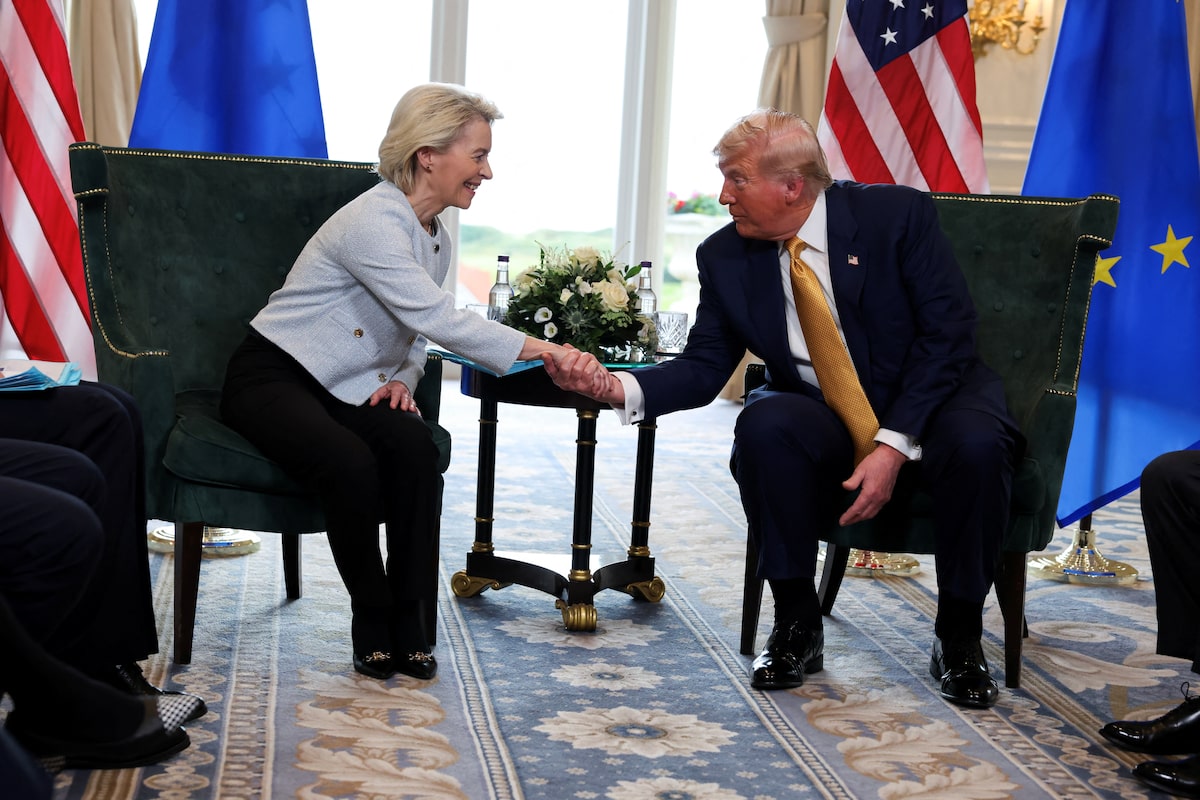
(Reuters Photo)
by Emilio De Capitani
The European Parliament’s recent stance on freezing the implementation of the EU-US trade agreement until the threats of new US tariffs against eight EU countries that have sided with Greenland are withdrawn has caused quite a stir. The position of the Strasbourg assembly certainly contributed, along with other factors, to President Trump’s surprising about-turn on this issue during his speech at the Davos Conference.There is now talk of a resumption of parliamentary work, and the press is referring inappropriately to the “ratification” of the agreement concluded on 21 August 2025 by Commission President Von Der Leyen and President Trump. I say “inappropriately” because the aforementioned “Framework Agreement”, like Magritte’s famous surreal painting, is not a real “agreement” within the meaning of the Treaty on European Union. If it were, it would have had to be negotiated in accordance with the procedure laid down in Article 207 of the Treaty on the Functioning of the European Union: the Commission would have had to obtain a formal mandate from the Council, the Parliament would have had to be promptly and fully informed (Article 218(10) TFEU) and, above all, it would have had to approve its contents before its conclusion.
None of this happened, and the so-called “framework agreement” is nothing more than a statement signed by the President of the Commission on behalf of the Union, without the involvement of the Council and Parliament. It is likely that von der Leyen therefore acted only after informal consultation with Council members such as Germany, but she certainly did not inform the European Parliament, which, although not involved in defining its content, should now not so much “ratify” the Agreement as adopt the European legislation implementing it.
On other occasions, President Von Der Leyen has already accustomed us to her casual interpretation of the Treaties, in particular by making use and abuse of Article 122 of the Treaty, which excludes the European Parliament from fundamental decisions such as those concerning industrial defence policy. That said, one would have expected at least a minimum of respect for the institutional balance in a policy such as trade, which falls within the exclusive competence of the Union.
But that is how it is. As long as the European Parliament avoids defending its institutional prerogatives by challenging, as it should have done, an “agreement” that is not really an agreement but ties its hands, this drift is likely to widen and worsen.
To what extent, then, can Parliament now at least influence the implementation of the so-called “Framework Agreement”? The answer is simple: by conscientiously performing its role as co-legislator, in particular by appropriately amending the draft Regulation currently under consideration by the Parliamentary Committee on International Trade (INTA) on the adjustment of customs duties on imports of certain goods originating in the United States of America and the opening of quotas (2025/0261(COD)). (see below the link to the recent EP press release on this issue)
The rapporteur is German socialist Bernd Lange. In his draft report, he has proposed several amendments that substantially modify the Commission’s original proposal and has meticulously clarified the content and conditions of application of the duties and quotas, as well as the possible safeguard and suspension measures. Above all, he has provided for the measures to monitor implementation to be adopted by the Commission by delegation and not as simple executive measures on which Parliament would not be able to intervene, if necessary.
We will now wait to see the reactions of the right and the EPP to see if they confirm this role for Parliament in the implementation phase of this policy, but in the meantime, the other co-legislator, the Council, has also defined its position. This is, of course, much less ambitious than that of the Parliamentary rapporteur; indeed, the Member States agree with the Commission in recognising a subordinate role for the EP, while taking care to ensure that their “experts” have step-by-step control over the implementation of the Regulation.
It is therefore easy to predict that, once the EP’s position has been voted on, there will be rather intense negotiations between the two institutions in the following weeks through the so-called “trilogue”, which will take place behind closed doors as usual.
It is equally obvious that the Commission will do everything in its power to avoid being controlled by the EP and that, above all, the US administration will try to influence the text of the future regulation in its favour. À suivre…
EP PRESS RELEASE : https://www.europarl.europa.eu/news/it/press-room/20260204IPR33305/eu-us-trade-legislation-meps-to-resume-work-on-turnberry-proposals
 European Area of Freedom Security & Justice