
UNSC RESOLUTION 2240(215) (NB:fighting smugglers and traffickers in the Mediterranean Sea)

NOTA BENE : After UNSC Resolution 2178(2014) on Foreign Fighters aiming to address a problem raised notably by the EU, UNSC Resolution 2240(2015) paves now the way for a strenghtened  EU intervention against smugglers and traffickers in the South Mediterranean currently conducted in the framework of the Operation EUNAVFOR -Sophia. Emphasis have been added to the original text and comment will follow in the coming days 

UNITED NATIONS 

Resolution 2240(2015) Adopted by the Security Council at its 7531st meeting, on 9 October 2015

The Security Council,

Recalling  its press statement of 21 April on the maritime tragedy in the Mediterranean Sea,

Reaffirming its strong commitment to the sovereignty, independence, territorial integrity and national unity of Libya,

Recalling that international law, as reflected in the United Nations Convention on the Law of the Sea of 10 December 1982, sets out the legal framework applicable to activities in the ocean,

Reaffirming also the United Nations Convention against Transnational Organized Crime (UNTOC Convention) and its Protocol against the Smuggling of Migrants by Land, Air and Sea, as the primary international legal instruments to combat the smuggling of migrants and related conduct, and the Protocol to Prevent, Suppress and Punish Trafficking in Persons,

Especially Women and Children, supplementing the UNTOC Convention, as the primary international legal instruments to combat trafficking in persons,

Underlining that, although the crime of smuggling of migrants may share, in some cases, some common features with the crime of trafficking in persons, Member States need to recognise that they are distinct crimes, as defined by the UNTOC Convention and its Protocols, requiring differing legal, operational, and policy responses,

Deploring the continuing maritime tragedies in the Mediterranean Sea that have resulted in hundreds of casualties, and noting with concern that such casualties were, in some cases, the result of exploitation and misinformation by transnational criminal organisations which facilitated the illegal smuggling of migrants via dangerous methods for personal gain and with callous disregard for human life,

Expressing grave concern at the recent proliferation of, and endangerment of lives by, the smuggling of migrants in the Mediterranean Sea, in particular off the coast of Libya and recognizing that among these migrants may be persons who meet the definition of a refugee under the 1951 Convention relating to the Status of Refugees and the 1967 Protocol thereto,

Emphasizing in this respect that migrants, including asylum-seekers and regardless of their migration status, should be treated with humanity and dignity and that their rights should be fully respected, and urging all States in this regard to comply with their obligations under international law, including international human rights law and international refugee law, as applicable, stressing also the obligation of States, where applicable, to protect the human rights of migrants regardless of their migration status, including when implementing their specific migration and border security policies,

Reaffirming in this respect the need to promote and protect effectively the human rights and fundamental freedoms of all migrants, regardless of their migration status, especially those of women and children, and to address international migration through international, regional or bilateral cooperation and dialogue and through a comprehensive and balanced approach, recognizing the roles and responsibilities of countries of origin, transit and destination in promoting and protecting the human rights of all migrants, and avoiding approaches that might aggravate their vulnerability,

Further recalling the International Convention for the Safety of Life at Sea and the International Convention on Maritime Search  and Rescue,

Expressing further concern that the situation in Libya is exacerbated by the smuggling of migrants and human trafficking into, through and from the Libyan territory, which could provide support to other organised crime and terrorist networks in Libya,

Mindful of its primary responsibility for the maintenance of international peace and security under the Charter of the United Nations,

Underlining the primary responsibility of the Libyan Government to take appropriate action to prevent the recent proliferation of, and endangerment of lives by, the smuggling of migrants and human trafficking through the territory of Libya and its territorial sea,

Mindful of the need to support further efforts to strengthen Libyan border management, considering the difficulties of the Libyan Government to manage effectively the migratory flows in transit through Libyan territory, and noting its concern for the repercussions of this phenomenon on the stability of Libya and of the Mediterranean region,

Welcoming support already provided by the most concerned Member States, including Member States of the European Union (EU), taking into account inter alia the role of FRONTEX and the specific mandate of EUBAM Libya in support of the Libyan Government, and by neighbouring States,

Acknowledging the European Council statement of 23 April 2015 and the press statement of the African Union Peace and Security Council of 27 April, which underlined the need for effective international action to address both the immediate and long-term aspects of human trafficking towards Europe,

Taking note of the Decision of the Council of the European Union of 18 May 2015 setting up ‘EUNAVFOR Med’ which underlined the need for effective international action to address both the immediate and long-term aspects of migrant smuggling and human trafficking towards Europe,

Taking further note of the ongoing discussions between the EU and the Libyan Government on migration related issues,

Expressing also strong support to the States in the region affected by the smuggling of migrants and human trafficking, and emphasizing the need to step up coordination of efforts in order to strengthen an effective multidimensional response to these common challenges in the spirit of international solidarity and shared responsibility, to tackle their root causes and to prevent people from being exploited by migrant smugglers and human traffickers,

Acknowledging the need to assist States in the region, upon request, in the development of comprehensive and integrated regional and national strategies, legal frameworks, and institutions to counter terrorism, transnational organised crime, migrant smuggling, and human trafficking, including mechanisms to implement them within the framework of States’ obligations under applicable international law,

Stressing that addressing both migrant smuggling and human trafficking, including dismantling smuggling and trafficking networks in the region and prosecuting migrant smugglers, and human traffickers requires a coordinated, multidimensional approach with States of origin, of transit, and of destination, and further acknowledging the need to develop effective strategies to deter migrant smuggling and human trafficking in States of origin and transit,

Emphasizing that migrants should be treated with humanity and dignity and that their rights should be fully respected, and urging all States in this regard to comply with their obligations under international law, including international human rights law and international refugee law, as applicable,

Bearing in mind the obligations of States under applicable international law to exercise due diligence to prevent and combat migrant smuggling and human trafficking, to investigate and punish perpetrators, to identify and provide effective assistance to victims of trafficking and migrants and to cooperate to the fullest extent possible to prevent and suppress migrant smuggling and human trafficking,

Affirming the necessity to put an end to the recent proliferation of, and endangerment of lives by, the smuggling of migrants and trafficking of persons in the Mediterranean Sea off the coast of Libya, and, for these specific purposes, acting under Chapter VII of the Charter of the United Nations,

  1. Condemns all acts of migrant smuggling and human trafficking into, through and from the Libyan territory and off the coast of Libya, which undermine further the process of stabilisation of Libya and endanger the lives of thousands of people;
  1. Calls on Member States acting nationally or through regional organisations, including the EU, to assist Libya, upon request, in building needed capacity including to secure its borders and to prevent, investigate and prosecute acts of smuggling of migrants and human trafficking through its territory and in its territorial sea; in order to prevent the further proliferation of, and endangerment of lives by, the smuggling of migrants and human trafficking into, through and from the territory of Libya and off its coast;
  1. Urges Member States and regional organisations, in the spirit of international solidarity and shared responsibility, to cooperate with the Libyan Government, and with each other, including by   sharing   information about acts of migrant smuggling and human trafficking in Libya’s territorial sea and on the high seas off the coast of Libya, and rendering assistance to migrants and victims of human trafficking recovered at sea, in accordance with international law;
  1. Urges States and regional organisations whose naval vessels and aircraft operate on the high seas and airspace off the coast of Libya, to be vigilant for acts of migrant smuggling and human trafficking, and in this context, encourages States and regional organisations to increase and coordinate their efforts to deter acts of migrant smuggling and human trafficking, in cooperation with Libya;
  2. Calls upon Member States acting nationally or through regional organisations that are engaged in the fight against migrant smuggling and human trafficking to inspect, as permitted under international law, on the high seas off the coast of Libya, any unflagged vessels that they have reasonable grounds to believe have been, are being, or imminently will be used by organised criminal enterprises for migrant smuggling or human trafficking from Libya, including inflatable boats, rafts and dinghies;
  1. Further calls upon such Member States to inspect, with the consent of the flag State, on the high seas off the coast of Libya, vessels that they have reasonable grounds to believe have been, are being, or imminently will be used by organised criminal enterprises for migrant smuggling or human trafficking from Libya;
  1. Decides, with a view to saving the threatened lives of migrants or of victims of human trafficking on board such vessels as mentioned above, to authorise, in these exceptional and specific circumstances, for a period of one year from the date of the adoption of this resolution, Member States, acting nationally or through regional organisations that are engaged in the fight against migrant smuggling and human trafficking, to inspect on the high seas off the coast of Libya vessels that they have reasonable grounds to suspect are being used for migrant smuggling or human trafficking from Libya, provided that such Member States and regional organisations make good faith efforts to obtain the consent of the vessel’s flag State prior to using the authority outlined in this paragraph;
  1. Decides to authorise for a period of one year from the date of the adoption of this resolution, Member States acting nationally or through regional organisations to seize vessels inspected under the authority of paragraph 7 that are confirmed as being used for migrant smuggling or human trafficking from Libya, and underscores that further action with regard to such vessels inspected under the authority of paragraph 7, including disposal, will be taken in accordance with applicable international law with due consideration of the interests of any third parties who have acted in good faith;
  1. Calls upon all flag States involved to cooperate with respect to efforts under paragraphs 7 and 8, and decides that Member States acting nationally or through regional organisations under the authority of those paragraphs shall keep flag States informed of actions taken with respect to their vessels, and calls upon flag States that receive such requests to review and respond to them in a rapid and timely manner;
  1. Decides to authorise Member States acting nationally or through regional organisations to use all measures commensurate to the specific circumstances in confronting migrant smugglers or human traffickers in carrying out activities under paragraphs 7 and 8 and in full compliance with international   human   rights   law,   as applicable, underscores that the authorizations in paragraph 7 and 8 do not apply with respect to vessels entitled to sovereign immunity under international law, and calls upon Member States and regional organisations carrying out activities under paragraphs 7, 8 and this paragraph, to provide for the safety of persons on board as an utmost priority and to avoid causing harm to the marine environment or to the safety of navigation;
  1. Affirms that the authorisations provided in paragraphs 7 and 8 apply only with respect to the situation of migrant smuggling and human trafficking on the high seas off the coast of Libya and shall not affect the rights or obligations or responsibilities of Member States under international law, including any rights or obligations under UNCLOS, including the general principle of exclusive jurisdiction of a flag State over its vessels on the high seas, with respect to any other situation, and further affirms that the authorisation provided in paragraph 10 applies only in confronting migrant smugglers and human traffickers on the high seas off the coast of Libya;
  1. Underscores that this resolution is intended to disrupt the organised criminal enterprises engaged in migrant smuggling and human trafficking and prevent loss of life and is not intended to undermine the human rights of individuals or prevent them from seeking protection under international human rights law and international refugee law;
  1. Emphasises that all migrants, including asylum-seekers, should be treated with humanity and dignity and that their rights should be fully respected, and urges all States in this regard to comply with their obligations under international law, including international human rights law and international refugee law, as applicable;
  1. Urges Member States and regional organisations acting under the authority of this resolution to have due regard for the livelihoods of those engaged in fishing or other legitimate activities;
  1. Calls upon all States, with relevant jurisdiction under international law and national legislation, to investigate and prosecute persons responsible for acts of migrant smuggling and human trafficking at sea, consistent with States’ obligations under international law, including international human rights law and international refugee law, as applicable;
  1. Calls for Member States to consider ratifying or acceding to, and for States Parties to effectively implement the Protocol against the Smuggling of Migrants by Land, Sea and Air, supplementing the United Nations Convention against Transnational Organized Crime, and as well as the Protocol to Prevent, Suppress and Punish Trafficking in Persons, Especially Women and Children;
  1. Requests States utilising the authority of this resolution to inform the Security Council within three months of the date of adoption of this resolution and every three months thereafter on the progress of actions undertaken in exercise of the authority provided in paragraphs 7 to 10 above;
  1. Requests the Secretary-General to report to the Security Council eleven months after the adoption of this resolution on its implementation, in particular with regards to the implementation of paragraphs 7 to 10 above;
  1. Expresses its intention to review the situation and consider, as appropriate, renewing the authority provided in this resolution for additional periods;
  1. Decides to remain seized of the matter.
Angela Merkel au Parlement européen, des paroles aux actes ?

ORIGINAL PUBLISHED ON CDRE (12 OCTOBER 2015)

 par Henri Labayle,

Le discours prononcé par Angela Merkel devant le Parlement européen, 7 octobre 2015 aux cotés de François Hollande, est remarquable en tous points. Au delà du symbole d’une intervention du couple franco-allemand, qui n’était d’ailleurs peut être pas le meilleur signal à envoyer à ceux que l’on tentait de convaincre, cette prise de parole publique devant les représentants des peuples européens ne manque pas de sens.

Il était donc naturel  d’en souligner l’impact, partageant le sentiment d’un Jürgen Habermas « aussi surpris que réjoui » par le positionnement allemand face à la crise des réfugiés dans l’Union.

L’intervention de la chancelière allemande traduit en effet une constance politique qui mérite le respect et elle annonce des évolutions techniques qui suscitent l’interrogation.

1. La constance

Angela Merkel persiste et signe, est-on obligé de souligner. Malgré une vague grandissante de critiques, confrontée à une fronde plus ou moins larvée au sein de sa propre majorité et à une crispation évidente de l’opinion publique allemande que traduisent des sondages récents, la chancelière n’a pas dévié d’un pouce quant au terrain sur lequel elle entendait se placer et entraîner à sa suite l’Union européenne.

Ce dernier est le seul concevable, il est celui des valeurs de l’Union européenne qui, aux termes des traités, la « fondent » et « sont communes aux Etats membres » et dont l’Union doit assurer la« promotion ». C’est à ces valeurs et à la dignité de l’être humain que s’est référée explicitement la chancelière allemande le 31 aout lorsque la crise matérielle de l’asile s’est transportée sur le terrain institutionnel.

Aussi, tenir le cap politique en faisant valoir qu’à l’inverse de ce que l’on entend ici et là, le débat ne se pose pas en termes d’opportunité mais d’obligation morale autant que juridique est un discours responsable. Tout autant que l’est le propos répétant qu’isolément les Etats sont impuissants et que la réponse collective est la seule envisageable. Effectivement, « céder à la tentation de rétrograder, d’agir à une échelle nationale » serait une erreur historique et il convient politiquement « d’assumer l’attrait de l’Europe ».

Tel est le bon angle d’attaque du débat public. Faut-il en effet rappeler que, depuis le traité de Maastricht qui la considérait comme une « question d’intérêt commun » jusqu’à l’affirmation d’une « politique commune d’asile » à Amsterdam, l’accueil des demandeurs de protection internationale s’est européanisé au point de nécessiter une seconde génération des textes composant le régime d’asile commun ? Les articles 18 et 19 de la Charte se bornent à en tirer les conséquences.

Du reste, et à supposer que le niveau européen de cette protection du droit d’asile soit discutable, comment oublier les contraintes pesant sur la totalité des Etats membres de l’Union en raison de leur adhésion à la Convention de Genève comme à celle des droits de l’Homme ? Enfin et au delà de la France et de la République fédérale et pour n’en rester qu’aux Etats membres récalcitrants, comment nier l’autorité de la proclamation de ce même droit d’asile par les textes constitutionnels en Hongrie (article 14), en Pologne (article 56) ou en Slovaquie (article 53) ?

Aussi, prétendre mener la contestation des mesures arrêtées dans l’Union en matière de relocalisation des réfugiés au nom du respect de la légalité, comme semble vouloir le faire la Slovaquie, témoigne d’une curieuse vision de la Communauté de droit à laquelle on appartient, par delà les arguments techniques ou procéduraux fondés ou non.

Cette constance avait également animé auparavant le propos remarquable du Président de la Commission, le 9 septembre dans son discours sur l’état de l’Union prononcé lui aussi devant le Parlement européen.

Rappelant le poids de l’Histoire du continent européen, avant, pendant comme après le second conflit mondial, le chef de l’exécutif communautaire a choisi de mettre l’accent sur « le respect de nos valeurs communes et de notre histoire » après avoir resitué l’ampleur de l’effort à accomplir. Soulignant l’impact du contexte international autant que les enjeux d’une sous-estimation des besoins de protection, Jean Claude Juncker a ainsi redonné sa signification politique à la fonction qu’il exerce, enfin.

Ce faisant, l’alliance des deux acteurs principaux de l’Union n’aurait pu produire d’effet sans le relais efficace d’une présidence luxembourgeoise renouant avec la tradition qui veut qu’une présidence assurée par un petit Etat membre soit souvent des plus productives. Là encore, la brusque accélération du dossier législatif « relocalisation » en a tiré le bénéfice, les deux décisions de relocalisation ayant été publiées et commençant à prendre effet.

Pour autant, la constance du discours est-elle annonciatrice de véritables changements dans la politique d’asile de l’Union européenne ou bien faut-il en douter, à l’image de certains commentaires médiatiques au lendemain de ce discours regrettant l’absence de mesures concrètes ?

2. Le changement

D’ores et déjà, il est en marche. La conduite du dossier législatif de la relocalisation en est précisément une manifestation douloureuse pour les partisans de la méthode intergouvernementale.

On sait en effet la grande relativité de la communautarisation des procédures législatives. Malgré l’appellation des traités, la « procédure législative ordinaire » qui voudrait que la majorité qualifiée et l’accord du Parlement soient la règle en matière d’asile et d’immigration est passablement différente dans la pratique décisionnelle. La culture du consensus qui anime les diplomates qui se prétendent législateurs les amène ainsi à préférer les pratiques anciennes, celles qui consistent à ne pas forcer les Etats membres, conduits au pire à se réfugier dans l’abstention.

Ainsi, le 20 juillet 2015, une « décision des représentants des gouvernements des Etats membres réunis au sein du Conseil» c’est-à-dire un acte non pas de l’Union mais un acte engageant simplement les Etats collectivement (CJUE, 30 juin 1993, Parlement c. Conseil et Commission, C-181/91 et C-248/91, point 25) a permis de surmonter, par consensus, les désaccords entre Etats et d’adopter la décision2015/1523 procédant à la relocalisation de 40 000 personnes à partir de la Grèce et de l’Italie.

En revanche, le retour à l’orthodoxie communautaire s’est avéré bien plus pratique lorsqu’il a fallu surmonter l’opposition résolue de quatre Etats membres : la décision 2015/1601 du 22 septembre 2015 a donc été adoptée selon les voies classiques du traité et même en utilisant la procédure de vote à la majorité qualifiée … Signe de l’ampleur des désaccords, les conclusions de cette réunion ont été présentées par le ministre luxembourgeois comme « celles de la Présidence » et non du Conseil …

La seconde marque de changement a frappé l’espace Schengen. Improprement présenté comme relevant des « accords de Schengen », présentation ambiguë qui pourrait laisser penser que ces accords peuvent être dénoncés, le droit de l’espace Schengen repose d’une part sur les articles 67 et 77 TFUE qui garantissent l’absence de contrôles aux frontières intérieures et, d’autre part, sur le règlement 562/2006 dit « Code Frontières Schengen » tel que modifié en 2013.

Ce dispositif de près de trente ans n’avait pas été conçu pour résister à une pression de l’ampleur de celle traversée par l’Union en cet été 2015. Il a donc volé en éclats tant à propos de la capacité des Etats membres à assumer leurs responsabilités de contrôles des frontières extérieures qu’en ce qui concerne l’interdiction d’exercer des contrôles nationaux aux frontières intérieures. Le rétablissement temporaire des contrôles aux frontières intérieures décidé par plusieurs Etats membres, de la Slovénie et l’Autriche avec l’aval de la Commission, conformément à l’article 25 du Code, a fait clairement ressortir la réalité.

Elle est double : d’une part, l’absence de modification substantielle d’un mécanisme conçu à 5 pour s’appliquer à 30 Etats est devenue clairement problématique, d’autre part, le maintien d’un espace de libre circulation intérieure dépend évidemment d’un renforcement effectif des contrôles aux frontières extérieures. Ce second constat ne connaît qu’une issue, à espace européen constant en tous cas : une gestion plus intégrée de ces frontières. Là encore, dès le début septembre comme au Parlement européen, la chancelière allemande n’a pas masqué la gravité de cet enjeu.

Troisième signe de changement, le plus lourd de signification sans doute, la remise en question du système dit de Dublin. Mal dénommé car né en réalité dans le chapitre VII de la convention d’application des accords de Schengen de 1990, ce système pose le principe du traitement unique de la demande d’asile. Critiqué à juste titre, d’une efficacité pour le moins douteuse comme en témoigne le dernier rapport d’AIDA, mis en cause jusqu’au Conseil de l’Europe, le système Dublin a connu diverses réformes mais n’a jamais été remis en question par principe.

La raison en est simple : il fait peser l’essentiel de la charge sur les Etats que le hasard de la géographie a mis au contact de la pression migratoire extérieure. Ceci sans aucune mesure avec leurs capacités de réponse, la Grèce étant un exemple caricatural de cette situation. Les Etats de seconde ligne, malgré ces dysfonctionnements, y trouvaient bon gré mal gré un certain confort et même si, dans les faits, le système n’a pas fonctionné comme on l’a vu en Italie ou en Grèce.

D’où une difficulté à accepter l’idée d’un changement, malgré le coup de tonnerre provoqué par l’ouverture des frontières allemandes, clairement en contradiction avec cet état du droit.

Cet attachement au dispositif Dublin s’est manifesté jusqu’au dernier moment. Ainsi, la réunion informelle des chefs d’Etat et de gouvernement du 23 septembre rappelait-elle que « nous devons tous respecter, appliquer et mettre en œuvre nos règles existantes, y compris le règlement de Dublin et l’acquis de Schengen ». De même, le dispositif de relocalisation adopté comme en préparation est-il présenté comme une « dérogation » au mécanisme de Dublin. Enfin, et sans que l’on voie exactement où elle entend se diriger, la Commission promet d’ouvrir le chantier de la réforme de Dublin en « mars 2016 ».

Sans tir de sommation, la salve de la chancelière allemande fait mouche et semble ouvrir un nouveau chapitre de la politique d’asile : « soyons francs, le processus de Dublin, dans sa forme actuelle, est obsolète » a-t-elle asséné aux parlementaires européens.

Dès lors, faut-il croire que la conclusion de la chancelière fera office de feuille de route ? Consciente de l’impasse dans laquelle sa politique l’a engagée, l’Union sera-t-elle capable d’une part d’ouvrir des voies légales d’accès à la protection et, d’autre part, de s’accorder sur une répartition équitable des charges telle que ses traités l’y invitent ?

(Amnesty International Briefing ) FENCED OUT : HUNGARY’S VIOLATIONS OF THE RIGHTS OF REFUGEES AND MIGRANTS

ORIGINAL PUBLISHED HERE 

INTRODUCTION

“[W]e would like Europe to be preserved for the Europeans. But there is something we would not just like but we want because it only depends on us: we want to preserve a Hungarian Hungary” Viktor Orbán, Prime Minister of Hungary, 25 July 20151

“We are also humans. Before we lived in peace and we have had our lives and dreams torn apart by wars and greed of the governments.” Hiba Almashhadani, an Iraqi refugee, 21 September 20152

In the first eight months of 2015, 161,000 people claimed asylum in Hungary. The Office for Immigration and Nationality has estimated that two thirds of those arriving3 were asylum-seekers from Syria, Afghanistan and Iraq who entered the country irregularly.4 These are, unquestionably, large numbers and they have presented Hungary with considerable, if not entirely unforeseeable, challenges. Hungary’s response to these challenges has, however, been hugely problematic. While Hungary is bearing much of the brunt of the EU’s structurally unbalanced asylum regime, it has also shown a singular unwillingness to engage in collective EU efforts to address these shortcomings and participate in initiatives designed to redistribute the responsibility for receiving and processing asylum seekers, notably the relocation and “hotspot” processing schemes that the European Commission and Council have been proposing.

Instead, Hungary has moved in recent months to construct fences along its southern borders, criminalise irregular entry to its territory and expedite the return of asylum seekers and refugees to Serbia, through its inclusion on a list of safe countries of transit. The cumulative effect, and desired consequence, of these measures will be to render Hungary a refugee protection free zone. Ultimately, Hungary’s attempts to insulate itself against a regional, and wider global, refugee crisis can only be achieved at the expense of the respect its international human rights and refugee law obligations. In fact, this is already happening; only the completion of a fence along the Croatian border is preventing Hungary’s isolationist migration policies from reaching fruition.

Hungary’s determination to avoid its responsibilities towards refugees is not just a Hungarian problem. It is also an EU problem. Hungary’s policies are not preventing entry to the EU, they are merely displacing the routes refugees and migrants are taking to reach it. Hungary’s policies also represent a structural threat to the rule of law and the respect for human rights that other member states and EU institutions cannot afford to ignore. The EU should therefore engage Hungary in a formal discussion, as foreseen by Article 7 of the Treaty of the European Union, with a view to bringing its migration and asylum policies in line with EU and other international law obligations and ensuring that Hungary participates fully in collective EU initiatives and reforms designed to address the current refugee crisis, while receiving the considerable support it needs to do so.

THE UNFOLDING OF THE “CRISIS”

On 15 September 2015 the Hungarian government declared a “crisis situation caused by mass immigration”.5 On the same day, the construction of a fence on the border with Serbia was finished and amendments to the Criminal Code and Asylum Law, making it an offence to enter the country through the border fence and establishing “transit zones” at the border, entered into effect.

On 21 September, the Hungarian Parliament adopted further amendments to the Police Act and the Act on National Defence. These extend the powers of the police in situations of “crisis caused by mass immigration” to block roads, ban or restrain the operation of public institutions, shut down areas and buildings and restrain or ban the entering and leaving of such places. The new measures authorise the army to support the police securing the border in the crisis situation and to use rubber bullets, tear gas grenades and pyrotechnical devices.6

On 22 September, the Hungarian Parliament adopted a resolution which stated, among other things, that Hungary should defend its borders by “every necessary means” against “waves of illegal immigration”. The resolution stated: “[W]e cannot allow illegal migrants to endanger the jobs and social security of the Hungarian people. We have the right to defend our culture, language, and values.”7

The number of asylum seekers in Hungary in 2015, represents a significant increase on the 42,777 applications registered in 2014. 8 The Hungarian government had, however, long been received signals of an expected increase in asylum applications. As early as 2012 the United Nations High Commissioner for Refugees (UNHCR, the UN Refugee Agency) as well as NGOs were calling for an improvement of the reception facilities for asylum-seekers in Hungary and the need to bring them in line with the EU reception standards.9

Instead of introducing measures in line with these calls, the government started to work on measures to keep refugees and migrants out of the country. In 2015 it spent 3.2 million Euros10 on a “national consultation on immigration and terrorism”11 in the course of which it distributed a questionnaire to over eight million citizens seeking answers to questions such as whether or not those who cross the borders illegally should be detained for a period longer than 24 hours.12 Another 1.3 million Euros was spent on an anti-refugee billboard campaign that included messages such as “If you come to Hungary, don’t take the jobs of Hungarians” or “If you come to Hungary, you have to respect our culture!”.13 98 million Euros was spent on the construction of the border fence with Serbia.14 The 2015 budget of the Office of Immigration and Nationality responsible for reception of asylum seekers and processing applications was 27.5 million Euros.15

The government did however move swiftly with the adoption of measures aiming at keeping refugees and migrants out and facilitating their return. On 1 August 2015, an amendment of the Asylum Law16 entered into force which authorized the government to issue a lists of safe countries of origin and safe third countries of transit. Serbia, Macedonia and EU member states, including Greece, are considered safe by the Hungarian authorities as a result of these changes, meaning that asylum applications by people transiting through from these countries can be sent back to them following expedited proceedings.17 On 15 September another set of amendments came into effect. They criminalized “illegal entry” through the border fence and introduced “transit zones” for asylum-seekers at the border and other changes.18

On 17 September, the Minister of Interior ordered a “partial border closure” of the border crossings at the Röszke/Horgoš motorway and at the express road for a period of 30 days. It justified it as a measure “in the interest of the protection of public security”.19 During the period of the partial border closure, it was not possible for passengers, vehicles and cargo to cross the state border between Hungary and Serbia. The border was re-opened on 20 September after the Hungarian and Serbian Ministries of Interior “succeeded in finding a solution to opening the border crossing station and ensuring the continued flow of passenger and cargo traffic.”20

Following the effective sealing off of the border with Serbia in mid-September, refugees and migrants started entering Hungary through the border with Croatia through the crossings at Beremend21 and Zakány.22 By the beginning of October an average of about 4,000 people were entering on a daily basis according to the Hungarian police.23 The measures taken by the Hungarian government have therefore served primarily to redirect the flow of refugees and migrants, not stop it. However, Hungary has already begun constructing a similar fence along the Croatian border, and has already almost completed the laying of barbed wire along its entirety.24 Once a full-scale fence has been constructed, asylum-seekers will effectively no longer be able to access Hungarian territory and protection proceedings. Those that do succeed in crossing the fence will be liable to prosecution – and return to Serbia or Croatia.25

INTERNATIONAL CRITICISM OF HUNGARY’S MIGRATION POLICIES

Hungary’s draconian response to the increase of the number of refugees and migrants entering the country has been roundly criticised by international human rights bodies.

On 15 September, the Secretary General of the Council of Europe, Thorbjørn Jagland wrote to the Hungarian Prime Minister, Viktor Orbán, expressing concerns over the legislation adopted “in the context of the migration crisis“. He asked for assurances that Hungary is still committed to its obligations under the European Convention on Human Rights. The Secretary General also warned that Hungary cannot derogate from its obligation to protect the right to life, prohibition of torture and other rights.26

On 17 September, the UN Human Rights Commissioner Zeid Ra’ad Al Hussein said that amendments of the Criminal Code and the Asylum Law which entered into force on 15 September are incompatible with the human rights commitments binding on Hungary. “This is an entirely unacceptable infringement of the human rights of refugees and migrants. Seeking asylum is not a crime, and neither is entering a country irregularly.” The UN Human Rights Commissioner further observed that some of the actions carried out by the Hungarian authorities, such as denying entry, arresting, summarily rejecting and returning refugees, using disproportionate force on migrants and refugees, as well as reportedly assaulting journalists and seizing video documentation, amounted to clear violations of international law.27 He also noted “the xenophobic and anti-Muslim views that appear to lie at the heart of current Hungarian Government policy”.

The response of the EU institutions has been less unequivocal. The EU Commissioner for Migration, Home Affairs and Citizenship, Dimitris Avramopolous, declared during his visit to Hungary on 17 September that “[The EU] will work collectively to protect the Union’s external borders.” Hungary, he noted, “is doing part in this work… [although the EC does] not always agree with the means used.” Commissioner Avramopolous expressed a commitment “to work with [EU’s] neighbours – establishing a common list of safe countries of origin and intensifying cooperation with the Western Balkan countries and Turkey.” At the same time, however, he acknowledged a “moral duty… inscribed in international and European laws” to offer protection to those who need it.28

METHODOLOGY AND PURPOSE OF THIS BRIEFING Continue reading “(Amnesty International Briefing ) FENCED OUT : HUNGARY’S VIOLATIONS OF THE RIGHTS OF REFUGEES AND MIGRANTS”

Alternatives to detention for asylum seekers and people in return procedures

EU FUNDAMENTAL RIGHTS AGENCY (full document accessible here)

Alternatives to detention for asylum seekers and people in return procedures

For asylum and return (i.e. expulsion) procedures to be implemented effectively, people need to be at the disposal of the authorities so that any measure requiring their presence can be taken without delay. To achieve this, EU Member States may decide to hold people in closed facilities. Less intrusive measures, which are usually referred to as alternatives to detention, reduce the risk that deprivation of liberty is resorted to excessively.

In light of the significant number of asylum seekers and migrants reaching the EU’s external borders and moving onward to other EU Member States, there is a danger that deprivation of liberty may be resorted to excessively and in cases where it is not necessary. With this compilation of legal instruments and other resources, FRA seeks to provide guidance to policy makers and practitioners on the use of non-custodial measures for asylum seekers and people in return procedures.

According to EU law, as well as Article 5 of the European Convention of Human Rights, deprivation of liberty for immigration-related reasons can only be used as a measure of last resort. An assessment needs to be made in each individual case to determine whether all the preconditions required to prevent arbitrary detention are fulfilled. Under Article 8 of the Reception Conditions Directive 2013/33/EU and Article 15 of the Return Directive 2008/115/EC, detention must not be used when less intrusive measures are sufficient to achieve the legitimate objective pursued.

Most of the wide array of alternatives to detention imply some restrictions on freedom of movement and/or other fundamental rights. Any restrictions to these rights must be in conformity with Article 52 (1) of the EU Charter of Fundamental Rights. This means that limitations must be provided for by law, must genuinely meet objectives of general interest recognised by the Union or the need to protect the rights and freedoms of others, respect the essence of the right, and be proportionate. Alternatives to detention must, therefore, be distinguished from unconditional release from detention or unrestricted placement in open facilities.

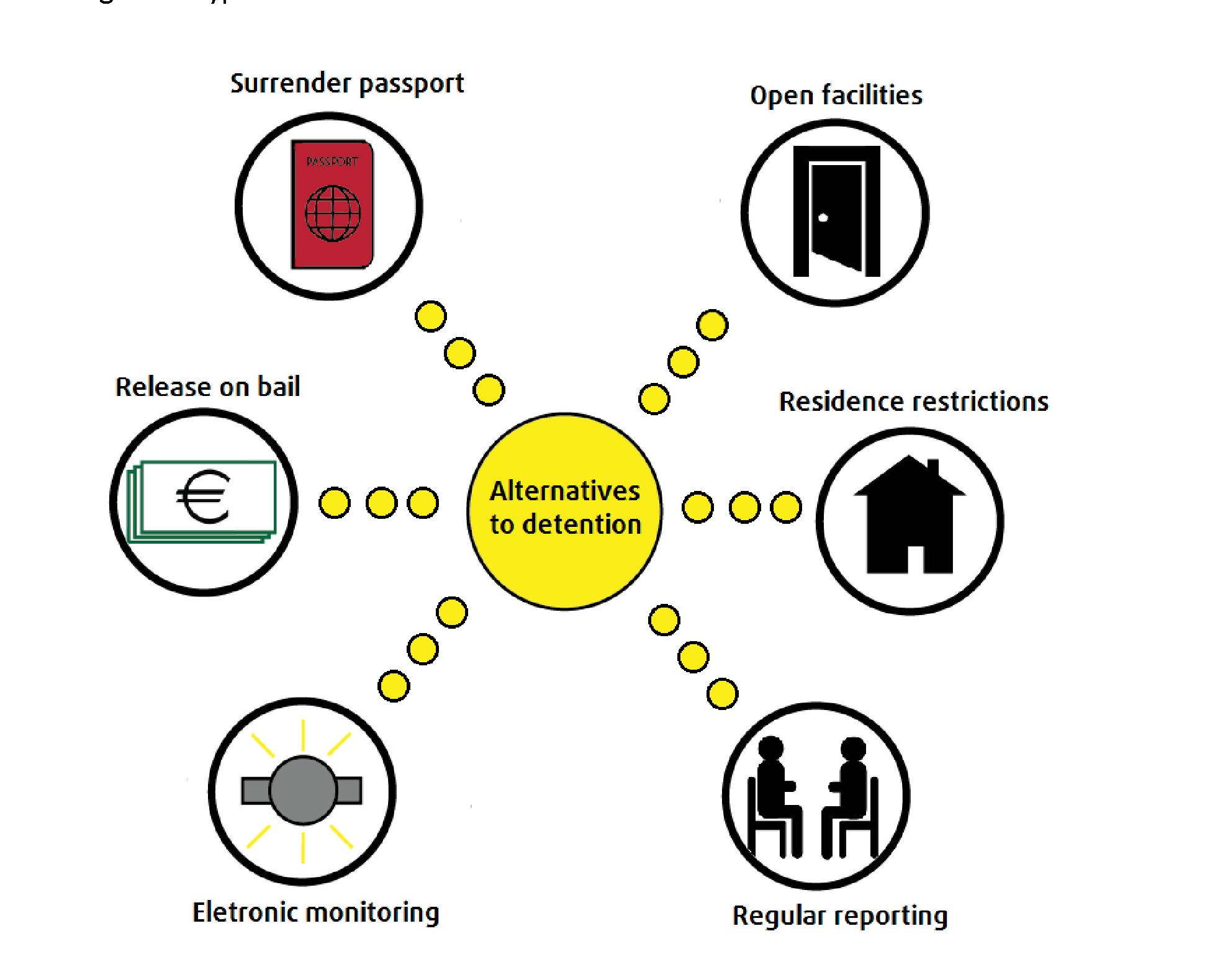
The alternatives, many of which can be used in combination with each other, can be broadly grouped under the following categories:

Obligation to surrender passports or travel documents
This obligation may be imposed alone or together with other alternatives, such as the duty to stay in a particular location or area. It is a soft measure that essentially serves to ensure that valid identity and travel documents are not lost or destroyed during the time required to prepare the return and removal process.

Residence restrictions
Such restrictions impose the duty of remaining at a particular address or residing within a specific geographical area, often combined with regular reporting requirements. The designated places can be open or semi-open facilities run by the government or NGOs, as well as hotels, hostels or private addresses. The regime imposed can vary, but people generally have to be present at the designated location at certain times, while absences are usually only allowed with a well-founded justification.

Release on bail and provision of sureties by third parties
In the context of criminal law, it is not uncommon to allow the release of a detained person on condition of bail, which will be forfeited if the person does not report to the authorities. Release based on financial guarantees is infrequently used in asylum and pre-removal proceedings, partly because it is assumed that many asylum seekers or third-country nationals in return procedures would not have the necessary means to put up bail.

Regular reporting to the authorities
This alternative obliges people to report to the police or immigration authorities at regular intervals, and is one of the more frequent alternatives to detention found in national legislation. Reporting duties on a daily, bi-weekly, weekly or even less frequent basis may also be imposed as an additional requirement to the obligation to reside in a specified area or location.

Placement in open facilities with caseworker support
This is an innovative alternative to detention that combines classical social work with time spent at designated places. Asylum seekers or people in return procedures are placed in open facilities and provided with individual coaches or counsellors to inform and advise them about their situation and options. This form of alternative was established following evidence that compliance with a return decision depends on the level of trust the person affected by the decision has in the authorities of the host country. Such trust is created through individual counselling and contacts with external actors, such as NGOs.

Electronic monitoring
Electronic monitoring or tagging is primarily used in the context of criminal law. Its use as a substitute for immigration detention is limited. Electronic monitoring is the most intrusive of the various alternatives to detention, as it substantially interferes with a person’s right to privacy, restricts freedom of movement and can have a negative impact on their dignity. It can also lead to discrimination through the potential association of people wearing an electronic device with criminals.

AlternativeDetention

Source: FRA (2015)

Significant attention has been devoted to alternatives to immigration detention in recent years. This has resulted both in a great deal of comparative research and in the developments of tools and other guidance to promote the use of alternatives. This compilation is aimed at policy makers and practitioners entrusted with the task of promoting the use of alternatives to detention and seeks to facilitate the usage of existing materials. It presents various instruments and research material, together with the general human rights and EU legal framework. The first section covers the international framework that safeguards the right to liberty, while those that follow focus specifically on alternatives to detention. The compilation sets out selected:

  • instruments on the right to liberty
  • non-binding United Nations instruments on alternatives to detention
  • non-binding Council of Europe instruments on alternatives to detention
  • European Union law provisions relating to alternatives to detention
  • case law from the European Court of Human Rights, the Court of Justice of the EU and the United Nations Human Rights Committee on alternatives to detention
  • recently developed tools
  • research publications.

The selected instruments are presented by category, beginning with legal instruments (binding and non-binding), and then continuing to case law, expert guidelines and research papers. The left column of each table lists the documents in question with an embedded hyperlink to the full text. The right column reproduces key excerpts from these documents, with additional explanations in italics where relevant. A short introduction precedes each table.

Using alternatives to detention benefits both the state and migrants, as on the one hand they are more cost-effective and on the other they are less intrusive and more respectful of fundamental right than deprivation of liberty. Although virtually all EU Member States provide for the possibility of alternatives to detention (current reforms in Malta are expected to introduce fully-fledged alternatives in the near future), they are still too little applied and when they are, it is primarily in cases involving particularly vulnerable people. Several EU Member States do not yet collect statistics on alternatives to detention, which makes it difficult to assess the extent to which they are used in reality.

Compilation of key resources to promote the use of alternatives to immigration detention in practice
1. Right to liberty: selected instruments
2. Alternatives to detention: selected instruments
2.1.  Selected non-binding United Nations (UN) instruments relating to alternatives to detention
– United Nations General Assembly
– General comments by UN treaty bodies
– Executive Committee of the High Commissioner’s Programme (ExCom)
– UN Working Group on Arbitrary Detention
– Special Rapporteur on the human rights of migrants
– Special Rapporteur on torture and other cruel, inhuman or degrading treatment or punishment…
– Selected non-binding Council of Europe instruments relating to alternatives to detention
– Selected European Union law on alternatives to detention
3. Alternatives to detention: selected case law
– European Court of Human Rights (ECtHR)
– Court of Justice of the European Union (CJEU)
– United Nations Human Rights Committee (HRC)
4. Alternatives to detention: tools
5.Selected research documents
Useful links CONTINUE READING (from page 6 of the FRA Study…)

Meijers Committee : EU list of safe countries of origin

ORIGINAL PUBLISHED ON THE MEIJERS COMMITEE PAGE 

Summary of recommendations

As part of the response to the unfolding refugee crisis in Europe, the European Commission recently proposed a Regulation establishing a common EU list of safe countries of origin.1 In this note the Meijers Committee submits a number of observations and recommendations to the Union legislator. In particular, the Meijers Committee

i) welcomes the Commission’s decision to opt for legislation rather than intergovernmental cooperation;
ii) expresses doubts whether a common list of safe countries of origin will have the desired effect of arriving at common procedural practices;
iii) advises that designations of countries as safe should as a rule take into account the position of vulnerable minority groups within the country;
iv)  recommends to apply the concept of safe country of origin only after an individual examination involving a personal interview and a right to legal assistance;
v) recommends to obtain external expert advice before adopting or amending the list, for example from UNHCR;
vi)  advises to codify the right to appeal against negative decisions for reason of a person coming from a safe country with automatic suspensive effect, as guaranteed by the EU Charter on Fundamental Rights and the ECHR.

At the end of this note, the Meijers Committee proposes to insert three amendments into the Regulation to bring the level of legal protection in conformity with relevant human rights law.
The amendments concern:
i) the right to an individual interview;
ii) suspensive effect of appeals with regard to removal;
iii)  Position of minorities in the designation criteria.

Legislation as the chosen instrument

The European Commission introduced a Regulation which directly creates a list of safe countries of origin. Any changes to the list can be made through a legislative act only. The regulation also amends articles in the Procedures Directive pertaining to the safe country of origin   concept. The Meijers Committee welcomes that the Commission proposes to establish this list through a Regulation. Establishing the list in an informal, intergovernmental manner would have left out co-decision of the European Parliament and judicial oversight of the Court of Justice.2 Given the serious ramifications of a common list of safe countries of origin, it is important that it is adopted in a transparent and democratic accountable manner.

The “safe country of origin” concept Continue reading “Meijers Committee : EU list of safe countries of origin”

CDRE Crise des réfugiés : les propositions de la Commission concernant la politique de retour de l’UE

ORIGINAL PUBLISHED ON SEPTEMBER 25 ON THE CDRE SITE 

par Marie Garcia, CDRE

A la suite du discours sur l’état de l’Union, prononcé par Jean-Claude Juncker, devant les députés européens, le 9 septembre 2015, la Commission a dévoilé un ensemble de propositions afin de remédier à la crise des réfugiés dans laquelle l’Europe est plongée depuis quelques mois.

Si l’attention médiatique s’est principalement portée sur les propositions relatives à la relocalisation des milliers de réfugiés, et pour cause, la Commission a corrélativement fait état de ses travaux concernant la politique de retour de l’Union européenne. Un plan d’action en matière de retour et un manuel sur le retour ont ainsi été présentés, répondant notamment, à l’appel lancé par l’Agenda européen en matière de migration, au printemps 2015. La Commission y soulignait en effet, que « l’une des incitations au départ des migrants en situation irrégulière tient au fait qu’il est notoire que le système de retour de l’UE – qui vise à renvoyer les migrants en situation irrégulière ou ceux dont la demande d’asile a été rejetée – ne fonctionne pas parfaitement ».

Pour autant, l’inefficacité d’un tel système, n’aura pas eu à attendre le péril de milliers de réfugiés dans les eaux méditerranéennes, pour être dévoilée. La Commission dans sa communication sur la politique de l’Union européenne en matière de retour et le Conseil dans ses conclusions sur la politique de l’UE en matière de retour, notaient déjà au printemps 2014, un certain nombre de dysfonctionnements et faisaient part de leur volonté de concentrer les efforts de tous les acteurs du retour sur « une mise en œuvre plus efficace et une consolidation en profondeur des règles existantes ».

Ainsi, ces nouvelles propositions semblent-elles moins enclines à résoudre la crise actuelle qu’à solutionner les défaillances récurrentes du système de retour de l’Union Européenne, comme en témoignent les chiffres avancés par la Commission européenne. En 2014, moins de 40% des migrants en situation irrégulière ayant reçu l’ordre de quitter l’UE sont effectivement partis, soit 192 445 ressortissants de pays tiers en situation irrégulière sur les 470 080 à l’encontre desquels les autorités nationales ont adopté une décision de retour. Rien de nouveau pour autant, le taux d’exécution des décisions de retour oscillant entre 40 et 45% pour les années 2009-2013 (voir le rapport du Réseau européen des migrations, EMN Return Experts Group Directory : Connecting Return experts across Europe, October 2014).

Face à ces défaillances les coupables sont enfin désignés, la Commission osant la formule selon laquelle, la mise en œuvre par les Etats membres du droit de l’Union en matière de retour « laisse à désirer ».

Déterminée à faire bouger les lignes, la Commission riposte et propose un plan de bataille aux ambitions néanmoins variables…

Le soutien opérationnel à l’égard des Etats membres

Il n’est pas inutile de rappeler que la directive « retour » et notamment son article 6§1, implique l’obligation pour les Etats membres, d’éloigner tout ressortissant d’un pays tiers en séjour irrégulier sur leur territoire, à moins que des motifs humanitaires ou charitables autorisent la délivrance d’un titre de séjour. Malgré la simplicité de la formule, les autorités nationales peinent à s’y conformer, leur inaction maintenant dans l’illégalité les individus à l’égard desquels elles prétendent pourtant tout mettre en œuvre pour leur faire regagner leur pays d’origine. L’exemple français relatif à la gestion des déboutés de l’asile et dont ce site s’est fait l’écho il y a peu, suffit à lui seul, à prendre la mesure de l’hypocrisie ambiante.

Brandissant dans un premier temps le spectre de la sanction, en annonçant qu’elle n’hésitera pas à engager des procédures d’infraction à l’égard des plus récalcitrants, la Commission s’attache surtout à clarifier les obligations des Etats membres et les moyens dont ils disposent pour mettre en œuvre leurs engagements.

De ce point de vue, le manuel sur le retour, élaboré en collaboration avec les Etats membres au sein du Groupe de contact relatif à la directive retour (Contact Committee Return Directive), constitue un outil de travail considérable. Véritable guide d’utilisation, à destination des organes nationaux en charge des retours dans les Etats membres, il explicite en grande partie la procédure de retour prévue par les dispositions de la directive 2008/115, et ce, après avoir recueilli auprès des représentants nationaux, lors de réunions informelles, toutes informations susceptibles d’en améliorer la compréhension. En effet, si la politique de retour se définit au niveau européen, son exécution nationale implique que l’on s’adresse aussi à tous les agents publics qui la mettent en œuvre quotidiennement mais dont la familiarité avec les spécificités du droit de l’Union européenne n’est pas toujours aisée. Ainsi, le droit de l’Union européenne peut-il être perfectionné, et sa mise en œuvre optimisée, sans que l’on ne s’engage précisément dans un nouveau processus législatif. Pour autant, l’évaluation de la mise en œuvre de la directive « retour » poursuit son cours, au risque de faire subir au texte quelques modifications, au plus tard en 2017. Effet d’annonce ou sérieux projet, l’avenir nous le dira.

La dimension opérationnelle de la politique de retour exigeait également de repenser l’organisation de la coopération pratique qui caractérise la matière. Les propositions de la Commission répondent donc à l’idée, qui n’est pas nouvelle, de renforcer le rôle et le mandat de l’Agence européenne pour la gestion de la coopération opérationnelle aux frontières extérieures de l’UE. Bien que déjà impliquée dans la coordination d’opérations de retour conjointes, l’exécutif européen entend dépasser la fonction d’assistance qui est celle de l’Agence aujourd’hui. Ainsi, pour faire de Frontex un acteur incontournable en matière de retour, la Commission soumet la possibilité d’autoriser l’Agence à lancer des opérations de retour et à coordonner et organiser ces opérations à partir d’un seul Etat membre. En ce sens, la création d’un bureau Frontex chargé des retours et la dotation de ressources supplémentaires (5 millions d’euros pour les activités liées aux retours) marqueraient (symboliquement ?) l’autonomie de l’Agence dans la mise en œuvre des procédures de retour nationales.

De plus, dans des situations d’urgence telle que celle que nous vivons aujourd’hui, Frontex doit également être en mesure de fournir une assistance opérationnelle aux Etats frontaliers soumis à une forte pression migratoire. Suscitant la polémique, la détermination de « hotspots » avalisée par le Conseil cette semaine, dans sa décision 2015/1523 instituant des mesures provisoires en matière de protection internationale au profit de l’Italie et de la Grèce, devrait permettre à Frontex, en collaboration avec d’autres agences européennes, de déployer des agents sur place, chargés de l’identification des migrants, de faciliter l’obtention des documents de voyage en collaboration avec les services consulaires et de coordonner voire cofinancer les vols de retour.

Enfin, dernier point, moins médiatisé mais tout aussi important, le partage d’informations pour mettre en œuvre le retour. Le constat de la Commission est sans appel : « Actuellement, les Etats membres ne partagent pas systématiquement les informations sur les décisions de retour ou les interdictions d’entrée qu’ils délivrent aux migrants. Par conséquent, un migrant en situation irrégulière qui a l’obligation légale de quitter le territoire peut éviter le retour, tout simplement en se rendant dans un autre Etat membres au sein de l’espace Schengen ».

En d’autres termes, les Etats membres devraient selon le considérant 18 de la directive « retour », introduire dans le système d’information Schengen, les décisions de retour assorties d’une interdiction d’entrée, afin, et cela relève d’une logique imparable, que les personnes visées par ce type de décision, ne puissent à nouveau entrer dans l’Union européenne, par le territoire d’un autre Etat membre. Ne constituant pas cependant, une disposition contraignante, les Etats membres n’alimentent que très ponctuellement cette base de données, réduisant à néant un échange d’information, pourtant capital, pour le bon déroulement des procédures de retour.

Le plan d’action et le manuel sur le retour recommandent donc une introduction systématique et obligatoire de ces décisions, ce dont le Conseil s’est réjoui dans ses conclusions sur une utilisation plus efficace du SIS le 14 septembre 2015… Sans pour autant suivre la Commission quant au caractère contraignant de la mesure. Parallèlement, la Commission envisage d’étendre le champ d’application et l’objet du règlement Eurodac afin de permettre d’utiliser les données relatives au retour et de la sorte recueillir des informations sur la situation de la personne concernée par la décision de retour.

En attendant la concrétisation de ces propositions, elle s’attaque à la question fondamentale de la réadmission, condition sine qua non de l’achèvement de la procédure de retour.

Les stratégies en matière de réadmission

Malgré la conclusion de 17 accords de réadmission, l’Union européenne ne peut prétendre mettre en œuvre une politique de réadmission performante. Engluée dans une stratégie qui a vraisemblablement fait son temps, elle peine à convaincre les pays de retour de bien vouloir participer à un jeu où les gagnants sont très souvent les mêmes. Sans qu’il soit besoin de s’appesantir sur les raisons d’un tel résultat, on peut en revanche regretter les réponses apportées par la Commission, dont le manque d’ambition est tout à fait critiquable.

Ainsi, pour encourager les pays tiers avec lesquels les négociations en matière de réadmission n’aboutissent pas, et qui par la même occasion sont les pays desquels une grande partie des ressortissants en situation irrégulière proviennent (Afrique et particulièrement Afrique du Nord), la Commission entonne son refrain habituel. Flattant l’égo brisé d’une Union dont l’autorité internationale est en berne, elle brandit le sacro-saint principe du « donner plus pour recevoir plus », sans lequel aucun accord de réadmission ne peut être conclu. La méthode a pourtant prouvé ses limites, la Commission soulignant dans le même temps, à propos du cas du Maroc, de la Tunisie et de l’Algérie, que l’Union est « empêtrée » dans de très longues négociations. Les « effets de levier » ne suffiraient-ils pas à satisfaire l’ensemble des parties ? La réponse est dans la question, la facilitation de la délivrance des visas, mesures incitatives phares, étant difficilement conciliable avec les intérêts des Etats membres de l’UE, lorsque ces derniers ont à négocier avec des pays tiers, dont le risque migratoire est bien trop élevé…

Concernant en revanche, les pays tiers avec lesquels des accords de réadmission ont été conclus, la Commission se félicite d’une mise en œuvre relativement aboutie de ces derniers, à défaut cependant, de devoir fournir encore de nombreux efforts pour les pays visés par les Accords de Cotonou (notamment le Nigéria, la RDC, la Côte d’Ivoire ou encore l’Ethiopie). Dans ce cas précis, les pays tiers parties à l’accord, s’engagent à accepter le retour et la réadmission de leurs propres ressortissants sans aucune formalité. Reste cependant, à mettre en œuvre effectivement l’engagement susvisé, au moyen, nous dit la Commission, de réunions bilatérales.

Enfin, arme fatale dont l’Union se gargarise depuis quelques mois, les « dialogues politiques à haut niveau en matière de réadmission », à destination de pays dits prioritaires, dont le risque migratoire est largement avéré. Lancés par la Haute représentante de l’UE pour les affaires étrangères et la politique de sécurité, ils devraient améliorer la coopération entre l’UE et les pays tiers en matière de réadmission, et ce, malgré un désintérêt à peine masqué, pour la question de l’aide à la réintégration des migrants de retour et l’aide au développement des pays de retour.

Dans l’ensemble donc, les signaux transmis sont relativement prudents, même si la Commission occupe davantage d’espace et fait preuve d’une plus grande témérité. Dans une matière où les Etats membres ne supportent que très mal la critique, l’on ne peut que s’en féliciter.


‘HOTSPOTS’ FOR ASYLUM APPLICATIONS: SOME THINGS WE URGENTLY NEED TO KNOW

PUBLISHED ON EU LAW ANALYSIS on Tuesday, 29 September 2015

by Frances Webber (*)

Through the mechanisms it is setting up for the relocation of refugees from Italy and Greece, the EU is trying to regain control of refugee movement in the EU. The tough screening process it is setting up at points of entry into the EU seems designed as a crude instrument to separate out a minority of ‘good’ refugees from what EU ministers want to convince us are a majority of ‘bad’ economic migrants, and to dispatch the latter rapidly and efficiently. But life is not that simple, and the hotspots’ screening procedures could result in large numbers of people being returned to unsafe or unviable situations without proper consideration of their claims.

According to the Commission’s explanation of ‘hotspots’, as part of the package decided on in September,  EU agencies including Frontex and Europol, as well as the EU’s asylum agency will help national officials in Greece and Italy to identify, fingerprint, screen and register asylum applicants, organise relocation to other member states of those who qualify and remove from the territory those ‘who either did not apply for international protection or whose right to remain on the territory has ceased’. (See Article 7 of the second Council Decision on relocation of asylum-seekers).  TheEuropean Commission has said that these functions will be performed in ‘hotspots’ in Greece and Italy. Four locations in Italy are already apparently operating, with a total capacity of 1,500:, with another two promised for the end of the year. In Greece, a ‘headquarters hotspot’ is to be set up in Piraeus, where asylum seekers arriving on the islands will be gathered and processed.

Organisations such as Doctors of the World welcomed the announcement as providing some official framework for reception, which they hope will allow them to operate in a more regulated environment. But questions arise immediately. What will the hotspots look like? Will refugee applicants be detained there? Are they to be refugee camps or removal centres? Matteo Renzi suggests they will be EU-run refugee camps, while Francois Hollande sees them as deportation camps – which suggests detention and coercion. And how are decisions to be made, and reviewed?

Who benefits?

We know from the Council decisions of 15 and 22 September that only those nationalities with a recognition rate (as refugees or persons needing international protection) of 75 percent or more will be accepted for relocation. As Steve Peers points out in his previousblog post on relocation, those who benefit from the process (for instance, Syrians, Iraqis and Eritreans, according to current statistics) will be allocated on a no-choice basis (although family unity must be respected), while host countries can express a preference for the kinds of asylum seekers they are prepared to take. No prizes for guessing those at the top and bottom of any preference list. For those relocated, attempts to move from their new host country to somewhere more sympathetic, less racist or where more compatriots live will be met with speedy return to the allocated host. Beggars can’t be choosers.

Peers covers the problems of relocation in his piece. I want to raise questions about the screening process, and what happens to those who are not selected for relocation. Will tests be administered to determine whether applicants are genuinely of the nationality they claim? According to the EU Commission’s paper, Frontex already deploys screening and ‘debriefing’ experts in Italy and Greece (presumably to ask questions about routes taken to get there, with a view to gathering intelligence about smugglers), in addition to ‘advance-level document experts’. These ‘experts’ are likely to be seconded civil servants from member states’ interior ministries. As such, will their mindset be attuned to detecting fraud rather than responding to need? What documents will they be scrutinising? Will possession of a genuine and valid Syrian, Iraqi or Eritrean passport (for instance) be a prerequisite to acceptance?  If not, what will nationality-testing entail? And given the shambolic nature of the language and knowledge tests imposed by the Home Office in the UK to determine asylum claimants’ nationality, what appeal or review rights will there be against a decision that someone is not in fact Syrian, or Eritrean or Iraqi?

And what will happen to those not from the big three refugee-producing countries? Presumably, the idea behind the hotspots is that all claims for international protection which do not lead to relocation will be dealt with there. If so, will claimants remain there for the duration, and if not, where and how will the residual group of claimants not selected for relocation live while their claims are processed? And how will their claims be processed? What will the timescales be? In the pressured environment of the camps, where speedy processing will be a priority, claims for international protection are unlikely to receive the careful and sympathetic assessment required by the 1979 UNHCR Handbook. So what will the procedures be? Crucially, what rights of appeal will there be against negative decisions?

The ‘safe countries’ list

It is presumably to facilitate speedy decision-making that the Commission’s package includes a proposed regulation for a list of safe countries of origin, containing countries of the western Balkans – Albania, Bosnia and Herzegovina, the former Yugoslav Republic of Macedonia, Kosovo, Montenegro and Serbia – and Turkey. While the proposed list does not mean automatic rejection of claims, its presumption that the country is a safe one for nationals to return to is a strong one, and forms the basis of an accelerated procedure which, as we know from the UK experience (the ‘detained fast-track’ process, currently suspended after judicial recognition of its unfairness to applicants), easily becomes a self-fulfilling process of rejection. The Commission itself acknowledges the un-safety of most of these countries for Roma, for LGBTI and for other minorities, and for Kurds, journalists and ‘others’ (such as political opponents) in Turkey. As Steve Peers points out in his blog post, ‘Safe countries of origin: assessing the new proposal’, Turkey does not belong on any safe country list; nearly a quarter of asylum applications by Turkish citizens were successful.

Accelerated removals

But if fair determination procedures are not in place, or if it soon becomes apparent that the hotspots are not a gateway to protection, or that application could lead to relocation to a hostile country, why would those who need international protection apply? The Council decisions state the obvious – that only those who have sought protection are eligible for relocation. But Frontex’s removal remit covers not just those whose claims are exhausted and so have no claim to remain on the territory, but also those who have not claimed protection. Does this mean that Frontex officials have a roaming mandate to go around Italy and Greece rounding up all those who have not registered a claim for asylum? The opportunity to claim international protection should be available at any time, up to the point of removal; but how will this right be guaranteed?

Without clear and robust safeguards in place, the EU’s relocation package could turn out to be a figleaf for a quiet but massive removal operation against, rather than a protection operation for, those arriving on Europe’s shores.

(*) Barrister, journalist and lecturer; vice chair, Institute of Race Relations; co-editor of Macdonald’s Immigration Law and Practice, 5th and 6th editions (2001, 2005) and of Halsbury’s Laws: British Nationality, Immigration and Asylum Law(2002); Author of Borderline Justice: the fight for refugee and migrant rights (Pluto, 2012)

RELOCATION OF ASYLUM-SEEKERS IN THE EU: LAW AND POLICY

ORIGINAL PUBLISHED ON EU LAW ANALYSIS

by Steve Peers

I last looked at the legal issues surrounding the refugee crisis two weeks ago, focussing on the international law dimension of the issue. But I left out the issue of relocation of asylum-seekers, pending further developments. Subsequently the EU has adopted a second, more controversial Decision on relocation of asylum-seekers within the EU this week (against the opposition of several Member States), following soon after the first Decision on this issue earlier in September. These measures are both provisional, in force for a total of two years, but there’s also a proposal for a permanent system of provisional measures. I will be looking at the relocation issue (including the pending proposal) in more detail in a report for a think-tank soon, but for now I’ll look briefly at three aspects of these measures: (a) the main content; (b) their legality, particularly since some Member States have threatened to sue to annul the second Decision; and (c) the merits of the relocation policy.

Content of the Decisions

First of all, two points about terminology. Some press reports refer to these Decisions ‘resettling’ refugees within the EU, but that’s not accurate. In both EU and international law, ‘resettlement’ refers to admitting people in need of protection from their country of origin or neighbouring countries. The EU uses the word ‘relocation’ instead, when addressing the issue of moving persons between Member States.

But that’s the process; how should we refer to the persons concerned? Technically, the most accurate term is ‘asylum-seekers’, since the relocation Decisions only apply to those who have applied for asylum but whose claim has not yet been determined. So I will use that term in this post. But since the Decisions only apply to those whose application is quite likely to succeed (more on that below), it should not be forgotten that the subsequent refugee determination procedure will likely conclude that the large majority of these asylum-seekers (but not quite all of them) are in fact refugees, or otherwise need protection. It would certainly be misleading to use the term ‘migrants’, since this word is sometimes interpreted as meaning that the people concerned have no protection need.

The first Decision

The first Decision provides for relocating asylum-seekers from Italy and Greece. It only applies to asylum-seekers who have applied for asylum in one of those States, and if that State would normally be responsible for considering the application under the Dublin rules. This will normally be the case, since the asylum-seeker will have crossed the border of Italy or Greece without authorisation. But in some cases, the Dublin rules would give priority to another Member State (if the asylum-seeker has close family there, for instance), and so in those case the Dublin rules would still apply, instead of the relocation procedure.

The relocated asylum-seekers will be split 60/40 between Italy and Greece: 24,000 from Italy and 16,000 from Greece. They will be allocated to other Member States on the basis of optional commitments made by those other States. (The UK, Ireland and Denmark have opt-outs; see discussion of the UK opt-out here). While the intention was to relocate 40,000 people, Member States could ultimately not agree to offer that many relocation spaces, falling several thousand short (see the accompanying Resolution of Member States).

Relocation will be selective, applying only to those nationalities whose applications have over a 75% success rate in applications for international protection (refugee status, and subsidiary protection), on the basis of quarterly Eurostat statistics. On the basis of the most recent statistics, this means that only Syrians, Iraqis and Eritreans will qualify. This might change over time, however, on the basis of each new batch of statistics.

In principle, the selection of asylum-seekers to be relocated will be made by Italy and Greece, who must give ‘priority’ to those who are considered ‘vulnerable’ as defined by the EU reception conditions Directive. However, the preamble to the Decision makes clear that the ‘contact points’ of the relocating Member States (national officials) will indicate a preference for specific asylum-seekers they are willing to accept. To this end, the preamble states that ‘specific account should be given to the specific qualifications and characteristics of the applicants concerned, such as their language skills and other individual indications based on demonstrated family, cultural or social ties which could facilitate their integration into the Member State of relocation’. But this preference is not binding: the main text of the Decision states that the relocation States must accept the asylum-seekers nominated by Italy and Greece, except that they can refuse relocation ‘only where there are reasonable grounds for regarding’ an asylum-seeker as a danger to their national security or public order or where there are serious reasons for applying the exclusion provisions in thequalification Directive (concerning acts such as war crimes, terrorism and genocide).

Relocation can only apply to asylum-seekers who have already been fingerprinted pursuant to the Eurodac Regulation. This simply restates an existing EU law obligation to fingerprint everyone over 14 who applies for asylum or is found crossing the external border without permission, although that obligation is sometimes not applied in practice. Also, ‘applicants who elude the relocation procedure shall be excluded from relocation’, although this rather states the obvious.

The relocation process should usually take no more than two months after the relocating Member State has indicated how many asylum-seekers it will take. Member States of relocation will be responsible for considering the application. After relocation, asylum-seekers will not legally be able to move between Member States, in accordance with the normal Dublin rules; if they do so, the Member State of relocation must take them back. The preamble to the Decision also notes that, to deter ‘secondary movements’ Member States can limit the suspensive effect of appeals against transfers, impose reporting obligations, provide benefits in kind, and issue national entry bans. They should refrain from issuing travel documents allowing the asylum-seekers to visit other countries. There might be carrots, as well as sticks: as an incentive to stay in the Member State of relocation, the Commission has proposed that relocated asylum-seekers should be allowed to work straight away, rather than after a 9-month wait (the longest period Member States can require under the reception conditions Directive).

As for the asylum-seekers themselves, there is no requirement that they consent to their relocation or have the power to request it. The Decision only requires Italy and Greece to inform and notify the asylum-seekers about the relocation, and the preamble states that they could only appeal against the decision if there are major human rights problems in the country to which they would be relocated. So neither the relocation itself, nor the choice of Member State that a person will be relocated to, is voluntary. It is possible, however, that the asylum-seekers left behind in Italy or Greece will be disappointed that they are not picked. There is no specific remedy for them to challenge their non-selection, although arguably to the extent that Italy and Greece select people who are not vulnerable for relocation, vulnerable persons could challenge their non-inclusion, in light of the legal obligation to select vulnerable persons as a priority.  Asylum-seekers do have the right to insist that their core family members (spouse or partner, unmarried minor children, or parents of minors) who are already on EU territory come with them to the relocated Member State.

Finally, other Member States have an obligation to assist Italy and Greece, while those Member States must in return establish and implement an asylum action plan. If they do not, then the Commission can suspend the Decision as regards either country. Member States relocating asylum-seekers receive a lump sum of €6000 per person from the EU budget to help with costs. The Decision applies until 17 September 2017, and covers asylum-seekers who arrived after 15 August 2015.

The second Decision

The second Decision follows the same basic template as the first Decision, but there are some key differences. First of all, it applies to 120,000 asylum-seekers, on top of the 40,000 provided for – but not fully committed – in the first Decision (the first Decision remains legally valid; it wasn’t amended or repealed by the second one).

Secondly, the numbers of relocated asylum-seekers in the second Decision is not based upon voluntary commitments by Member States, but upon specific numbers set out in an Annex to the Decision. While most Member States agreed to these numbers (the Decision needed a qualified majority vote of ministers in the Council to pass), clearly not all did: Slovakia, Romania, Hungary and the Czech Republic voted against the Decision. This means that there is a legal obligation to take these specific numbers of people.

Thirdly, the distribution of relocation is much different. Reflecting events on the ground over the summer, which has seen a much bigger influx of potential asylum-seekers into Greece, the second Decision provides for relocating 50,400 from Greece, but only 15,600 from Italy. The remaining 54,000 were meant to be relocated from Hungary, but Hungary did not want to be seen as a ‘frontline State’. So those 54,000 are ‘on ice’ for now. They will be relocated in a year’s time either from Italy and Greece on the same basis as under this Decision, or relocated on a different basis in light of changes in circumstances (subject to approval from the Council in either case).

Fourthly, Member States can request a temporary delay of 30% of their intake of asylum-seekers in ‘exceptional circumstances’, if it gives ‘duly justified reasons compatible with the fundamental values’ of the EU, such as human rights and non-discrimination. This delay can then be authorised by the Council on a proposal from the Commission. The preamble to the Decision indicates that such circumstances ‘could include, in particular’ a sudden inflow that places ‘extreme pressure’ upon even a well-prepared asylum system, or a ‘high probability’ of such an inflow.

Fifthly, the preamble contains stronger language as regards the ‘secondary movement’ of asylum-seekers. Member States can take measures as regards social benefits and remedies, and can ‘should’ detain asylum-seekers in accordance with the Returns Directive if no alternative means of preventing secondary movements are available.

Sixthly, in addition to the lump sum of €6000 per person from the EU budget for Member States of relocation, Italy and Greece will receive €500 per person to help with costs. Finally, the Decision will also apply for two years, but it will apply to all those who have arrived in Italy or Greece since the end of March this year, not just from mid-August.

Legality of the Decisions

Both decisions are based on Article 78(3) of the TFEU, which is a revised version of the ‘emergency power’ relating to immigration issues that has been in the Treaties since 1993 – but was never used until this month.

Article 78(3) reads as follows:

In the event of one or more Member States being confronted by an emergency situation characterised by a sudden inflow of nationals of third countries, the Council, on a proposal from the Commission, may adopt provisional measures for the benefit of the Member State(s) concerned. It shall act after consulting the European Parliament.

This should be seen in the context of the purpose of Article 78(1), which states that the EU shall have:

a common policy on asylum, subsidiary protection and temporary protection with a view to offering appropriate status to any third-country national requiring international protection and ensuring compliance with the principle of nonrefoulement. This policy must be in accordance with the Geneva Convention of 28 July 1951 and the Protocol of 31 January 1967 relating to the status of refugees, and other relevant treaties.

Article 78(2) specifies that the EU shall have power to adopt measures to create ‘a common European asylum system’, listing seven areas where it can act by means of the ordinary legislative procedure. (Note that the proposed permanent system for relocation would be based on Article 78(2), not Article 78(3), so the legality of that proposal raises different issues; I’m not considering that proposal here).

Several elements of Article 78(3) are obvious: there must be a Commission proposal (which there was for both decisions); the Council votes by qualified majority (this isn’t expressly mentioned in the clause, but it’s the default rule); and the European Parliament (EP) is only consulted, whereas it has its usual joint decision-making power as regards other asylum legislation. It’s implicit that Article 78(3) measures can only relate to asylum, due to the placement of this clause in Article 78. Moreover, prior to the Treaty of Lisbon, the previous version of this clause had been free-standing, and therefore applicable to all immigration and asylum issues; its placement in the asylum Article was surely no accident and must therefore be legally relevant.

The strongest legal argument against the validity of the second Decision is a procedural one. CJEU case law has always stated that where the EP has to be consulted on a measure, it must be reconsulted if the essential elements of the measure are then changed after it was initially consulted. That certainly applies here, because the removal of Hungary from the list of frontline States changed an essential element of the law. Against this, it might be argued that there is no obligation to reconsult, or a less stringent obligation to reconsult, in ‘emergency’ cases. But if the claim is successful on this point, it won’t accomplish much: the Council will only have to consult the EP again, and the CJEU might (as it often does) keep the Decision in force in the meantime, since the legal flaw is purely procedural.

As to the substance of the emergency measures power, first of all it must implicitly be consistent with Article 78(1), forming part of a ‘common’ policy, ensuring compliance with ‘non-refoulement’ and being in accordance with the Geneva Convention. The two Decisions meet those criteria; some alternative suggestions like closing the external border or returning people to unsafe countries would not.

Next, several terms in Article 78(3) have to be defined: an ‘emergency situation’, a ‘sudden inflow’, a ‘provisional measure’ and the ‘benefit’ of Member States. The idea of an ‘emergency’ suggests a situation which Member States find particularly difficult to handle, and the current crisis certainly qualifies for that. Some have questioned whether the inflow is ‘sudden’, given that it has been building up for years, with the Syrian civil war starting back in 2011. But the overall numbers have clearly increased sharply in 2015; the scale of that increase surely qualifies as a ‘sudden’ inflow, even if the inflow did not start overnight.

Surely it is up to the Member States in question to determine if they will ‘benefit’ from the measures concerned; that’s why it was legally necessary to remove Hungary from the list of beneficiaries. Just because another policy might, in the view of other Member States, be preferable, doesn’t mean that the Member States concerned will not benefit. Anyway, it’s manifestly clear that Italy and Greece will benefit from having fewer asylum-seekers on their territory, as things now stand.

There’s a strong literal argument that the measures in question can only benefitMember States, as distinct from (say) Serbia – although the EU could still assist Serbia by other means. But that issue doesn’t arise, since the two Decisions are only relocating asylum-seekers from Member States. A purely consequential impact on third States (fewer people will transit Serbia) isn’t sufficient to infringe this rule.

This leaves us with the definition of ‘provisional measures’. The notion of ‘provisional’ means that it must be limited in time. Since the Treaty of Lisbon removed the previous limitation to six months, this means that measures can last for longer than that. Although there may be a legal argument that two years is too long, a period of one year (during which time a permanent system may well be agreed) is surely legal. So the most a successful claim could do here is curtail the length of the validity of the second Decision, not annul it completely. If a provisional measure is renewed, or replaced with a similar provisional measure, the ‘provisional’ nature of the powers would be infringed, but we have not got to that stage yet.

What ‘measures’ can be adopted? Can they amend existing legislation? This is relevant because the two Decisions derogate from the Dublin rules, as any relocation system would have to do. The EP’s role has been circumvented because it was only consulted. While I previously held the view that for this reason, emergency asylum measures could not derogate from EU asylum legislation, I no longer think that’s correct. Because the Treaty refers to a ‘common’ asylum policy, it must follow that the power to adopt emergency measures would be nugatory if it couldn’t amend existing legislation.

Does the EU have power to adopt quotas of asylum-seekers? A power to adopt quota rules is ruled out under Article 79(5) TFEU in the case of those looking for work. But those limitations only apply to ‘that Article’, and the Treaty drafters chose to regulate asylum issues, including reception conditions for asylum-seekers and the status of refugees (which concern access to employment) on the basis of Article 78 instead. Indeed, as noted already, there’s no right to work for asylum-seekers on the basis of EU law unless they have been waiting nine months for a decision (although Member States can choose to be more generous if they wish), and some asylum-seekers will be too young to seek work or otherwise not seek work due to family responsibilities or illness, for example. So asylum-seekers aren’t within the scope of Article 79. Moreover, the issue of relocation quotas had been discussed several times before, to the Treaty drafters must have been aware of it. If they had wanted to rule out quotas for asylum-seekers in Article 78(3), they would therefore surely have done so expressly. Article 79(5) has an a contrario effect.

Should Article 78(3) be narrowly interpreted? The Treaty drafters chose to use broad wording, and indeed Article 80 TFEU refers broadly to the principle of solidarity and burden-sharing (‘including’, ie not limited to, financial support). Unlike Treaty provisions which stress the narrowness of the EU’s powers, such as the powers over health or education, Article 78 repeatedly refers to a ‘common’ or ‘uniform’ policy (there are more such references in Articles 67 and 78(2)). The Treaty drafters placed limits on the scope of the EU’s immigration policy (as we have seen already); and in the same Title of the Treaty, there are various special rules relating to competence or voting over various aspects of border controls, civil law, police cooperation, and criminal law. It’s quite striking that no comparable limits exist as regards the EU’s asylum powers. One may reasonably argue that there should be such limits, but I am not convinced that there are such limits at the moment.

Just because those powers exist, however, does not mean that they should necessarily be used. So finally I will turn to the question of whether relocation is a good idea in general, and whether it is wise to force it upon recalcitrant States – even if it is legal.

Appraising the relocation policy

In principle, the objectives of the relocation policy are entirely valid. Article 80 TFEU refers to the need for solidarity and burden-sharing among Member States as regards asylum, and this reflects also the burden-sharing principle of international law, set out in the preamble to the Geneva Convention on refugees. The numbers who have arrived in Greece and Italy in recent months are clearly unmanageable for those countries to handle alone, although it should not be forgotten that some of the (potential) asylum-seekers concerned have moved on to other Member States under their own steam in the meantime. While solidarity also can (and does) take the form of financial support and additional personnel, reception centres cannot be built overnight and officials from other Member States cannot simply become part of the Greek or Italian civil service for a while.

If anything, the relocation Decisions are insufficient. It’s clearly an overstatement to say that the EU has ‘done nothing’ to help those countries: the Decisions won’t relieve all the pressure upon Italy and Greece, but equally it should in principle relieve some of it. According to the preamble to the second Decision, it will relieve Greece and Italy of 43% of the asylum-seekers who clearly needed international protection (ie the nationalities with high success rates in asylum claims) who arrived there over July and August. But this is less impressive than it first appears, since it assumes that the further 54,000 asylum-seekers now ‘on ice’ will be relocated from those countries, whereas this is not yet certain. And while the asylum-seekers in question will be relocated over two years, the numbers referred to in the preamble arrived over two months. Although the first Decision will also relieve some pressure, the percentage of the asylum-seekers from priority countries who will arrive in Italy and Greece over the next two years who will be relocated will therefore be much less than 43%. It is even possible that the more systematic application of the obligation to fingerprint applicants will mean that Italy and Greece would end up responsible for more applicants from the priority countries than before.

Overall, then, taking into account the numbers of asylum-seekers not subject to the Decisions because they are not from a priority country, the two Decisions are likely to prove insufficient. This can be addressed in practice by further such Decisions (or the proposed new permanent system for addressing these issues) in the near future.

The question of whether it is possible to reduce the numbers of asylum-seekers who arrive at the EU’s external borders in the first place is outside the scope of my analysis here – although this will ultimately determine whether a mass influx continues to occur in the years to come.

As for the details of the Decisions, there are two particularly controversial issues: the role of asylum-seekers, and the wisdom of enforcing quotas upon unwilling Member States. On the first point, it is problematic to compel asylum-seekers to move to a country that they do not wish to be in, since this has already proved unworkable in the original Dublin context. It would have been preferable at least to give asylum-seekers the opportunity to express a (non-binding) preference (with reasons) for particular Member State, or perhaps a list of several preferred Member States. That would increase the likelihood that asylum-seekers will stay put, since they are would be in a Member States where they prefer to be. It will also increase the likelihood that they will integrate into the host State once obtaining protection status (as most people subject to the Decisions will), given that they may prefer particular destinations because they have extended family members, friends or acquaintances there. But it will probably not be possible to respect every asylum-seeker’s preferred destination – or every asylum-seeker who wants to relocate.

In the absence of any attempt to consider the asylum-seekers’ preferences, Member States instead fell back upon the idea of punishing them if they make secondary movements. Although the Dublin system has notably not worked well at ensuring that asylum-seekers always remain in the State which is responsible for their application, it has worked better when asylum-seekers have been fingerprinted, so that it is easy to ascertain the responsible Member State; and relocation under the Decisions will only be possible for those who have been fingerprinted. While the Decisions correctly state that asylum-seekers who make secondary movements have to be taken back (pursuant to the Dublin Regulation), the preamble to the second Decision wrongly claims that they could be detained pursuant to the Returns Directive. In fact, since that Directive doesn’t apply to asylum-seekers (see the CJEU rulings in Kadzoev and Arslan), the narrower grounds for detention in the Dublin Regulation would apply instead, if the person concerned applies for asylum.

It’s also not clear exactly what benefits sanctions and remedies restrictions could be legally applied to asylum-seekers who don’t stay in the Member State of relocation, beyond the possibility of limiting the suspensive effect of a legal challenge. As regards benefits, the CJEU ruled in Cimade and GISTI that benefits must still be paid to asylum-seekers even if they have moved to another Member State (by that Member State), until the point when they are transferred back to the responsible Member State under the Dublin rules. This is now reflected in the preamble to the Dublin III Regulation. It might prove more fruitful to take up the Commission’s suggestion of allowing relocated asylum-seekers to work at an earlier date.

On the second point, historically calls for asylum burden-sharing have relied upon moral suasion, not legal imposition. The relocation process will in any event be difficult to carry out if the outvoted Member States refuse to cooperate with it. (It’s not clear if they will suspend their commitments under the first Decision too – although note that Hungary made no such commitments in the first place). The Commission can begin infringement proceedings for non-cooperation, but this will take time, and the Member States in question might prefer to pay a fine (the sanction for non-compliance with a CJEU infringement ruling) than cooperate with relocation.

While the recalcitrant Member States’ objections to burden-sharing are not very convincing, more efforts should have been made to offer them an alternative. The original suggestion of a financial contribution to alleviate the costs of the Member States with the biggest burden was dropped, since it was (wrongly) perceived as a sanction, rather than as an alternate type of burden-sharing. Perhaps a better idea would have been to offer the option of assisting the neighbouring countries hosting Syrians, Iraqis and Eritreans, either by resettling more people directly from those countries or by making bigger financial contributions to those countries (and thereby reducing ‘push’ factors). Either option could have indirectly relieved the burden on Greece or Italy.

Finally, to what extent can the outvoted Member States (or others) reduce their obligations under the Decisions? As we have seen, the second Decision allows them to reduce their intake temporarily, if the Council approves. They must have good reasons, in particular relating to reception capacity. Given the exceptional nature of the rule, it is hard to see how other reasons can easily be accepted; certainly paranoia cannot. And the grounds for the request must be compatible with EU values, so Islamophobia is equally an impermissible ground too.

(MEIJERS COMMITTEE) Military action against human smugglers: legal questions concerning the EUNAVFOR Med operation

ORIGINAL PUBLISHED HERE ON 23 September 2015

  1. The EUNAVFOR Med operation

On 22 June 2015, the Council of Ministers of the European Union adopted a Common Foreign Security Policy (CFSP) Decision establishing a military crisis management operation with the aim of combatting fighting people smuggling: EUNAVFOR Med.1 This mission is currently in its first phase, focusing on intelligence gathering, i.e. surveillance and the   assessment of existing smuggling networks.

A second phase would involve searching and possibly diverting vessels on the high seas and territorial waters, either under a mandate of the UN Security Council or with the consent of the appropriate coastal state. The Foreign Affairs Council has recently established that the conditions for the second phase have been met insofar as operations in international waters are concerned.2 During the third phase, vessels and related assets of human smugglers would be destroyed and smugglers apprehended.

The mission will operate in a complex legal environment of overlapping rules of refugee law, international human rights law, the law of the sea, and international rules on the use of force. This note discusses some of the most pressing legal questions raised by this operation.

  1. General remarks

At the outset, the Meijers Committee would like to raise a general point regarding the focus on people smuggling as a response to the loss of life at sea. In the absence of safe and legal access to the right to seek asylum in Europe, together with routes for legal migration, people will turn to human smugglers as a last resort. Increased border controls have resulted in higher casualties as people are forced to take more dangerous routes.

The Meijers Committee questions the appropriateness of the approach taken under EUNAVFOR Med to stop the loss of life at sea. The Committee would like to point to the shift from saving lives at sea under  the  Italian-led  Mare  Nostrum  Operation,  to  border management  (Triton),  to  military  action (EUNAVFOR Med). The Meijers Committee emphasizes that the legal obligation to save lives at sea should have primacy in all Union action at sea and that a long-term solution must also involve improving legal access to asylum and legal employment.

  1. Human smuggling as a threat to international peace and
    security

The Meijers Committee notes that the decision establishing the EUNAVFOR Med operation refers explicitly to the need for a UN Security Council Resolution or consent of the coastal states concerned before the second phase of the operation can enter into force.

In this respect the Meijers Committee notes a fundamental difference from the EUNAVFOR operation Atalanta against piracy off the Somalian coast, which was taken as a model for EUNAVFOR Med. The Atalanta operation was explicitly supported by a UN Security Council Resolution, and had the consent of the coastal state involved.3

Articles 39 and 42 UN Charter stipulate that the Security Council shall only authorize the use of force if ‘necessary to maintain or restore international peace and security’. The Meijers Committee is not convinced that the EUNAVFOR MED mission meets this standard. Although the humanitarian crisis may meet this standard, the activities of human smugglers – unlike piracy do not qualify. Although the Security Council has previously adopted resolutions in response to refugee crises in Iraq and Haiti, these were intended to stabilize the countries of origin and not to prevent persons from seeking refuge elsewhere.

  1. Phase 2: search and diversion of ships

The Second Phase of the operation would involve the search and diversion of ships in third-country territorial waters, which requires the consent of the flag state or a UN Security Council Resolution.

The Meijers Committee recalls that on the high seas, Article 87 UN Convention on the Law of the Sea (UNCLOS) ensures the right to freedom of navigation. Article 110 permits a warship to board and inspect a vessel if, inter alia, it has no nationality. As regards the vessel, a finding of statelessness should allow states to exercise jurisdiction in order to ensure compliance with the ‘minimum public order on the high seas’, namely, the duties that normally fall on the flag state (Art. 94 UNCLOS).4 This could include a state’s power to escort the vessel into harbor for inspection. As regards the people on board, UNCLOS does not seem to provide a basis for the exercise of jurisdiction.

Although Article 110(1) UNCLOS expressly allows that grounds of interference may be established by Treaty, the UN Smuggling Protocol seems to impose a duty of cooperation only on the contracting parties, while maintaining the requirement of flag state authorization. Article 8(7) of the Smuggling Protocol provides a firmer legal basis for interference with stateless vessels than Article 110 UNCLOS. The wording ‘suppressing the use of the vessel’ or ‘take appropriate measures’ implies the possible use of force. Nevertheless, such force should be used as a means of last resort and will be subject to the requirement of necessity and proportionality. It is noted, however, that the Migrant Smuggling Protocol lacks the precision of, for instance, the UN drug trafficking regime, which explicitly sets out the measures that an intercepting power may take against a drug transport.5 Accordingly, no clear legal basis for action is provided in international law.

Diversions on the high seas may not result in the refoulement of people on board. It is important to stress that States cannot relieve themselves of this obligation by labelling an operation as ‘search and rescue’. The IMO Guidelines on the treatment of persons rescued at sea state that ‘[disembarkation of asylum-seekers and refugees recovered at sea, in territories where their lives and freedom would be threatened should be avoided.’ This approach has been confirmed by the European Court of Human Rights in the Hirsi case.6 Member States remain bound by their obligations under international human rights law, independently of the nature and location of their intervention. In this regard it is particularly problematic that Libya one of the most important coastal states whose cooperation is sought is currently a notoriously dangerous and unstable country.

It is unclear how the EU intends to give practical effect to these obligations in the course of the EUNAVFOR Med mission. The Meijers Committee would recommend that clear guidelines be put in place, comparable to the rules applicable in the framework of Frontex coordinated operations at sea.7

  1. Phase 3: destruction of vessels and apprehension of smugglers

The Third Phase of the Operation would entail the destruction of vessels and related assets, and the apprehension of smugglers. The Meijers Committee argues that clear, binding, publicly available rules should be adopted prior to the commencement of Phase 3.

As regards the smugglers it must be noted that unlike piracy and international crimes, international law does not establish universal criminal jurisdiction over human smuggling. As with diversions, the interference with vessels believed to be engaged in human smuggling requires the consent of the flag state (or a UN SC Resolution). In case the ship is sailing without a flag, Article 8 of the Protocol allows a party to take ‘appropriate measures in accordance with relevant domestic and international law’. The extent to which this includes the exercise of criminal jurisdiction over human smugglers is not clear, however.

The Council decision establishing EUNAVFOR Med is silent about the possible detention and prosecution of smugglers. The Meijers Committee points out that even though EUNAVFOR Med is executed by military forces, the EU is not acting as party to an armed conflict and thus normal peace­time law applies. This means that after arrest, those suspected of migrant smuggling should be brought promptly before a judge8. In the case of subsequent criminal prosecution, jurisdiction should be established in one of the Member States. In this respect it is noted that not all Member States have established universal jurisdiction over human smuggling. If smugglers are to be extradited or released to third countries, their fundamental rights should be guaranteed.

The Meijers Committee notes that EUNAVFOR Med is aimed at the destruction of vessels used or suspected of being used for migrant smuggling, possibly even inside third-country territory, yet it remains unclear what legal standard is applied to identify such vessels. The Meijers Committee cautions that the destruction of vessels cannot be arbitrary. Unlike UNCLOS, which provides for clear rules on the seizure and liability for seizure of pirate ships, there is no explicit legal basis in international law for the seizure of migrant smuggling boats. The right to property as enshrined in Article 1 of Protocol 1 ECHR, which will apply to the Member States acting extra-territorially, prescribes that any destruction of property must be provided for by law and must be necessary and proportionate.

  1. Unclear division of responsibility between the EU and its
    Member States

The Meijers Committee recalls that Article 21 TEU requires CFSP actions to be based on human rights. This includes respect for human dignity, including the prohibition of torture and inhuman treatment; personal security and liberty; and protection from arbitrary detention and arrest.9 It also notes, however, that the Court of Justice of the EU has no authority to ensure this respect for fundamental rights as it lack jurisdiction over the CFSP.10 This means that legal remedies would have to be provided under the national law of the participating Member States.

The experience with joint operations under the coordination of Frontex shows that in case of violations of fundamental rights, it is unclear to whom wrongful conduct must be attributed. Although the operation is coordinated by the EU, it is the Member States that provide the assets and personnel, over which they maintain operational command.

Case law issuing from the European Court of Human Rights on the obligations of the Member States as contracting parties to the European Convention on Human Rights clearly indicates with regard to the Member States that they cannot escape their responsibilities under the Convention by acting outside the Convention’s territorial scope. The situation is more complicated, however, when Member States act as agents for the European Union (Bosphorus) or within the context of UN Peace Keeping Operations (Al Jeddah, Behrami, and Saramati). The Meijers Committee therefore stresses that it is fundamentally important that questions of international responsibility and responsibility under the European Convention for Human Rights are addressed prior to commencement of Phases 2 and 3.

Conclusions and recommendations

I. There are no indications that combating migrant smuggling contributes to the restoration of international peace and security or to ending the ongoing humanitarian crises;

II.      Without express consent from third states or authorization from the UN Security Council, the EU lacks jurisdiction over   vessels or assets in third-country territorial waters;
III.      Without express consent from third-country coastal states or   authorization from the UN Security Council, there is no clear legal basis for coercive measures against vessels or assets on the high seas;
IV Despite the unclear legal framework covering interdiction on the high seas, international human rights law does apply;
V.      Should a legal basis for action on the high seas and in territorial waters be provided, clear rules of engagement and proper safeguards should be in place to prevent indiscriminate destruction of civilian property; any undue loss should be compensated;
VI.      An unambiguous legal basis for the arrest and detention of suspected smugglers is needed, and also for the seizure and destruction of any personal property. Suspects should either be prosecuted, extradited or released, the last action having due regard to the right to asylum and the prohibition of refoulement;
VII.      Clear attribution rules and accountability mechanisms for human rights violations committed by EUNAVFOR assets should be in place;
VIII.      The right to apply for asylum, access to asylum procedures on land with proper language and legal assistance, and the prohibition of refoulement should be respected and subject to judicial oversight;
IX.       Outsourcing migration control to third countries, even though outside Member State jurisdiction, should take place with assurances and safeguards against human rights violations.

Notes

1 Council Decision (CFSP) 2015/972 of 22 June 2015 launching the European Union military operation in the southern Central Mediterranean (EUNAVFOR MED), OJ 2015, L157/51.

2 Council of the European Union, “EUNAVFOR Med: Council adopts a positive assessment on the conditions to move to the first step of phase 2 on the high seas”, Press Release, 14 September 2015, no. 643/15.
3 http://www.un.org/Depts/los/piracy/piracy_documents.htm
4 E. Papastavridis, ‘Enforcement Jurisdictions in the Mediterranean Sea: Illicit Activities and the Rule of Law on the High Seas’, International Journal of Marine and Coastal Law, Vol. 25, 2010, p. 585.
5 See Council of Europe Agreement on Illicit Traffic by Sea, implementing article 17 of the United Nations Convention against Illicit Traffic in Narcotic Drugs and Psychotropic Substances.
6 ECHR, Hirsi Jamaa and others v. Italy, Grand Chamber, Judgment, 23 February 2012, Application no. 27765/09.
7 Regulation (EU) No 656/2014 of the European Parliament and of the Council of 15 May 2014 establishing rules for the surveillance of the external sea borders in the context of operational cooperation coordinated by the European Agency for the Management of Operational Cooperation at the External Borders of the Member States of the European Union, L 189, 27 June 2014.
8 ECHR, Medvedyev v France, 9 March 2010, appl. no. 3394/03.
9 The promotion and protection of human rights during common security and defence policy operations. In-between a spreading state of mind and an unsolved concern. M L Sánchez Barrueco, in The EU as a ”Global Player” in human rights?, J E Wetzel (edit.), 2011, pp. 158-160.
10 See also Case T-271/10, under appeal C-455/14 P.

About : The Meijers Committee is an independent group of legal scholars, judges and lawyers that advises on European and International Migration, Refugee, Criminal, Privacy, Anti-discrimination and Institutional Law. The Committee aims to promote the protection of fundamental rights, access to judicial remedies and democratic decision-making in EU legislation.

The Meijers Committee is funded by the Dutch Bar Association (NOvA), Foundation for Democracy and Media (Stichting Democratie en Media) the Dutch Refugee Council (VWN), Foundation for Migration Law Netherlands (Stichting Migratierecht Nederland), the Dutch Section of the International Commission of Jurists (NJCM), Art. 1 Anti-Discrimination Office, and the Dutch Foundation for Refugee Students UAF.

Contact info: Louis Middelkoop Executive secretary post@commissie-meijers.nl +31(0)20 362 0505

Please visit www.commissie-meijers.nl

IMPROVING THE LEGISLATION FOR LABOUR MIGRATION IN THE EUROPEAN UNION (a Study for the EP)

FULL STUDY ACCESSIBLE HERE 

AUTHORS: Prof. Iván Martín Dr. Anna di Bartolomeo Prof. Philippe de Bruycker, Géraldine Renaudiere Dr. Justyna Salamońska Prof. Alessandra Venturini (Migration Policy Centre, Robert Shuman Centre for Advanced Studies, European University Institute)

The paradox between the need for international labour migration to counter the impending demographic crisis in Europe and the lack of commensurate policy instruments to attract and integrate labour migration from third countries into the EU is one of the key strategic issues for Europe. Upon request by the LIBE committee, this research paper reviews the social and economic context of EU international labour migration policy, the status of relevant EU legislation and the available policy options from a comprehensive labour market perspective, as well as their feasibility. These options for opening up legal labour migration channels to the EU should be considered in the framework of the ongoing discussion over the European Agenda on Migration.

EXECUTIVE SUMMARY

Attracting international labour over the medium- to long-term is a crucial strategic issue for the European Union: demographic challenges, enhanced European global competitiveness, sustained European growth and the survival of welfare systems over the next decades, all depend on it.

However, EU labour migration policy has received very little attention from policy-makers, media and the public in general, even in the framework of the recent proposal for a European Migration Agenda.

As a matter of fact, the EU has no comprehensive set of policy instruments to cope with the international labour required by its labour markets. There are several reasons to undertake the development of a more coherent and more comprehensive legal labour migration policy framework in the EU:

  • Non-economic migrants (family reunification, refugees and foreign students) amount to between two thirds and three quarters of all third-country nationals entering the EU labour market;
  • Labour migration policy is the only instrument allowing the selection of skilled migrants with the qualifications and skills required by European labour markets;
  • Effective legal labour migration channels are a necessary component of any strategy to fight irregular labour migration;
  • Legal migration is a key component of international bilateral migration policy dialogues between the EU and its partner countries, in particular Mobility Partnership with Neighbourhood countries. A coherent EU labour migration policy framework is required to integrate this issue into policy dialogues.

As a consequence, an EU labour migration policy framework should be an integral part of the emerging EU labour market and employment policies.

The political sensitiveness of immigration policy and the exclusive competence of Member States to decide the volume of admissions of third-country nationals seeking work are two major constraints on any policy initiative in this field.

Structure and main conclusions

This paper first reviews available evidence on the need for labour migration from third countries to the European Union. Today, in most Member States high unemployment and underemployment levels coexist with substantial labour shortages as perceived by employers. Whereas there is not an overall quantitative labour shortage for the whole EU, several studies find the existence of qualitative labour market shortages for specific skill levels, sectors or occupations, in particular for low-skilled occupations. Highly-skilled profiles are, instead, needed only in a limited number of occupations and countries. Accordingly, any strategy addressing labour needs in the EU – including highly-skilled migration schemes – should be geared to national labour markets’ needs and be strongly sector-oriented.

By looking at the different forecasts available, it can be seen that international migration is poised to play a major role in filling the EUs labour market needs.

Accordingly, redesigning pro-immigration policies should be a complementary response to current and future European labour supply dynamics.

This paper, also, reviews the gradual development of an EU-wide legal framework on economic migration and its current status. After a 2001 attempt to adopt a comprehensive approach to economic migration to the EU, EU legislation has opted for a “category-by-category” approach. To date this has focused on students and researchers, highly-qualified migrants, seasonal workers and intra-corporate transferees. There is also a proposal recasting the Directives on foreign students and on researchers that has not yet been adopted. Assessments of the implementation of the Researchers Directive (2011) and the Blue Card Directive on highly-qualified migrants (2014) show low rates of use. In both cases, as with the Seasonal Workers Directive, the wide powers of discretion retained by Member States and insufficient promotion of the existence of new rules undermines the potential of directives.

Beyond the conditions of admission, the intra-EU mobility of third-country nationals remains a key component of EU labour migration policy and one of the biggest failures in European immigration policy. Overall, the EU labour migration system lacks effective coordination mechanisms between Member States for policy implementation at the EU level.

The paper, next, looks at the existing evidence for the impact of EU migration policies on migration flows in the labour market, as well as the integration challenges posed by the arrival of third-country nationals. Available data do not allow for a thorough assessment of the impact and effectiveness of immigration policies on migrant flows and – especially – on migrant composition in terms of reasons for entrance: family reunification beneficiaries, refugees, workers and students. Only very limited quantitative studies have been conducted in a systematic and comparative way at the EU level. This lack of data and research severely limits our ability to understand and design an evidence-based EU labour migration policy.

However, the low level of use of EU labour migration policy tools, such as the Researchers Directive or the Blue Card Directive, suggests that the impact of EU labour migration policy on migratory movements is very limited.

Empirical evidence reveals that migrants do not integrate into the labour market to the same extent as native workers. They have lower wages and are more likely to be unemployed than native workers with the same characteristics.

Regarding the proposal for a European Agenda on Migration presented by the European Commission on 13 May 2015, the chapter on “A new policy on legal migration” does not contain major novelties in relation to the current EU labour immigration regime. The proposals lack a clear vision of future EU labour migration policy and its integration with labour market and employment policy. They do not build a comprehensive and coherent policy set and they do not make up for the shortcomings of current EU labour migration policies. Overall, they are not suited to respond to the identified and projected labour needs of the European Union over the medium- to long-term. However, they open a unique opportunity to discuss EU labour migration policy: this opportunity should not be wasted.

Main recommendations

In this regard, the paper calls for a comprehensive labour market vision of EU economic migration regime. The current piecemeal, category-specific approach to legal labour migration at the EU-level does not respond to the needs of EU labour markets, which are subject to a process of gradual unification.

Indeed, EU labour migration policy should be an integral part of EU labour market policy. As such, it should incorporate measures facilitating the labour market integration of all flows of third-country nationals into the EU labour markets. This would include not only economic migrants entering the EU labour market with a work permit, but also all third-country nationals ultimately accessing European labour markets. Here there are, also, family reunification beneficiaries, asylum-seekers and foreign students.

An operationalization of the EU preference principle is crucial to ensuring the smooth implementation of any EU-wide labour migration scheme and the articulation between international migration and the intra-EU mobility of EU nationals.

Social partners and social dialogue mechanisms are a necessary component of any EU labour migration initiative. They both define an EU labour migration policy responding to the actual needs of the labour market and defuse misrepresentations of migrants in political discourse and public opinion.

A public information and communication strategy on the realities of migration and the need for a comprehensive labour migration policy at EU level should be an integral part of any policy debate in this field, given the strong anti-immigration attitudes in wide sectors of public opinion in many Member States.

Legal labour migration opportunities to the EU should be integrated into EU migration agreements with third countries (such as Mobility Partnerships), as well as mechanisms to facilitate the labour and skills matching for migrant workers from those countries. This would allow the articulation between EU labour migration policy and EU external cooperation in this field.

More precise and disaggregated migration statistics should be collected at the EU level, and the current Commission Annual Report on Immigration and Asylum could be transformed into a fully-fledged EU-wide migration policy review mechanism.

Last, but not least, more research and better production of data are crucial in any effective evidence-based labour migration policy at the EU level. More research is needed, in particular, in the following areas:

  • Labour market integration of non-economic migrants;
  • Patterns of intra-EU mobility of third-country nationals legally residing in the EU;
  • Mechanisms to better match the profile of labour migrants to the needs of the EU labour markets;
  • Foreign students graduating in EU education institutions should have some opportunity to access EU labour markets, enhancing thus the attractiveness of the EU destination, and an EU Traineeship Programme for third-country nationals could be a building block to facilitate the smooth integration into of third-country nationals with the required skills.
  • More generally, the recognition and certification of qualifications and skills obtained in third countries by third-country nationals should be made easier and progress towards an EU-wide recognition system should be envisaged.The actual implementation and working of labour market tests in different EU Member States.Policy options to open new avenues for legal labour migration to the EUThe paper briefly reviews a series of concrete policy options for widening the legal channels for access to the European labour market in response to identified labour market needs. The analysis of existing options allows some conclusions on the right mix of policy instruments to integrate into a comprehensive labour market approach. The main objectives would be the following: ensuring a more efficient international labour matching of migrant workers; optimizing the labour force already present in the EU; fitting legal migration channels to the needs of the European labour markets; and ensuring the availability of a sufficient pool of potential labour migrants for employers. In terms of policy instruments, an analysis of existing options suggests the following conclusions:
    1. Improving labour matching within and outside the EU
    • An EU-wide Labour Market Information System and an EU labour market needs a forecasting system integrating migration flows of non-economic migrants. Both are the basis of any effective, evidence-based labour migration policy at the EU level. The former can be used to facilitate international labour matching for third-country nationals and to operationalize the principle of EU preference and to ensure a better matching of labour migration policy outcomes to the actual needs of EU labour markets.
    • Current EU and Member States job intermediation mechanisms (notably public employment services matching systems) could be extended to third country nationals, in particular through partnerships with public employment services in countries of origin. An obvious step there would be to extend the European Job Mobility Portal, EURES, to third countries, in particular Neigbourhood countries in the framework of Mobility Partnerships.

    . The role of private placement agencies in international labour migration matching should be enhanced and regulated, for instance through the development of a system of certified international recruitment agencies.

    1. Optimizing the labour force already present in the EU
    • The labour market integration of non-economic migrants has to be
      supported
      , first by getting a better knowledge of their skills and facilitating
      changes in migratory status;

    . The intra-EU mobility of third-country nationals legally working in EU Member States should be facilitated; and the targeted regularization of irregular migrants for whom there is labour market demand should be incentivized.

    1. Fitting legal migration channels to the needs of the European labour markets

    . The ongoing reform of the EU Blue Card should impose fewer costs on migrants and employers and grant more rights, in particular to intra-EU mobility, to Blue Card holders.

    • Targeted and occupation-specific job search visas might be a more effective instrument to match EU labour migration policy to EU labour market needs than supply-driven expression-of-interest system, as suggested in the European Agenda on Migration.
    1. Extending the pool of potential labour migrants for employers
      • Foreign students graduating in EU education institutions should have some opportunity to access EU labour markets, enhancing thus the attractiveness of the EU destination, and an EU Traineeship Programme for third-country nationals could be a building block to facilitate the smooth integration into of third-country nationals with the required skills.
      • More generally, the recognition and certification of qualifications and skills obtained in third countries by third-country nationals should be made easier and progress towards an EU-wide recognition system should be envisaged.