The Calais crisis: which Member State is responsible?

ORIGINAL PUBLISHED ON EU LAW ANALYSIS (31 July 2015)

by Steve Peers

Several thousand migrants are living in poor conditions near Calais, many apparently intent on making it to the UK. Their attempts to find passage via the Eurotunnel are severely delaying travel on both sides of the border. Which country is responsible for them: the UK or France?

At the outset, we should note that this is in a way a clash between two different types of movement within the EU. On the one hand, we have the free movement that the EU specifically tries to encourage: the free movement of goods in the lorries, persons in the trains, and transport services in either context. On the other hand, we have what the EU calls ‘secondary’ movements of (potential) asylum-seekers, which it specifically tries to discourage. EU internal market law is adopted to facilitate the first type of movement, while EU asylum law is harmonised to reduce the incentive for the second type.

Of course, the migrants don’t actually want to shut EU free movement down, since that would defeat their whole purpose. They merely want the lorries to slow down long enough to stow away on board, then continue on their journey – in effect bringing the two types of movement together. It’s the government attempts to prevent this that leads to near-gridlock.

But which of those governments is responsible? Let’s examine the issue first from the migrants’ perspective, and then from the free movement perspective. (While some consider the word ‘migrant’ offensive, I will continue to use it. In my view, it simply refers to a category of people, like teachers or nurses. It would make sense to refer to them as ‘asylum-seekers’ or ‘refugees’ only if it were clearly the case that almost all of them had applied for asylum or qualify as refugees; the available information doesn’t indicate this clearly enough. The word ‘migrant’ doesn’t deny their humanity; it simply explains their situation.)

Immigration and asylum law

Some of the migrants have applied for asylum in France, and so their position is governed by EU asylum law. This includes the Dublin Regulation, which determines which Member State is responsible for their application. That may not be France, but rather the Member State which they first entered – if France can prove that they entered there. If France cannot prove that another Member State is responsible, then it must assume responsibility. The UK would only be responsible for their applications if they have close family members in the UK, living there as refugees or asylum-seekers.

In the meantime, while the asylum-seekers are on French territory, the EU’s Directive on reception conditions for asylum-seekers applies. The EU Court of Justice has specifically ruled, in a case involving France, that this Directive applies to the State where asylum-seekers are currently located, even if the Dublin rules say those asylum-seekers should be transferred to another Member State. It only applies to that other Member State once the asylum-seekers are actually transferred there. This ruling obviously applies a fortiori to asylum-seekers who simply want to travel to another Member State and apply there instead. The whole point of the Dublin Regulation is to deny asylum-seekers exactly that choice. Although the Regulation fails epically in practice to stop asylum-seekers trying to choose the State they would like to apply in, the Directive still applies to ensure minimum living standards for asylum-seekers in the State they are present in.

What does that mean in practice? The Directive requires the Member State where the asylum seekers are present to ensure basic standards as regards welfare and accommodation, among other things. It appears from press reports that these standards are not respected as regards the migrants near Calais.

Furthermore, the latest EU Directive on asylum procedures, which applied from last week, sets deadlines to deal with asylum claims. That part of the Directive doesn’t apply until 2018, but it could be argued in the meantime that the principle of effectiveness of EU law (which the CJEU has frequently applied in immigration law cases) requires asylum claims to be dealt with efficiently, not just ignored.  As for the substance of asylum law, some press reports suggest that France gives asylum to Eritreans much less often than the UK (and much of the rest of the EU). This may be due to a flawed application of the EU’s Qualification Directive. If this is not being fixed in the French courts by an asylum-seeker’s appeal or a judicial review by NGOs, then the Commission should identify the specific error in interpretation of the law and bring infringement proceedings against France.

But not all of those migrants have applied for asylum. For those people, since it seems unlikely that any of them are legal migrants, this must mean that they are irregular migrants. Their position in France is therefore governed by the EU’sReturns Directive, which specifies that the Member States must issue irregular migrants with a return order and try to enforce their expulsion to a country of origin or transit as soon as possible. The EU Court recently ruled that Member States could not simply issue irregular migrants with a fine and make no effort to remove them. It must equally follow that Member States cannot turn a blind eye to their existence, when (as in the Calais case) a large number of them are openly staying on Member States’ territory.

The Returns Directive does not create an absolute obligation to remove irregular migrants. First of all, a Member State can choose to regularise their position at any time. Secondly, if they apply for asylum, EU asylum law applies, until the end of the asylum process, when they are either recognised as needing protection or their application fails its final appeal. In the latter case, the Returns Directive then applies again. Thirdly, it may prove impossible in practice to remove them to their State of origin or transit, because there is not enough proof of where they come from.  In that case, they remain in a kind of limbo, unless the State chooses to regularise them. Irregular migrants are entitled to emergency health care and essential treatment of illness during their stay. As far as we can tell from press reports, it does not appear that the French authorities are making any active effort to return the irregular migrants in Calais to their countries of origin or transit pursuant to the Directive.

Free movement law

The CJEU has ruled, in a case involving France, that Member States have a responsibility to prevent free movement of goods being disrupted by private individuals. While States have a margin of discretion exactly how to deal with that private behaviour, it is not unlimited. In that case, farmers’ groups had been vandalising lorries full of other Member States’ produce for years on a regular basis, and many of the perpetrators were known to the police. France was therefore liable for doing nothing very effective to stop this. It was compensating the victims, but this was not enough.

On the other hand, in the case of Schmidberger, Austria was not liable for allowing a disruption to trade by private protesters who briefly blocked a transit route. According to the CJEU, the protesters’ right to demonstrate overrode the free movement of goods, given that the disruption didn’t last very long.

What about industrial action? This is also a separate source of the current restrictions on movement between the UK and France. On this point, the CJEU has been quite critical of trade union action that restricts free movement: in the controversial cases of Viking Line and Laval, it ruled that while EU law recognized trade unions’ right to strike and take other collective action, these rights were easily overruled by EU free movement rules. But those cases concerned the freedom of establishment and free movement of services; the current strikes in France affect the free movement of goods. An EU Regulation adopted after the earlier French case states that while States have an obligation to deal with private disruptions to the movement of goods, this is without prejudice to the right to strike.

Applying these cases to the current problems at the UK/France border, it’s not clear whether the disruptions caused by strikes are an unjustifiable restriction on free movement.  The strikes seem only to concern pay and conditions, whereas in Lavaland Viking Line, while the disputes were also indirectly about pay and conditions, they were mainly directed at shutting down free movement due to perceived ‘social dumping’.

What about the disruptions linked to the migrants’ attempts to travel to the UK?  While EU law does recognize a right to asylum, it’s possible to apply for that right in any Member State, and so it is not necessary to travel to the UK to that end. The number of migrants would surely be reduced if France applied its obligations to: process asylum applications; decide on Eritrean claims correctly; and remove irregular migrants who had not applied for asylum. France must also extend basic standards of welfare and housing to asylum-seekers, whether that acts as a ‘pull’ factor or not.

Is the UK liable in any way? The UK does exercise border controls on French territory, pursuant to a treaty between the two countries on ‘juxtaposed controls’, agreed in the context of the Channel Tunnel. But the UK’s obligations under that treaty do not extend to admitting asylum-seekers or other irregular migrants who want to use the tunnel to travel to the UK. More broadly, the UK’s border checks in France don’t turn any part of France into British territory, just as the reciprocal French border checks in the UK don’t turn any bits of Kent French, or transfer St. Pancras station to the Paris metro system.

So France is responsible for the impact on free movement, due to its separate breaches of EU immigration and asylum law. This shouldn’t be seen as a selfish or parochial conclusion; after all, it’s not really radical to say that States are generally responsible for what happens on their territory. That’s the normal rule of public international law, and it’s linked to the basic principle of State sovereignty. The EU rules in this case reflect that principle.

Having said that, allocating responsibility does not as such solve the problem. It would be open to the French government to denounce the treaty on juxtaposed controls, with a negative impact on the UK. So it makes sense for the UK government to offer a contribution to solve the problem, even if it is not obliged to do so. The government has already accepted this principle, paying for the construction of a security fence. And it would equally make sense to make a contribution as regards immigration issues, for instance the costs of removal or basic support, linked to a requirement to move to other parts of France to receive that support.

EU VISA POLICY: A DASH FOR GROWTH?

PUBLISHED ON EU LAW ANALYSIS ON Monday, 6 July 2015

by Steve Peers

Historically, EU visa policy has principally concerned itself with controlling the risk of irregular migration and possible threats to security, balanced against EU foreign policy objectives. But in the last few years that policy has increasingly come to take account of economic growth (most notably as regards the EU tourism industry). This reorientation was launched in a Commission communication of 2012, and is already reflected in the last set of changes to the EU’s visa ‘whitelist’, which now includes trade and investment among the criteria for liberalising visas. Indeed those most recent amendments applied this policy by moving Peru and Colombia onto the visa waiver whitelist in return for signing a trade deal with the EU.

Will this policy also impact upon the EU’s visa code, which sets out the detailed rules for visa applications? Last year, the Commission proposed an overhaul of the code, alongside a parallel proposal for a ‘touring visa’ for those who wanted to stay for more than three months in the Schengen area (but for no more than three months in any one Schengen State). I have previously examined two specific issues relating to the visa code proposal: the position of EU citizens’ family members, and the possibility of developing the (implied) rules on humanitarian visas. The following analysis completes my comments (for now). It’s based on my ongoing work on the fourth edition of EU Justice and Home Affairs Law.

Visa code proposal

The proposal to overhaul the visa code keeps the basic structure of the code intact, but suggests a number of significant amendments. It doesn’t affect the issue of who does or doesn’t need a visa to visit the EU in the first place. The code only applies to States fully applying the Schengen system: 22 EU Member States (excluding the UK, Ireland, Croatia, Cyprus, Romania and Bulgaria, although the latter four States must apply it someday when they join Schengen), and four Schengen associates (Norway, Iceland, Switzerland and Liechtenstein).

It should be recalled that the CJEU has already ruled, in its judgment in Koushkaki (discussed here) that anyone who meets the criteria to obtain a Schengen visa set out in the visa code is entitled to one. The proposal wouldn’t change that case law either.

There’s a long list of proposed amendments, but the main aim of the proposal is to simplify the process of applying for a Schengen visa. So the obligation to appear in person to apply in a consulate would be dropped, except for when the applicant has to be fingerprinted for registration in the Visa Information System database (once every five years). Already only 30% of applicants appear in person, since most countries have outsourced the collection of visa application information to private companies. There would be revised rules determining which Member State consulate is responsible for each application, to make sure that each applicant will be able to apply for a visa without having to travel to a consulate in another country. Applicants could apply for a visa up to six months in advance (at present, the rules only allow them to apply up to three months in advance).

Checks on whether applicants have accommodation, means of subsistence and an intention to return would be relaxed if they were regular travellers with a ‘clean’ immigration record (this could be checked in the Visa Information System). Applicants would no longer have to obtain travel medical insurance, and Member States would have to make decisions more quickly. The rules on waiving the €60 visa application fee would become uniform, so that (for instance) there would be no fee for children under 18, researchers or diplomats. Regular travellers with a clean record would have a right to a multiple-entry visa, with a three year validity rising to five years (currently such visas might be valid for as short as six months). There would also be more possibilities to apply for visas at borders; at the moment this is a highly exceptional rule which mainly applies only to seafarers.

The European Parliament has not yet issued a draft report on either proposal, but the Council was initially unenthusiastic. A report earlier this year indicated that many Member States questioned the liberal proposed rules on multiple-entry visas, as well as the abolition of the medical insurance requirement, because of ‘large numbers of medical bills left unpaid’. Many also objected to shorter time periods for the application, and for any facilitation for EU citizens’ family members. A few opposed the proposed additional mandatory fee waivers. More recently, a redraft of part of the text shows that Member States were willing to accept the multiple-entry visa rules if the criteria were stricter, as well as some (but not all) of the fee waivers, while retaining the medical insurance requirement.

Touring visa proposal Continue reading “EU VISA POLICY: A DASH FOR GROWTH?”

Agenda européen pour les migrations et protection des réfugiés : « l’Europe n’est pas à la hauteur »

ORIGINAL PUBLISHED HERE 3 JUILLET 2015

par Henri Labayle, CDRE

Ces fortes paroles du président de la Commission, à l’issue du Conseil européen des 25 et 26 juin, sont un reflet exact de la situation. La déception qu’elles traduisent est à la mesure du geste politique accompli par le chef de l’exécutif. Il convient de lui en rendre justice.

La tiédeur des conclusions adoptées par les chefs d’Etat et de gouvernement est en effet symptomatique d’une Europe se berçant de mots, incapable de respecter les valeurs dont elle se réclame. En bref, en pleine crise d’identité comme de projet. Incapables de s’accorder sur un accueil obligatoire des demandeurs de protection (1), les Etats membres se sont satisfaits du simple principe de cet accueil (2).

1. Le refus de tout mécanisme contraignant

Il ne fallait pas être grand clerc pour deviner les suites réservées à la proposition courageuse de la Commission de donner, enfin, un sens concret à la solidarité entre Etats membres que ces derniers ont prétendu graver dans le marbre des traités. Au point qu’ici même, il y a un mois, on avait conclu à leur enterrement avant l’heure, sinon à une manoeuvre politique.

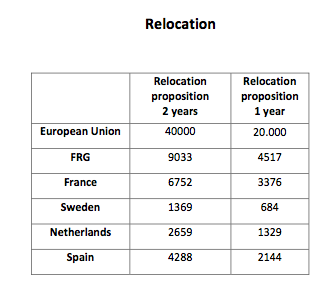
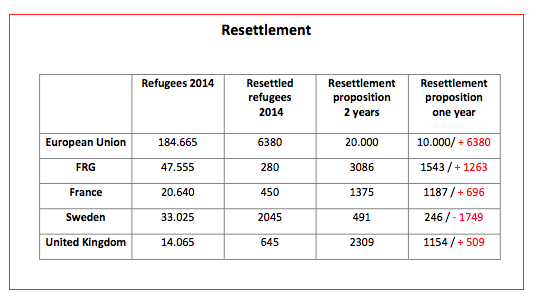
Il était en effet peu vraisemblable qu’une majorité se dégage en faveur des idées phares contenues dans la proposition faite au Conseil d’instituer des mesures provisoires en matière de protection internationale au profit de l’Italie et de la Grèce (COM (2015) 286). L’ambition était politique sinon numérique : les Etats étaient invités à réinstaller et relocaliser 60.000 demandeurs de protection dans l’Union européenne, de manière obligatoire, en deux ans et sur la base de critères de répartition.

Pour une fois, l’Union n’a pas déçu ceux qui l’observent : elle a été effectivement incapable d’assumer ses responsabilités, comme à l’habitude. La nouveauté, en revanche, provient des lignes de front qui se sont dessinées à cette occasion, allant au delà des surenchères verbales.

a. la lenteur des mesures opérationnelles Continue reading “Agenda européen pour les migrations et protection des réfugiés : « l’Europe n’est pas à la hauteur »”

STATEWATCH : the migrant crisis in the Mediterranean

Published on Statewatch 

Key Analysis and Documents

1.   Statewatch Special Report: “War” to be declared on migrants: “Structured border zones”
2.   EU: Letter from Commissioner Avramopolous to Ministers with Annex
3.   EU: MED-CRISIS: Official statement on the launch of EUNAVFOR
4.   Statewatch Briefing: Coercive measures or expulsion: Fingerprinting migrants
5.   Statewatch Analysis: The EU’s Planned War on Smugglers
6.   Council: Secret plan for a war on smugglers – document (PSC)
7.   Council Press Release: 18 May 2015
8.   European Commission: A  European Agenda on Migration
9.   Mission in the Med: financial support under the ATHENA Decision
10. European External Action Service: Libya, a Political Framework for a Crisis Approach (EUBAM)
11. Ongoing EU external operations (European External Action service)

NEWS

1.   EU: German-Italian-French non-paper on EU migration policy
2.   EU: European External Action Service (EEAS): European Union Naval Force
3.   EU: European External Action Service (EEAS): EU prepares to go to “war” in the Med
4.   EU: No agreement on sharing “relocation” of migrants
5.   EU: Council of the European Union: LIMITE documents: Migration – Policy debate
6 .  Liquid Traces – The Left-to-Die Boat Case (Vimeo, link)
7.   EU:  Recommendation of XXX on a European resettlement scheme
8.   EU:  The new EU Migration Agenda takes shape: analysis of the first new measures
9.   EU:   MED CRISIS: Press coverage
10. EU: ACP: Destroying boats is not a solution to migration
11. EU: European Parliament: Migration: MEPs debate EU response.”

Key Analysis and Documents

1. Statewatch Special Report: “War” to be declared on migrants who – fleeing from war, persecution and poverty – have arrived in the EU are to be contained and detained in “Structured border zones” to be set up to “ ensure the swift identification, registration and fingerprinting of migrants (“hotspots”)”

This is set out in the Draft Conclusions of the European Council [the EU Heads of State] meeting on 25 and 26 June 2015: Draft conclusions (pdf)

Section 5.c says: “the setting up of structured border zones and facilities in the frontline Member States, with the active support of Member States’ experts and of EASO, Frontex and Europol to ensure the swift identification, registration and fingerprinting of migrants (“hotspots”);” [emphasis added]
Will the “swift fingerprinting” of those described here as “illegal” migrants involve coercive measures? See: Statewatch Briefing on a “Working Document” issued for discussion by the Commission: Coercive measures or expulsion: Fingerprinting migrants (pdf):

“If the data-subject still refuses to cooperate it is suggested that officials trained in the “proportionate use of coercion” may apply the minimum level of coercion required, while ensuring respect of the dignity and physical integrity of the data-subject..”

Statewatch Director, Tony Bunyan comments: “Where is the EU going? Migrants, including pregnant women and minors, who have fled from war, persecution and poverty are to be forcibly finger-printed or held in detention until they acquiesce or are expelled and banned from re-entry.”

Steve Peers, Professor of Law, University of Essex comments on the Draft Conclusions: “It is remarkable that Member States (if this draft is accepted) are indeed willing to accept the relocation of 40,000 asylum-seekers from Italy and Greece, and 20,000 resettled refugees.
It is also notable that all Member States will participate in the latter decision – with even the UK agreeing recently to resettle a few hundred more Syrians. This is a very modest amount of the numbers needing protection however.
The European Asylum Support Office does not seem to have the powers to participate in fingerprinting asylum-seekers, and the reference to ‘bringing together’ rules on fast-tracking asylum applications is very vague. Is the intention to lower standards, and if so, how exactly? Any moves to negotiate more readmission agreements and to expel more people who supposedly have no need for protection will have to comply fully with EU, ECHR and all national and international human rights standards.
Equally if Frontex is to gain more powers over expulsion it must be made more fully accountable, including as regards individual complaints against it.”

See: UN says one million refugees should be no problem for EU (euractiv, link): “The UN rights chief yesterday (15 June) called for the European Union to take bolder steps to address its swelling migrant crisis, insisting the bloc could easily take in one million refugees”

2.  EU: Jailing migrant families together with convicted criminals: A desperate EU policy to deter irregular migration by Steve Peers, Professor of Law, University of Essex:
Taken together, the loss of these protections will mean that irregular migrants, including irregular migrant families, will not only be detained in ordinary prisons, but mixed in with the ordinary prison population of convicted criminals and those awaiting trial for serious crimes. Moreover, their capacity to challenge their detention by means of judiicial review will be severely curtailed.
Coupled with the recent Commission paper offering guidelines for using force, including against pregnant women, on migrants who refuse to be fingerprinted, this represents a significant turn in EU policy – turning toward direct and indirect threats of physical violence to control their behaviour and induce them to leave.
To say the least, this is hard to square with the EU’s frequent professions of support for the human rights and decent treatment of migrants.”
See: Letter from Commissioner Avramopolous to Ministers with Annex (Statewatch version, 75KB) orlink to Council’s 10.5 MB version (pdf)

3. EU: MED-CRISIS: Official statement on the launch of EUNAVFOR: Council launches EU naval operation to disrupt human smugglers and traffickers in the Mediterranean (Council of the European Union, pdf):
“The first phase focuses on surveillance and assessment of human smuggling and trafficking networks in the Southern Central Mediterranean…. The Council will assess when to move beyond this first step, taking into account a UN mandate and the consent of the coastal states concerned..” [emphasis added]
It is by no means certain that a UN mandate will be forthcoming as this requires the consent of the affected states, in this case Libya. The EU’s own mission in Libya, EUBAM, withdrew from from the country last autumn, has been slimmed down and is now based in Tunisia because of the highly unstable security situation in Libya where two separate governments are vying for power in addition to a number of warring groups:.See:

EU and political situation in Libya: Interim Strategic Review of EUBAM Libya (LIMITE doc no: 7886-15, 13 April 2015, pdf): “a number of additional considerations have arisen as a result of the mission’s relocation to Tunis. The mission’s legal status in Tunis is still unclear, with the Tunisian authorities unofficially indicating that they would prefer not to explore the issue….its presence in Tunis will make it difficult for mission staff to assess conditions and operate in Libya [emphasis added]

4. Statewatch Briefing: Coercive measures or expulsion: Fingerprinting migrants (pdf):
New guidelines released by the European Commission allow Member States to use physical and mental coercive measures to take fingerprints of migrants and asylum seekers entering Europe, including minors and pregnant women. If they refuse, they face detention, expulsion and a potential five year EU-wide ban.
“If the data-subject still refuses to cooperate it is suggested that officials trained in the proportionate use of coercion may apply the minimum level of coercion required, while ensuring respect of the dignity and physical integrity of the data-subject..” [emphasis added]

5. Statewatch Analysis: The EUs Planned War on Smugglers (pdf) by Steve Peers, Professor of Law, University of Essex:
“it is clear from the documents discussed in the EUs Political and Security Committee last week that (unless plans have changed radically in the meantime) the High Representative is being economical with the truth. The EU action clearly contemplates action by ground forces. Moreover, it anticipates the possible loss of life not only of smugglers but also of Member States forces and refugees. In effect, the EU is planning to declare war on migrant smugglers without thinking through the consequences.”

6. Secret EU plan for a war on smugglers – document (PSC, pdf)

7. Press Release: Council establishes EU naval operation to disrupt human smugglers in the Mediterranean (pdf) and Comparison between Draft and Final Statements (pdf)

8. European Commission: A European Agenda on Migration (COM 240-15, pdf)

9. Mission in the Med could call for financial support under the: ATHENA Council Decision (pdf)

10. European External Action Service: Libya, a Political Framework for a Crisis Approach (LIMITE doc no: 13829-14, pdf)

11. Ongoing EU external operations (European External Action service, pdf)

NEWS

1. EU: German-Italian-French non-paper on EU migration policy (pdf) and Letter (pdf). Includes:
– Dialogue with source/transit countries: At upcoming EU-Africa summit in Malta “we should also discuss the relationship between migration and mobility and their impact on development, the promotion of fair trade and the strengthening of security cooperation as well as return and readmission issues”
– Proposal for EU CSDP civilian mission in Niger: EUCAP Sahel Niger to become permanent and “work even more closely with Nigerien authorities in the fight against smuggling and trafficking in human beings”
– Adequate funding for continued “engagement” with countries in the Horn of Africa, to deal with migration from/through those countries (in the recent ISF-Police work programme some money was put aside for this, see: Annual Work Programme for 2015 for support to Union Actions under the Internal Security Fund – Police cooperation and crime prevention (pdf)
– “We must increase the effectiveness of return and readmission programmes”
And: “Our migration policy goals should relate to other relevant horizontal foreign policies such as counter-terrorism, maritime security, water and climate policy and a reviewed European Neighbourhood Policy which also considers the neighbours of our neighbours.”

2. EU: MED-CRISIS: European External Action Service (EEAS): European Union Naval Force – Mediterranean (Press statement, pdf): Contributing States: Currently 14 Member States (BE, DE, EL, ES, FI, FR, HU, IT, LT, LU, NL, SE, SI, UK):
The Council shall assess whether the conditions for transition beyond the first phase have been met, taking into account any applicable UN Security Council Resolution and consent by the Coastal States concerned.”
Consent is needed for the EU to act within the territorial waters of another state (eg: Libya) and see: Comments below on this position.

See also: EU foreign ministers to agree on Mediterranean intelligence operations (euractiv, link): “EU foreign affairs ministers will today (22 June) agree on an intelligence gathering operation, the first phase of the bloc’s response to the burgeoning migration crisis in the Mediterranean, but military action against people smugglers will depend on the support of Libya’s National Unity Government and the United Nations.” and Naval bid to tackle migrants in Med (Yahoo News, link): “With GCHQ – Britain’s listening post in Cheltenham – said to be tracking the activities of smuggling gangs moving people to the Libyan coast, Defence Secretary Michael Fallon indicated that he wanted to see more intelligence-sharing.” also:Exclusive: France backs Italy-UK Plan for Sicily Intel Cell (Migrant Report, link)

See: EU agrees to launch military operation against people smugglers (FT, link): “EU officials have warned that casualties were possible after deciding to launch military action against people smugglers in the Mediterranean. Ministers of the 28-country bloc meeting in Luxembourg on Monday gave the go-ahead for a c controversial intelligence gathering operation, which will precede full-blown military action this year … “The use of firepower will be done in such a way that we do all we can to prevent any casualties to anyone,” said one EU official. “There is a difference between smugglers and migrants. If they are migrants, we will be even more cautious.” Asked whether the military operation created the risk of collateral casualties, the official replied: “Of course it would.”” and: EU navies take up position in Mediterranean(euobserver, link)
3. EU: European External Action Service (EEAS): EU prepares to go to “war” in the Med: Proposal of the High Representative of the Union for Foreign Affairs and Security Policy to the Council for a Council Decision launching the European Union military operation in the Southern Central Mediterranean (EUNAVFOR MED) (pdf);
“The Operation Plan and the Rules of Engagement concerning the European Union military operation in the Southern Central Mediterranean (EUNAVFOR MED) are approved…. EUNAVFOR MED shall be launched on xxx 2015.”
See: EU naval mission for Med gets green light (Politico, link)
See also: Draft Council Decision on a European Union military operation in the Southern Central Mediterranean (EUNAVFOR MED) (LIMITE doc no: 8921-15, pdf) and Proposal for for a Council Decision on a European Union military operation in the Southern Central Mediterranean (EUNAVFOR Med) (LIMITE doc no: 8731-15, pdf): This contains details on:
Mission: “The Union shall conduct a military crisis management operation contributing to the disruption of the business model of human smuggling networkssystematic efforts to dispose of vessels and assets before they are used by smugglers”
Mandate: includes: “boarding search, seize and diversion of smuggling ships”
“The Operation Headquarters of EUNAVFOR MED shall be located in Rome, Italy”
“PSC shall exercise the political control and strategic direction of EUNAVFOR MED”
[Political Security Committee]
“The EUMC shall monitor the proper execution of EUNAVFOR MED conducted under the responsibility of the EU Operation Commander” [EU Military Committee]
The Council hereby authorises the PSC to invite third States to offer contributions”

4. EU: No agreement on sharing “relocation” of migrants: Council of the European Union: Justice and Home Affairs Council, 15-16 June 2015, Luxembourg: Final press release (pdf):
“As regards the concrete proposal on relocation, Ministers stressed that on the basis of the principle of solidarity they are all ready to make an effort to help member states under a particular migratory pressure. Several delegations stressed the necessity to strike the right balance between solidarity and responsibility.. Ministers invited the Council’s preparatory bodies to continue these discussions with the aim of achieving full implementation as soon as possible.”
See also; Civil Liberties Committee Chair, Claude Moraes, regrets EU minister’s failure to reach agreement on the migration package (EP Press release, pdf)

5. EU: Council of the European Union: LIMITE documents: Migration – Policy debate & European Council draft Conclusions
European Agenda on Migration – Policy debate (LIMITE doc no: 9825-15, 11 June 2015, pdf) Many areas of disagreement between Member States on how to respond to the crisis in the Mediterranean:
“”Immediate Action” but also builds on four pillars as a basis for a comprehensive European migration policy: – Reducing incentives for irregular migration; – Border management; – Strong common asylum policy; – New policy on legal migration….
There is wide consensus with regard to the need to further cooperate with third countries since both the root causes of and solutions to migration related issues can be sought there. In order to ensure a genuinely comprehensive approach, some Member States have suggested to strengthen the links with the Internal Security Strategy and measures proposed therein….
Member States’ views differ on the proposed concept of relocation in order to respond to high volumes of arrivals that includes temporary scheme for persons in need of international national protection.. The total number of persons to be relocated, the available funding, and the capacity of the Member States’ structures to deal with relocation were equally questioned…”
[emphasis added]
and: Update: COR -1 (LIMITE doc no: 9825-15, 12 June 2015, pdf)

European Council (25 and 26 June 2015) – Draft guidelines for the conclusions (LIMITE doc no: 8392-15, 10 June 2015, pdf): Covers Mediterranean crisis response, security challenges, economic issues, the Digital Agenda and the UK:
Position on “1. “Relocation / resettlement p.m.” is blank as is Position: “IV. UK p.m” and “Return policy:Mobilise all tools to promote readmission of unauthorised economic migrants to countries of origin and transit….” [emphasis added]
read the restraint manual.

6. Liquid Traces – The Left-to-Die Boat Case Vimeo, link): “Liquid Traces offers a synthetic reconstruction of the events concerning what is known as the “left-to-die boat” case, in which 72 passengers who left the Libyan coast heading in the direction of the island of Lampedusa on board a small rubber boat were left to drift for 14 days in NATO’s maritime surveillance area, despite several distress signals relaying their location, as well as repeated interactions, including at least one military helicopter visit and an encounter with a military ship. As a result, only 9 people survived.” See also: Left ot die – report (link)

7. EU: MED-CRISIS: Germany and France urge Commission to revise immigration plan (euractiv, link): “Germany and France on Monday (1 June) urged the EU to find a fairer way to admit and distribute asylum seekers, as their leaders met the European Commission chief in Berlin….. France and Germany said in the joint statement that they currently were among five member states, along with Sweden, Italy and Hungary, that “are in charge of 75% of the asylum seekers”. “This situation is not fair and no longer sustainable,” they said.”
See European Commission: Recommendation of XXX on a European resettlement scheme (COM 286-15, pdf) and Annexes (pdf)

8. EU: MED-CRISIS: European Commission: Recommendation of XXX on a European resettlement scheme (COM 286-15, pdf): It was going to be 5,000 people, then 40,000 now:
“The Commission recommends that Member State resettle 20 000 people in need of international protection”
and Annexes (pdf)

8.  The new EU Migration Agenda takes shape: analysis of the first new measures (EU Law Analysis, link)

9. EU: MED CRISIS: Press coverage:
EU’s refugee plans need a reality check: The EU this week outlined plans to resettle and relocate refugees, but one expert taking a closer look at the proposals argues they put the rights of migrants and asylum seekers at risk. (The Local, link) Good critique of EU plans

EU border chief wants protection from armed smugglers: The EU’s border agency Frontex wants military protection from armed migrant smugglers as it expands operations in the Mediterranean and closer to the Libyan coast (euobserver, link)

British tourists complain that impoverished boat migrants are making holidays ‘awkward’ in Kos(Independent, link)

Mediterranean migrant crisis: Hundreds rescued off Sicily (BBC News, link) and Migration: Are more people on the move than ever before? (BBC, link) with map

Italy Hands Smuggler Unprecedented Life Sentence as Europe Prepares for Migrant Deluge (BB, link)

Tunisian – and Top E.U. Generals – Fear Mission Creep Madness in Libya (The Daily Beast, link): “A newly revealed classified document and a history of grave misjudgments warn against the dangers of the new EU plan to stop migrants…. Europe’s defense chiefs are warning their political superiors that the planned military mission to stop migrant-smuggling boats crossing the Mediterranean can lead to land operations in Libya and possible clashes with the Islamic State’s affiliate in that failing North African state, a turn of events bound to threaten neighboring Tunisia’s fragile equilibrium still further.”

Tunisian PM Speaks Against EU Military Action to Stop Refugee Smugglers (Sputnik News, link):
“Tunisia opposes any military effort by the EU to tackle refugee smuggling across the Mediterranean Sea, Prime Minister Habib Essid said Thursday. “Tunisia’s position was always clear… We are originally against all military action, both to regulate political conflict and to regulate the problem with illegal smugglers,”  Essid said in the European Parliament.”

Migrants en Méditerranée : la Tunisie contre toute intervention militaire [Migrants in the Mediterranean: Tunisia against all military intervention] (rtbf.be, link):
“Habib Essid said that his country is “against any military intervention to solve this problem. This problem must be resolved upstream and downstream. These people take risks, sell everything they have around them to come to Europe, for more freedom, for better economic opportunities for work. I know the problems this poses for all countries of the European Union, but the solution is to look other than make occasional military interventions.”
The European Parliament press release does not mention these comments: Tunisia’s Prime Minister Habib Essid on security and migration challenges (pdf)

Before the Boat: Understanding the Migrant Journey (MPI, link): “Deep, sophisticated insight into the decision-making process of those who undertake these journeys is necessary; without this information and a wider understanding of the political economy of migrant smuggling, policymakers essentially are making decisions in the dark.”

10. EU: MED-CRISIS: ACP: Destroying boats is not a solution to migration (euractiv, link): “The Secretary-General of the ACP (African, Caribbean and Pacific) group of states said yesterday (21 May) that his organisation was against the EU’s idea of destroying the boats of human traffickers, who make fortunes by luring prospective immigrants into risky journeys across the Mediterranean.”

And see: Twisting the ‘lessons of history’ to authorise unjustifiable violence: the Mediterranean crisis (Open Democracy, link): “More than 300 slavery and migration scholars respond to those advocating for military force against migrants attempting to cross the Mediterranean. This is no slave trade. Where is the moral justification for actions that cost lives?”

Also: “The War on migrants and refugees: has the ‘never again’ imperative been forgotten?” (Franck Duvell, link): “This imperative derived from the lessons learned from the Holocaust and the failure to rescue the European Jews has now been relinquished it seems. Are we now back at the moral state of the 1930s were unwanted populations are removed from the ‘realm of moral subjects’ (Bauman 1996) and killed or left to die and the needy are turned away and refused shelter?”

11. EU: European Parliament: Migration: MEPs debate EU response (pdf): “MEPs discussed on 20 May European Commission plans to tackle the large numbers of migrants seeking to reach the European Union, often risking their lives at sea. Commission vice president Frans Timmermans and migration commissioner Dimitris Avramopoulos announced a number of measures, including an emergency mechanism for relocating migrants, a resettlement scheme to take in migrants from countries outside the EU and more funds for securing borders.”

See also: MEPs angry at member states over immigration (euractiv, link): “EU lawmakers on Wednesday accused some member states of passing the buck by rejecting a Brussels plan for binding quotas for refugees making the dangerous Mediterranean crossing.”

Meijers Committee : Promoting Intra EU labour mobility of international protection beneficiaries

Original published on the Meijers Committee (*) site

Summary : The Meijers Committee proposes to enhance the opportunities for employment of international protection beneficiaries across the EU by allowing them to work in another Member State after two years of legal residency and under more favourable conditions than current EU directives allow. This incentive for achieving economic independence corrects the current legal regime under which socioeconomic criteria play no role in sharing the responsibility for asylum-seekers and international protection beneficiaries. It also allows for greater personal freedom of the people concerned and gives them a better chance of building a stable future. The proposed measure draws largely from that existing framework in terms of rights and obligations of individuals and Member States.

    1. Introduction

The Council of the EU is currently discussing new approaches to sharing the responsibility for asylum seekers and international protection beneficiaries among Member States. The Meijers Committee advises that these discussions should move beyond the issue of distributing asylum seekers and also explore the possibilities of enhancing intra-EU movement for persons who have been granted asylum.
In this note, the Meijers Committee proposes to allow international protection beneficiaries recognised in one Member State to take up a confirmed job offer in another Member State.
Granting beneficiaries of international protection free movement within the EU on objective conditions of having work and not becoming a burden on the social assistance system of another Member State contributes to the economic dynamism of the Union and helps relieve the pressure on those Member States whose asylum systems are particularly burdened and where socioeconomic conditions are generally less then favorable. It also enhances the prospects that the beneficiaries of international protection will better integrate by increasing their economic opportunities.

Finally, it stresses that these third-country nationals may be an asset to the EU rather than a burden or a problem.

To that purpose, the Meijers Committee proposes to apply elements of the free movement regime for EU workers to international protection beneficiaries and to complement these with certain conditions which have already been worked out in the regime for conditional labour mobility of international protection beneficiaries who have acquired EU long-term resident status and other relevant EU instruments. This note sets out the main features of such a measure.

2. Subject of the proposal

Introduce a supplementary measure to the existing system of distribution of asylum seekers and international protection beneficiaries or to a possible quota system, which permits international protection beneficiaries recognised in one Member State to take up a confirmed job offer in another Member State. This allows a distribution of beneficiaries of international protection between Member States on the basis of employer’s needs and the economic activities of third-country nationals.

The beneficiaries may gain a confirmed job offer in a second Member State by looking in EURES  or by using his or her right to travel up to three months within a single period of six months in the Schengen area. Most likely the people involved will look for work in Member States where family or contacts reside.
Permit vacancies in other Member States be taken up by third-country nationals already lawfully in the EU, rather than introduce new third-country nationals from outside the EU.
Avoid or diminish long-term unemployment, dependence on social benefits or irregular employment in the Member State that granted international protection by granting the beneficiaries conditional mobility within the Union.

3.Existing framework for labour mobility within the EU

There are at present several EU regimes for labour mobility for different categories of persons:

  • Free movement of EU workers and their Non-EU family members under Directive 2004/38 (Citizenship).
  • Conditional labour mobility of third-country nationals who acquired the status of an EU long-term resident in one Member State by allowing them to accept a job in another Member State under Directive 2003/109 (Long Term Residents). The latter State may refuse a work permit and admission during the first year on labour market grounds. Since 2013, beneficiaries of international protection have been covered by this Directive on the basis of Directive 2011/51.
  • Directive 2009/50 (Blue Card) for highly qualified workers from outside the EU.
  • Directive 2014/66 (Intra Corporate Transfer) for third country nationals.
  • Proposal to recast and merge the Students and Researchers Directive (COM(2013) 151 final), including a period for a third-country national to search for employment after graduation from a European education institute.

Although Directive 2011/51 has provided international protection beneficiaries with a right to reside in a second Member State to exercise an economic activity, this right is subject to strict conditions. It is only acquired after five years of lawful residence in the first Member State.

Further, the second Member State may, during the first year, apply a labour market test, under which preference may be given to Union citizens and third-country nationals who are legally resident and receive unemployment benefits in the second Member State. However, there are good reasons to allow free movement of international protection beneficiaries on more favourable terms.
Other third-country nationals are normally only admitted to a first Member State if they meet conditions of having work, resident family members with sufficient income, or have been admitted as a student, in short because of their socioeconomic bond with the destination country. International protection beneficiaries, on the other hand, often do not have self-evident bonds with the first Member State due to the nature of their residence (asylum) and the Dublin criteria for allocating asylum seekers.
The measure proposed by the Meijers Committee would help correct this effect.

4.Growing experience with labour mobility of third-country nationals within the EU

Actual, large-scale use of the Long-term residents Directive 2003/109 started only five years after the directive had to be implemented in national law of the 25 Member States bound by it.
Italy and Spain had both issued permits to more than 1.8 million EU long-term residents by the end of 2013. Mobility to another Member State commenced only recently. Germany issued 1,500 residence permits to third-country nationals who had acquired the EU long-term resident status in 2012, and 3,000 in 2013. At the end of 2013 Germany had issued more than 5,500 residence permits to third-country nationals who had acquired the EU long-term resident status in another Member State, and at the end of 2014 almost 10,000 such permits had been issued, mainly to third-country nationals arriving from Italy, Slovenia, Spain and the Czech Republic.1

5. Legal elements

Is there a legal basis in the Treaties?
Yes, Article 78(2)(a) TFEU obliges the Union to provide a uniform status of asylum for nationals of third countries, valid throughout the Union. The exception of Article 79(5) TFEU (“Member States may determine volumes of admission of third-country nationals coming from third countries to their territory in order to seek work”) does not apply, since the third-country nationals are already lawfully resident in the EU.

 Does the proposal satisfy the subsidiary requirements?
The legal position of international protection beneficiaries regarding labour mobility is already regulated by Directive 2011/51, provided they are long term residents pursuant to Directive 2003/109. The proposed mobility between Member States requires a common action. The EU is currently looking for a common solution to the question of responsibility for asylum seekers and international protection beneficiaries. This measure would address part of that question.

 Is this proposal proportionate?
The proposed measure is simple and relatively easy to achieve: it requires a limited amendment of the existing legal framework, which consists primarily of directives or a short new directive. The competence to check whether the   proposed employment conditions are   in conformity with national law remains with   Member States.

 What should the personal scope be?
Given the similarity of their status, both refugees and subsidiary protection beneficiaries should be covered. Beneficiaries of forms of national protection cannot be covered by an instrument under EU law as there is no legal basis for such in the TFEU. But they could be covered on the basis of national law of the second Member States.

 What should the personal scope be? (II)
For workers only. The right to move arises only if a labour agency of the second Member State confirms the existence and conditions of the job offer and that job provides sufficient resources for the third-country national to sustain himself, without recourse to social assistance in the second Member State.

When can an international protection beneficiary apply for a job in another Member State?
After a minimum of two years of lawful residence in the first Member State, rather than the five years under the revised Directive 2003/109. In those two years the beneficiaries will have an opportunity to settle in a Member State and, if necessary, supplement their professional qualifications. Moreover, this waiting period reduces the chances that the protection status is granted primarily to allow onward mobility within the EU.

Is transfer of international protection status necessary?
The proposal requires no rules on automatic transfer of international protection between Member States, similar to Directive 2011/51 revising Directive 2003/109.

What terms regarding health insurance apply?
Health insurance coverage maybe be required by the second Member State, similar to Article 15(2)(b) of Directive 2003/109.

Are integration requirements allowed?
No integration conditions before admission to the second Member State. Such conditions are also absent from the Qualification Directive 2011/95.

6.Rights in the second member state

Protection against refoulement
Protection status is granted on the basis of similar rules as in Directive 2011/51. Similarly, the rules of Directive 2011/51 on protection against expulsion to third countries, the right to return to the first Member State until long-term resident status in the second Member State is obtained, and the concomitant obligation of the first Member State to take the third-country national back will apply.

Equal treatment
The equal treatment clause of Article 11 of Directive 2011/98 (Single Permit) will apply automatically to these third-country nationals admitted to employment.

Family reunification
Family reunification should take place on the basis of the same rules as Article 16 of Directive 2003/109, i.e. if already reunited in the first Member State, admitted family members may accompany or join; if not yet reunited in the first Member States, the rules of Directive 2003/86 apply, such as a residence permit for at least one year and sufficient income.

Public assistance
No right to public assistance during the first three years, and after that transitional period access to public assistance as provided in Article 11 of Directive 2003/109.

Recognition of professional qualifications
Recognition of professional qualifications acquired in another Member State by the second Member State should take place on the basis of a regime similar to Directive 2005/36.

Consequences of dismissal or unemployment
The worker will be permitted to look for another job and is entitled to equal treatment on the basis of national law concerning unemployment benefits in accordance with the Single Permit Directive 2011/98. In case the worker complies with the conditions of Directive 2009/50 on entry and residence of third-country nationals for the purposes of highly qualified employment he may, in accordance with Article 10(2) of that directive, apply for a Blue Card in his Member State of residence or in another Member State. Before the worker has acquired the long-term residence status in the second Member State, the first Member State will be obliged to take the third-country national back if entitlement to unemployment benefits ends and no new job is found.

7.Risk that Member States grant asylum more often

The Meijers Committee has no reason to expect that increased possibilities of free movement will encourage Member States to grant asylum more often, because i) the right to move to another Member State is conditioned on two years of lawful residence in the first Member State, ii) the right only accrues to international protection beneficiaries who find work in another Member State, and iii) the first Member State remains responsible for taking the person back if the conditions for residence in the second Member State are no longer fulfilled until long-term resident status in the second Member State is obtained.

NOTE
1 See Bundesministerium des Innern, Migrationsbericht 2013, p. 100ff and reply of the German government of April 2015 (no. 4/132) to a written parliamentary question in the Bundestag.

About
The Meijers Committee is an independent group of legal scholars, judges and lawyers that advises on European and International Migration, Refugee, Criminal, Privacy, Anti-discrimination and Institutional Law. The Committee aims to promote the protection of fundamental rights, access to judicial remedies and democratic decision-making in EU legislation. The Meijers Committee is funded by the Dutch Bar Association (NOvA), Foundation for Democracy and Media (Stichting Democratie en Media) the Dutch Refugee Council (VWN), Foundation for Migration Law Netherlands (Stichting Migratierecht Nederland), the Dutch Section of the International Commission of Jurists (NJCM), Art. 1 Anti-Discrimination Office, and the Dutch Foundation for Refugee Students UAF.

Contact info: Louis Middelkoop Executive secretary post@commissie-meijers.nl +31(0)20 362 0505

Please visit www.commissie-meijers.nl for more information.

Jailing migrant families together with convicted criminals: A desperate EU policy to deter irregular migration

ORIGINAL PUBLISHED ON STATEWATCH

by Steve Peers, Professor of Law, University of Essex: (23.6.15)

This week’s European Council (Summit) meeting is due to discuss the issues of immigration, in light of the recent high loss of life of Mediterranean migrants. The draft Summit Conclusions call for most Member States to participate in “relocating 40,000 people in clear need of temporary protection” from Greece and Italy, as proposed by the Commission. If agreed, this would be a significant change in traditional EU policy – although the details of relocation have yet to be worked out, and the Commission proposal did not use the phrase ‘temporary protection’. All Member States would also agree to sign up to resettle 20,000 refugees directly from regions of origin over two years. Even the UK has volunteered to participate it in this, recently offering to take a few hundred more people from Syria.

Yet in conjunction with this policy the EU intends to harden its policy towards irregular migrants, ie those non-EU citizens who have not applied for asylum or whose applications have failed. The draft summit conclusions endorse a strategy of encouraging more non-EU countries in Africa to take their citizens back, by offering them further incentives to do so. But furthermore, the EU intends to put greater pressure on the migrants themselves to leave. The Summit Conclusions refer to a letter to Interior Ministers from the EU Home Affairs Commissioner Avramopolous, who suggests a number of actions to this end.

The letter calls for a widespread use of detention of irregular migrants, for up to 18 months. In particular it calls for use of an obscure clause allowing for exceptions to the normal EU standards for detention of irregular migrants. This means that three usual protections will no longer apply:

– detention of irregular migrants in separate facilities from ordinary prisoners, or at least (if they are detained in prisons) separately from the prisoners within them;
– detention of families separately; and
– frequent judicial review of immigration detention.

Steve Peers comments:

Taken together, the loss of these protections will mean that irregular migrants, including irregular migrant families, will not only be detained in ordinary prisons, but mixed in with the ordinary prison population of convicted criminals and those awaiting trial for serious crimes. Moreover, their capacity to challenge their detention by means of judiicial review will be severely curtailed.

Coupled with the recent Commission paper offering guidelines for using force, including against pregnant women, on migrants who refuse to be fingerprinted, this represents a significant turn in EU policy – turning toward direct and indirect threats of physical violence to control their behaviour and induce them to leave.

To say the least, this is hard to square with the EU’s frequent professions of support for the human rights and decent treatment of migrants.”

Sources

1. Draft European Council conclusions

2. Letter from Commissioner Avramopolous to Ministers with Annex (Statewatch version, 75KB) orlink to Council’s 10.5 MB version

3. Coercive measures or expulsion: Fingerprinting migrants (pdf)

See also: Statewatch Special Report: “War” to be declared on migrants


JUMP BEFORE YOU’RE PUSHED: THE CJEU RULES ON THE VOLUNTARY DEPARTURE OF IRREGULAR MIGRANTS

ORIGINAL PUBLISHED ON EU LAW ANALYSIS

by  Steve Peers

For the first time, the CJEU ruled yesterday (in its judgment in Zh and O) on the provisions of the EU’s Returns Directive (the main set of rules governing the expulsion of irregular non-EU migrants) concerning ‘voluntary departure’. The word ‘voluntary’ is a euphemism here, of course:  there’s still a legal obligation for the migrant to leave, underpinned by the threat of force. But nevertheless it still makes a big difference to the people concerned whether they have a chance to leave the country under their own steam. If they aren’t given that chance, they are likely to be woken up in their homes in the middle of the night, arrested, detained in jail, and restrained on their journey to their country of origin or transit by an armed officer. Some are injured or die during this process. So it’s far better to jump than to be pushed.

But when do irregular migrants have the choice to do so? The Returns Directive makes it the normal rule to give them a period for voluntary departure, for a period of between seven and thirty days.  This time must be extended if necessary in individual cases, for instance whether there are children in school. But there are exceptions: Member States may decide not to grant this period, or to curtain it to less than seven days, in three cases: where there’s a ‘risk of absconding’; where ‘an application for a legal stay has been dismissed as manifestly unfounded or fraudulent’; and if the person concerned ‘poses a risk to public policy, public security or national security’.

If one of these exceptions apply, the removal must then be carried out by national officials, and the Directive in principle requires the migrant to be issued with an entry ban. (It’s still an option for a Member State to issue an entry ban in cases of voluntary departure). Migrants who have the chance of voluntary departure are entitled to family unity, emergency health care and education in the meantime, and it’s implicit that they would not normally be detained.

The Zh and O judgment concerns the third of the exceptions from the rule of giving a period for voluntary departure: the exception for ‘public policy’, et al. Last year’s judgment in Mahdi, discussed here, touched on the first exception (the ‘risk of absconding’), in a different context (the grounds for detention). Zh and O was about two separate cases, and the Dutch courts asked three questions to clarify the meaning of the public policy exception.

Judgment

The national court wanted to know whether the ‘public policy’ exception had the same meaning as the similar provisions in the EU’s citizens’ Directive, and also the EU Directives on family reunion and long-term resident non-EU citizens. First of all, the CJEU said that the exception had to be interpreted ‘strictly’. It confirmed that the three exceptions to the rule of voluntary departure were the ‘only’ ones allowed. A Member State has to ‘prove’ that there is a risk to public policy. Secondly, the voluntary departure rule aimed, among other things, to protect the ‘fundamental rights’ of the persons concerned during the expulsion process.

So while Member States ‘retain the freedom’ to decide on the concept of public policy, they did not have full latitude to determine the concept without any control by the Court. Here the CJEU referred ‘by analogy’ to case law on the EU citizens’ Directive. So the exception had to be applied on a ‘case-by-case basis’, to decide if the ‘personal conduct’ of the migrant ‘poses a genuine and present risk to public policy’. This meant the suspicion of committing a criminal act, or even a criminal conviction, could not by itself justify the conclusion that a ‘public policy’ risk exists.

On the other hand, the ‘public policy’ exception could still apply where an appeal against a criminal conviction had not yet been decided, or where there was no conviction, as long as ‘other factors’ justified the use of that exception. What are those other factors? The Court referred to the ‘nature and seriousness’ of the act and ‘the time which has elapsed since it was committed’. So the national court had to consider that in one case, the migrant was actually not trying to stay in the Netherlands without authorisation, but was on his way out (travelling to Canada) when he was stopped. In the other case, the migrant had been accused of domestic abuse, but it was relevant that there was nothing to substantiate that accusation.

Finally, the Court ruled that there did not have to be a separate assessment of the question of limiting voluntary departure; that issue could be considered when making the initial return decision. The Court reiterated its prior judgment in Boudjlida (discussedhere), when it ruled that the migrant must have the opportunity to be heard on the question of whether voluntary departure ought to be granted.

INTEGRATION REQUIREMENTS FOR THIRD-COUNTRY NATIONALS: THE FIRST CJEU RULING

ORIGINAL PUBISHED ON EU LAW ANALYSIS

by Steve Peers

When can a Member State require immigrants to undertake integration courses? The Court of Justice dealt squarely with this issue for the first time in today’s judgment in P and S, which concerned the application of the EU’s Directive on the long-term residence of non-EU citizens. (The UK, Ireland and Denmark have an opt-out from this law).

The judgment has a broader relevance, since the EU Directive on family reunion for non-EU citizens also provides for Member States to adopt integration conditions. On the other hand, EU free movement law does not provide for Member States to impose such conditions on EU citizens or their family members. As for Turkish nationals, the EU-Turkey association agreement does not provide for such a condition either, but Member States may impose one subject to a standstill rule in most cases (see last year’s Dogan judgment, discussed here).

Today’s judgment turns on the wording of the long-term residence Directive, which states that Member States ‘may require third-country nationals to comply with integration conditions, in accordance with national law’. The case concerned non-EU citizens who already had long-term resident status under the Directive, but Dutch law still requires them to take civic integration courses and penalises them with a fine every time they fail. A later change to Dutch law requires non-EU citizens to pass these courses before they get long-term residence status, but that later version of the law was not directly at issue in this case.

Judgment

According to the Court, the requirement to take integration courses does not as such infringe the Directive, first and foremost because the Directive clearly permits an integration condition to be imposed before obtaining long-term resident status. Next, the Court ruled that the requirement did not breach the equal treatment rule set out in the Directive, since Dutch nationals could be presumed to have knowledge of Dutch society and the Dutch language, whereas non-EU citizens could not.

However, that was not the end of the Court’s analysis. It then focussed on whether the national rules undercut the effectiveness of the Directive. The Directive had as its main aim the integration of non-EU citizens, and the Court stated that learning the national language and about the host State could facilitate communication with Dutch citizens, and ‘encourages interaction and the development of social relations’. Acquiring a knowledge of Dutch also ‘makes it less difficult’ to find work and take up training courses. The integration requirement therefore contributed to the aims of the Directive.

The Court went on to say that there were some limits upon what Member States can do, as regards ‘the level of knowledge required to pass the civic integration examination’, ‘accessibility of the courses and the material  necessary to prepare’ for the exams, the level of registration fees and ‘specific individual circumstances, such as age, illiteracy or level of education’. But the Court seemed most concerned about the amount of the fines, which were quite high and would be imposed for every failure, or even where the non-EU citizen had not sat the exam within the required time. The fines were also imposed on top of the high fees to sit the exam. So in principle this aspect of the system infringed EU law, although it was left to the national court to apply the Court’s ruling in practice. Finally, the Court stated that it was irrelevant whether the persons concerned already had long-term resident status, since (in this case) it was not a condition for getting or retaining that status.

Comments

The Court’s ruling makes clear that Member States can in principle impose integration requirements for long-term residence status, subject to the principle of effectiveness. The main feature of that principle in this case was the fees for failing (or not sitting) the exam, in conjunction with the fees for sitting the exam. Obviously the Dutch government is now obliged to lower those fees, and other Member States’ rules could be challenged on the same basis. The ruling is obviously particularly relevant to less wealthy migrants who would struggle to pay the fines and test fees several times over.

Although the Court did not rule in any detail on the other limits which EU law imposes upon national integration requirements, such limits certainly exist, as regards the level of knowledge needed to pass, the accessibility of tests and materials, and ‘specific individual circumstances’. It is not clear from the judgment exactly how Member States are obliged to take account of such circumstances – whether by means of a complete exemption from the test or a different version of it. But it should be noted that the list of specific circumstances mentioned by the Court is not exhaustive (‘such as’).

While the judgment clearly implies that Member States may even withhold long-term residence status if an integration test is not passed, the Court did not rule on that issue as such. So it remains open to argue that there may be stricter limits or other factors to consider when Member States impose an integration condition to acquire that status.

Nor did the Court rule on whether the failure to meet an integration condition could be a ground to lose long-term resident status. The Directive does not list this as one of the possible grounds for loss of that status, and it should follow from the objective of the Directive that the list of grounds which could lead to such a loss of status is exhaustive. This also follows from the structure of the Directive: if failure of an integration test could lead to loss of status, why did the drafters of the Directive only mention integration tests in the clause dealing with acquisition of that status?

Today’s judgment is only the first in a line of cases upcoming concerning integration conditions (the next batch of cases concern the parallel clause in the family reunion Directive). As a starting point, the Court has struck a good balance between ensuring that immigrants fit into society and the need to prevent integration tests forming a disguised means of excluding migrants from ever really fitting in despite their genuine efforts.

THE NEW EU MIGRATION AGENDA TAKES SHAPE: ANALYSIS OF THE FIRST NEW MEASURES

ORIGINAL PUBLISHED ON MAY 28 ON  EU LAW ANALYSIS

by Steve Peers

This week the European Commission took its first steps towards implementing its new EU Migration Agenda (previously discussed here). A number of the items in the agenda have already been addressed (for instance, the military mission against smugglers on the Libyan coast, as discussed here). Others will be addressed later: a broader reform of legal migration law and changes to the rules on asylum procedures and the ‘Dublin’ rules on responsibility for asylum-seekers.

The first batch of measures contained five different elements. First of all, the Commission launched a public consultation on the reform of the existing EU law providing for a ‘Blue Card’ for the admission of highly-skilled non-EU migrants. I have commented previouslyhere on the implementation of this law and the reforms to it which should be adopted.

Secondly, the Commission released an Action Plan against migrant smuggling. This mainly elaborates upon several ideas mentioned already in the main agenda. This includes: a revision of EU anti-smuggling law, planned for 2016, to increase smugglers’ penalties and clarify humanitarian exceptions from the rules; possible new rules on immigration liaison officers in 2016; a Handbook on expulsion in 2015; a possible revision of the rules on trafficking victims, in 2016, to include ‘victims’ of smuggling; a revision of the legislation on Frontex (the EU border agency), to give it more powers relating to expulsion; changes to the rules on the Schengen Information System in 2015-16, so that all Schengen Member States’ entry bans are applicable across the Schengen area; a handbook on prevention of migrant smuggling in 2017; readmission agreements with sub-Saharan countries; and stronger enforcement of the rules prohibiting employment of irregular migrants. Most of these measures concern all irregular migrants, not just those who were smuggled to the EU.

Thirdly, the Commission adopted a Recommendation on the resettlement of refugeesdirectly from outside the EU to EU Member States. The text of this measure has not yet appeared, and so I can’t comment on it in detail. Obviously though, as a Recommendation it is non-binding, and as an act of the Commission, it does not need the approval of the Council or the European Parliament. According to the new Immigration Agenda, there will be EU funds attached to each resettled refugee, so Member States are encouraged to resettle people. It is a useful measure to ensure that a bigger number of persons are rescued without having to risk their lives or pay smugglers to cross the Mediterranean, although the overall numbers are likely to be modest.  In the event that Member States do not make use of the Recommendation to resettle refugees, the Migration Agenda promises a proposal for a binding measure, although it might be hard to find sufficient support in Council for its adoption.

Fourthly, the Commission issued guidance on the fingerprinting of asylum-seekers, as provided for in the EU’s Eurodac legislation, which sets up a database of such fingerprints in order to apply the ‘Dublin’ rules more effectively. In the Commission’s view, any irregular border-crosser who refuses to give fingerprints ought to be detained, expelled and subjected to an entry ban, in accordance with EU asylum law and the Returns Directive. Alternatively, Member States could force them to take fingerprints, with apossible exception for pregnant women and minors. Frankly, the correct application of the EU’s Dublin system is not worth the health of life of a single unborn child.

Moreover, the Commission appears to be confused about the details of the relevant legislation. It would be necessary to prove that refusal to take fingerprints ‘avoids or hampers the preparation of return or the removal process’ to justify detention under theReturns Directive; but the purpose of the fingerprinting is mainly to apply the Dublin asylum rules, not to ‘prepare the return and/or carry out the removal process’, which is the legal basis for detention of irregular migrants under the Returns Directive. Furthermore, the rules on entry bans in that Directive make no reference to the issue of fingerprinting. As for asylum-seekers, the paper is correct to say that they can be detained in order to ‘verify their identity and/or nationality’ in the EU’s Reception ConditionsDirective. However, for asylum-seekers who have been fingerprinted already by a Member State and then apply for asylum in a second Member State, the Commission fails to mention that the Dublin rules apply. They permit detention only where there is a ‘significant risk of absconding’, which does not automatically follow from a refusal to be fingerprinted.

Fifthly, the Commission proposed a Decision on relocation of asylum-seekers between Member States. This is the only one of this week’s proposals which would (if adopted) be legally binding. Like most Commission proposals, this needs a qualified majority of Member States to support it in the Council; unlike most EU law, the European Parliament need only be consulted. It seems from press reports that there will be a ‘blocking minority’ of Member States preventing its adoption, unless some of them change their position. It’s also possible that it will be agreed, but with major changes. But for now, let’s look at what the proposal would do if adopted.

The main thrust of the proposal is to derogate from the usual ‘Dublin’ rules as regards Italy and Greece, and distribute about 40% of the asylum-seekers which would normally be the responsibility of those Member States under the Dublin rules to other Member States. Due to opt-outs, the other Member States will not include Denmark or the UK, although it seems possible that Ireland will opt in. The proposal also will not apply to the non-Member States bound by the Dublin rules (Norway, Switzerland, Iceland and Liechtenstein). It would effectively be a regime within a regime, with only 25 or 26 of the 32 Dublin States applying it.

The relocated asylum-seekers will be split 60/40 between Italy and Greece, and will be allocated to other Member States on the basis of the criteria set out in the Annexes to the proposal. Relocation will be selective, applying only to those nationalities whose applications have over a 75% success rate in applications for international protection. It’s clear from the proposal that the Commission believes that only Syrians and Eritreans will qualify. The Member State of relocation will be responsible for considering the application, and asylum-seekers and refugees will not be able to move between Member States, in accordance with the normal Dublin rules. (After five years’ residence, refugees can move between Member States, according to the EU’s long-term residence Directive).

Besides the nationality criterion, who will be relocated? Asylum-seekers must be fingerprinted in order to qualify. The selection of asylum-seekers will be made by Italy and Greece, who must give ‘priority’ to those who are considered ‘vulnerable’ as defined by the EU reception conditions Directive. This refers to a long list of people:

‘such as minors, unaccompanied minors, disabled people, elderly people, pregnant women, single parents with minor children, victims of human trafficking, persons with serious illnesses, persons with mental disorders and persons who have been subjected to torture, rape or other serious forms of psychological, physical or sexual violence, such as victims of female genital mutilation’

Implicitly, the other Member States must accept the asylum-seekers nominated by Italy and Greece, except that they can refuse relocation if it’s ‘likely that there are national security or public order concerns’.

What about the asylum-seekers themselves? There is no requirement that they consent to their relocation or have the power to request it. The proposed Decision only requires Italy and Greece to inform and notify the asylum-seekers about the relocation, and the Commission suggests that they could only appeal against the decision if there are major human rights problems in the country to which they would be relocated. So neither the relocation itself, nor the choice of Member State that a person will be relocated to, is voluntary. This is problematic, since forcing asylum-seekers to a country that they don’t want to be in is one of the key problems facing the Dublin system already.

Of course, it’s possible that like children left in an orphanage who weren’t picked by new parents, there will be rather more asylum-seekers disappointed that they were notselected for relocation.  Do they have the right to a legal challenge? Arguably yes, to the extent that Italy and Greece select people who are not vulnerable for relocation, in light of their legal obligation to select vulnerable persons as a priority.

Asylum-seekers do have the right to insist that their core family members (spouse or partner, unmarried minor children, or parents of minors) who are already on EU territory come with them to the relocated Member State. It’s not clear if Member States could count the transfer of family members towards their overall quota. If the asylum-seekers obtain refugee status in the State of relocation, they could also apply for family reunion under the EU’s family reunion Directive.

Similarly, it’s not clear if Member States can count towards their overall quota asylum-seekers who would normally be the responsibility of Italy and Greece, but who have already found their way on to another Member State’s territory. This might be termed relocation sur place. According to the rules in the Decision, this would in any event depend upon the willingness of Italy and Greece to designate such asylum-seekers for relocation. And as the Commission notes, persons who would already be the responsibility of Greece cannot be sent back there anyway due to the collapse of the asylum system in Greece, according to the CJEU ruling in NS (the position regarding Italy is more qualified: see thediscussion of last year’s Tarakhel judgment). Of course, it is possible that the relocation of significant numbers of asylum-seekers away from Greece will contribute to solving the systemic problems with that country’s asylum system in the foreseeable future.

Overall, if the Council is willing to agree to the proposed Decision, it is likely to make a significant contribution to solving the problems with the asylum systems of some Member States, although only the more significant review of the Dublin rules promised for 2016 (or a profound improvement in the situation of countries of origin or transit) could provide a long-term solution. It is very striking that while this proposal effectively admits that the Dublin system is profoundly dysfunctional, the separate set of fingerprinting guidelines issued on the same day adopts a tone of head-banging savagery to try and get that system to work.

A final question arising is the impact of the proposed asylum measures on the UK. While the UK has an opt out, some suggest that all asylum-seekers who reach the EU could ultimately obtain EU citizenship and then move to the UK. However, the proposed Decision only relocates asylum-seekers who have already reached the EU, rather than increase the total number of asylum-seekers. Furthermore, a recent fact check suggests that only a modest number of non-EU citizens get Italian nationality each year, and that Italy only grants refugee status to a handful of people. Indeed, the only prominent Italian citizen with an African background currently in the UK is Mario Balotelli – but I don’t want to intrude into the private grief of Liverpool football fans.

The European Agenda on Migration: four announcements and a funeral ?

published HERE on  2 June 2015


by Henri Labayle, CDRE

Rarely has a Commission Communication been so eagerly anticipated. The “European Agenda on Migration” (COM (2015) 240)was presented with great pomp on 13th May 2015 by the two vice-presidents of the Commission in connection with the dossier and the Commissioner.

Rarely has a declaration of intent of this nature produced such a virulent media and political outcry either. The searing vociferation is compounded by the fact that its authors express themselves at length on subjects they know nothing about, most notably the French political class. It has also given numerous opportunities for minor powdered Marquis to hold forth on the ‘human rightsism’ of the Commission, with no regard of the values, the rights and the traditions of the Republic which they claim to possess.

The announcement of the deadline had worked as a shield for the Community’s executive over the last few weeks in order to weather the storm of the crisis in the Mediterranean whilst also providing protection against the gales blowing from the British election campaign. It was time to deliver and the text arguing the Commission’s proposals is now on the European Union’s table.

Since then, the Commission has hastened, and it is an understatement, since a few texts have not been formally adopted, to demonstrate that it was working on it by calling a new press room, on may the 27th,, making things clear.

The Communication (2015) 240, even after a second reading, is not convincing. Quickly, doubt creeps in especially because the precipitation of declarations maintains the confusion on the proposed measures, the numbers and roles of stakeholders. Could this apparent desire to combat the most glaring flaws in asylum and immigration policy not, after all, be a pretext or an avoidance strategy destined to leave it up to the Member States to take responsibility for policy failure in the eyes of the public? In other terms, does this noisy announcement not prefigure a funeral in due form at worst and, at best, a result far below the needs ?

1. Four ‘pillars’ under the guise of policy

The European Agenda on Migration reveals the political engagement of Juncker, candidate in 2014. It also reveals the commitment of the President of the Commission to give political meaning to his actions as he had indeed previously announced. In a somewhat curious demarcation between the “immediate” and the long term, the discourse is far from seductive. Neither the appellation of this European Agenda on “Immigration” which surprisingly does not mention “asylum” nor its thematic structure provide for a convincing Commission Communication.

a.  reprehensible perspective

Let’s begin with the immediate. The Mediterranean crisis is not given its true name- that is to say an asylum crisis well before an immigration crisis; this brutal pressure shows the limits of the Union’s border control policy. Inscribed in a shift of global migratory inflow, nothing would suggest that it would cease thanks to some additional budget and technical injections. Also, we struggle to understand the interest in separating and highlighting immediacy from long term goals except if it is to give credence to the idea that the causes may disappear abruptly which is entirely unlikely. The choice of presentation blurs the guidelines of the actions proposed by the Commission.

Next and most especially it must be pointed out that asylum policy is in no case a component of immigration policy. This is indicated by treaties without a trace of doubt. This policy expresses an obligation which weighs not just on the Union but also on the Member States having individually subscribed to the international engagements under edict, from Geneva to Strasbourg. All of the British blustering makes no difference to the legal reality: it is not possible to “send back” persons seeking protection with or without the Union. Nor is this blustering all that credible in light of the self-proclaimed advantageous presentation as an island ‘fortress’ when in fact it is known that the United Kingdom on its own annually issues 700,000 of the 2.3 million residency permits granted in the Union.

Grouping together these two distinct chapters “common asylum policy” on one side and “common immigration policy” on the other is a political error. By doing so it gives credence to the idea that accepting or denying a person seeking protection or an ordinary immigrant falls under the same procedure. However what constitutes an obligation for the first case is merely optional for the second one.

This amalgamation by the Commission creates a disastrous political effect. It renders any effort at trying to educate with regards to national public opinion which already has a set view on the matter and refuses obstinately to listen to the necessity of protection or even to open the door to the continent to anybody whatsoever.

b.  prerequisite: immediate action in the Mediterranean

The European Agenda claims to be providing a one-off response to an emergency situation whilst testing potential solutions for the future. One can understand the Commission wanting to assume its role in the management of a crisis which we already witnessed on 23rd April how the European Council then the European parliament took notice of the tragedy under way.

Yet the reach of this discourse is clouded. How is the determination to chase after smugglers and save lives, to support frontline States’ efforts by allocating an extra almost 90 million euros for these chapters not an integral part of a solid, lasting migration policy in the Union? Such schemes must be intended as permanent and it is entirely doubtful that the current budget increase for certain agencies will be renewed due to the lack of true awareness and the rapidly worsening context.

In fact, the Mediterranean crisis carried to breaking point as it is today is a testing ground and prefigures long-term solutions. We will come back to this point with regards to relocalisation. Actually, are we not witnessing a rise of the Union, particularly its agencies, due to the inability of some Member States to manage migration ? It is doubtful that this “communautarisation by default” does not cause a strong reaction from other Member States, particularly France and the Federal Republic … It is one thing to tolerate it about crossing borders and Frontex and another to accept it about asylum considering international protection obligations involving each member State individually …

c. First pillar: reduce incentive of irregular migration

It indicates the order of political priorities within this common policy even if the listing of the envisaged means contains absolutely nothing new and if its poverty occasionally enhances a reading that merely highlights what already existed.

Consequently, presenting sending a European migration liaison officer to high tension countries as some sort of progress likely to reverse the flow of migration brings a smile to our lips… Aligning millions of euros in an effort to prove the need of Mobility Partnerships for which we have yet to find out their real usefulness and Regional Development and Protection Programmes (RDPP) for North Africa and Horn of Africa are again far from convincing and just part of a political public relations spiel.

The same holds true when the Commission gives in to its “action plan” addiction so as to propose measures aiming to make smuggling and trafficking a “high risk and low return”, criminal activity. These empty words have been heard time and time again within the Union circles. The idea itself is rather promising; fighting traffickers on the financial terrain as was the case for fighting certain forms of terrorism. However one remains perplexed as to how this could be implemented in an efficient way.

These pious vows correspond perfectly to the hollow wishes heard thousands of times before, “an action plan will be brought forward and the goal must be to transform smuggling networks into ‘high risk and low return’ operations and to address long term root causes of forced and irregular migration through development cooperation and humanitarian assistance”

On the contrary, modifying the legal basis of Frontex and thus reinforcing its capacity to initiate return missions would seem like a far more interesting proposition. Frontex is often pilloried because its task of monitoring and returning irregular migrants is far from gratifying. Yet this agency successfully carries out its missions and all that is its limiting further success is the parsimonious approach with which the Union’s States devote financial means to it.

d. Second concern: border control

The second “pillar” of the Agenda simply refers to article 77 TFUE which mentions an “integrated management system for external borders”. It is politically linked to the objective of “saving lives”; it has been all too clear in light of recent current affairs how slow the members of the Union were to stand up and take notice. The Communication is not overly innovative on this point. All that is mentioned is the need to consolidate intervention standards on the ground alongside a promise to “launch a broad debate” over setting up a European system of Border Guards. None of this is likely to break the budget.

As for the rest, using new technologies to identify risks or manage “smart borders”, or, notably, strengthening Frontex’s capacities and mandate, none of this is really anything new under the sun.

What is probably more significant is the open backing of third countries via the Action Plan with Africa and in particular Regional Development and Protection Programmes which have been allocated an extra 30 million euros. The rumours surrounding this issue have been confirmed with two States being focussed on:   Niger and Mali. With a view to improving safety for migrants and combatting against smugglers these proposals seem quite astonishing considering the situation of the latter State.

Another now officially confirmed innovation is the backing of third States which will undoubtedly take the non-experimental form of a “pilot multi-purpose centre” and is to be set up in Niger thereby reigniting the debate dear to Tony Blair’s heart some ten years ago over externalisation of asylum policy. It should, according to the Commission, provide “provision of information, local protection and resettlement opportunities for those in need’” In other terms, circumventing migrants’ onward journeys by offering “assisted voluntary return options” for those who understand what that entails. With the support of the IOM and especially the UNCHR which has not opposed this scheme as a matter of principle, it would appear in all likelihood to become a key area of the Union’s policymaking.

e. “Solid” common policy on asylum

Yet another astonishing promise in light of the enormous investment in this common policy; two generations of successive texts have thus first laid the foundations then corrected the major flaws of the common asylum system.

In affirming that high priority will be given to setting up an integral and coherent Common European Asylum System it is in fact the same as listing all of the breaches for which the Commission seems to be unaware that contentious proceeding exists in order to reach outcomes.

Yet this prodedure would be of some use when the Communication states, for example, that progress could be made with “guidance, notably by encouraging States to systematically identify and take migrants’ fingerprints”, which is a clear reference to Italian practices.

The Commission thus proposes on may 27th guidelines on fingerprinting for the EU’s common asylum system to work effectively. Because“migrantsneed to be systematically fingerprinted upon arrival”, the Commission services have publishedguidelines for Member States setting out a best practices approach for fingerprinting newly arrivedapplicants for international protection. « Hotspot » teams from EASO, Frontex and Europol will workon the ground to swiftly identify, register and fingerprint incoming migrants and assess those whoare in need of protection”. We are impatient to read a legal analysis of that option from the member States’ point of view as well as of the applicants…

In the same vein, the Commission refrains from a particularly deep analysis of the asylum figureswhich Eurostat has just published. By taking a closer look at the figures what quickly becomes clear is that the Union and individual States are faced with the same problem; a high concentration of applicants is found in the same zones. In France, for example, Ile-de-France and the Lyonnaise region bear the brunt of the pressure. What can also be seen is that recognition rates are somewhat variable- Eurostat queries the Hungarian recognition rate of 9%. The fluctuation among the types of protection granted to applicants of the same nationality depending on Member States could also be deemed surprising. None of this is even mentioned.

Among the reasons which inspired the Commission to write the Communication are these figures which reveal the internal divisions within the Union. Although European asylum law is presumed to be harmonised, deeply worrying questions remain and no geographical responses are received.

So, for the reasons that we are well aware of, the number of Syrians has quadrupled since 2012 and they now make up the largest contingent of asylum beneficiaries. Nevertheless, 60% of the 68,000 persons are placed under the protection of either Germany (27,500) or Sweden (16,800) and they are not the top nationality protected in France or in the United Kingdom. Similarly, though Eritrea (14,600 refugees) is the second most protected nationality in the Union, more than three quarters of the Eritreans obtain asylum in just three States: the United Kingdom, Sweden and the Netherlands. Is it any wonder to find them in Calais once they have been informed that 183 of their compatriots’ asylum requests were granted in France in 2014?

Rather than attacking the shortcomings of Member States, it is better to stigmatise individuals and the “abuses of the asylum system” and propose to cut back on its impact by, for example, reopening the dossier on specific provisions on safe country of origin as found in the Asylum Procedure Directive…

f. New legal migration policy

Stating this in the midst of an irregular immigration crisis cannot be considered as overly deft politically, despite the terms of article 79 TFUE. The presentation of this “new” policy seems somewhat excessive; how can it be qualified as “new” when in fact it does not or barely exists as a Member State retains the right to define the total number able to access its respective job market?

And yet, its main goal is obvious. It has been repeated for years by the Commission, confirmed by demographers and deliberately ignored by Member States which have firmly shut their eyes when faced with the demographic decline. In contrast, one cannot help but smile upon seeing the ‘Blue Card’ directive being brought back ou; aside from the 11,580 cards issued in Germany out of a total 12,854 in the entire Union in 2013, which other State issues any?

As for the wish to set “new priorities for our integration policies”, once more, how is it possible to renew something which does not or just barely exists? The driving ambition of the Commission would seem purely to render “remittance transfers cheaper, faster and safer.” What an utter lack of seriousness…

2. The outcome, a programmed burial ?

The European Agenda on Migration displays two sides. That of a recycling operation of various measures, all of which had initially proven to be more or less complete failures. The other side is that of a new and strong political message querying the community of the Member States with no regard for the public opinion held in each state. It receives as such the strong and justified support of NGOs and UNHCR.

This leads to some confusion in its reading. How can the clear discourse of the chief of the Community’s executive be criticised radically when he is finally speaking from a solid political standpoint (and it was high time to do so) in terms of solidarity? It has to be said that this solidarity is commendable as it is attempting at least to provoke real political change even if that enflames public opinion.

a. Dissimulating an impasse

The spectacle of irregular migrants and asylum seekers displays the blatant failure of joint policy. Any semblance of this was abandoned by the Commission after the only great commissioner that the JIA has ever known, Antonio Vitorino departed. Since then, verbiage, uncontrolled technocracy, standardised discourse and a surreal management culture have taken the place of any form of political direction. The latest Commission follows on in this tradition from what we can judge.

Between 2012 and 2014, in two years, the number of asylum seekers in the Union doubled, jumping from slightly more than 300.000 requests to just over 600.000. This explosion poses major challenges for the Union and as we saw above, it reveals for all to see the weaknesses and lack of cohesion within it. And yet no political lesson is publicly drawn from this.

So, the Dublin system, the cornerstone upon which the Common Asylum system is built, claims that since Schengen (its heir) the Member State in which migrants arrive in the Union is responsible for the processing of those migrants. This thereby establishes, on the face of it, the bulk of the pressure on the State Members situated on the periphery of the Union. But, if we are to look a little more closely at the asylum figures in order to gauge more than just who does the most and who does the least, much can be gleaned. Of the four Member States currently receiving 71% of asylum requests (Germany, Sweden, Italy and France), just one country, Italy, is in direct contact with the new arrivals. The failure of the Union’s strategy is thus based on figures without it causing much concern because, despite its flaws, the system continues to be accepted by the States, including those in the second line which refuse any change to it.

Proof that the Commission refused to shoulder its responsibility was already evident in the polite silence heard over the dysfunctions of its cursory evaluation carried out during the revisions of the text in 2008, despite the criticisms of Parliament at the time. The problems remain and the figures are grim: the rate of asylum seekers transferred to the State responsible in accordance with the Dublin system barely reaches 16% annually in France, according to the last report from the French Senate.

Following the old saying, ‘never change a losing team’, the Agenda has laid its cards on the table; it will only be at the beginning of the upcoming evaluation of Dublin III, in 2016, that the Commission will “determine whether a revision of the legal parameters of Dublin will be needed to achieve a fairer distribution of asylum seekers in Europe”…

As for irregular immigration, Eurostat’s figures are also grim; the Commission is well aware of this fact when it quotes its figures: out of the 425,000 return decisions delivered in 2013, only 167 000 were correctly enforced. After having weathered the incomprehensible thunderbolts of those who had taken umbrage over the harmonisation of conditions in which returns must take place, the Union has not really tackled the problem which contaminates the entire issue, leaving judges to weave and unweave hesitant jurisprudence.

Yet, putting names and faces to the focal point of grievances surrounding this blockage is now possible by, for example, listing the third States which are reticent in assuring the cost of taking back their own nationals who reside irregularly in Europe. In descending order Morocco, Pakistan, Albania, Russia, and India could thus represent grounds for diplomatic consideration. This is not impossible. So it can be noted in the Agenda that the Commission is at last envisaging modifying its practice of readmission agreements by now focusing on nationals and ceasing to believe that third States will indeed cover costs of foreign nationals having transited their territory seeing as this creates tension in interior affairs.

b. a protection against failure

One can wonder about this. Due to the sharpness of the President of the Commission’s political intelligence alongside there being not a shadow of doubt over his perfect knowledge of the European context the risks involved in certain leading proposals cannot be ignored. But a double-edged discourse confuses matters and inevitably leads either to failure of this attempt or to empty it of its scope.

As we denounced above, the initial amalgam involves fostering a detestable ambiguity between asylum seekers and ordinary migrants both from a political and technical standpoint. Those applying for protection are reduced to the lowest common denominator, stigmatised and they therefore become the primary victims of this amalgamation.

And now today it is precisely the first tangible result of the Commission’s communication. The press has unanimously and blithely mixed up the numbers in the proposals of the Commission which exclusively deal with asylum seekers. However the press mixed up these figures with those of ordinary irregular migrants. This misinterpretation induced by the biased presentation of the Agenda was of course immediately relayed by the political class in its entirety and, within a few member states such as France, the confusion is obvious as the various interpretations of the President and the Prime minister clearly show.

A second trouble reigns over the impact created following the Commission’s announcement of the proposals of “relocation” and “resettlement”. Yet the idea is very simple: it refers to either people who are already in the Union (relocation) or those who are still outside of it (resettlement). The European Agenda in fact outlines two distinct measures which concern totally different situations and the vagueness of what is said combined with the mix-up surrounding by the word “quotas” is far too obvious to have escaped the authors’ attention. Clarifying and completing things was probably the aim pursued by the May 27th press room where the announced texts were not available and, for the Recommandation, not even formally adopted !!!

The first proposal is entirely new. It involves instigating a temporary “resettlement” procedure in the case of applicants who “are in clear need of protection”. This proposal would be justified under the principle of solidarity of article 80 TFUE so as to “ensure the fair sharing of responsibility between all of the Member States”.

The Commission thus proposes “triggering the emergency response system envisaged under Article 78(3) TFEU”. This is in fact a preconceived lie; the treaty does not to date contain an “emergency response system” but on a much more modest scale, an emergency “procedure”. Indeed, the procedure states that “in the event of one or more Member States being confronted by an emergency situation characterised by a sudden inflow of nationals of third countries, the Council, on a proposal from the Commission, may adopt provisional measures for the benefit of the Member State(s) concerned. It shall act after consulting the European Parliament.” No more, no less and by qualified majority. Hence a more careful formulation since then, that of a “Proposal for provisional emergency relocation measures”.

The Commission shows no fear in anticipating the agreement of the Member States in Council; this is yet another highly revealing novelty. The “relocation” would appear to concern in all likelihood applicants who have already entered the Union’s soil, illegally as the Commission said it. Logically enough but rather arbitrarily, the Commission adds that those eligible for relocation are therefore applicants with nationalities who have an average EU recognition rate for international protection that is equal to or above 75%, according to the latest available EU-wide Eurostat data, in other words, Syrians and Eritreans.

It would be established on a redistribution key based on criteria such as GDP (40%), size of the population (40%), unemployment rate (10%) and the past number of asylum seekers and of resettled refugees (10%). The receiving Member State will be responsible for the examination of the application in accordance with Union law. Let us point out in passing that each state is trying to dispel the “Land of Asylum” image that France once held and now belongs to the past. It is currently fighting to obtain that the number of applicants, which is to its avantage, accounts finally for 30% of the criteria …

The system is a “ proposal for a Council decision establishing provisional measures in the area of international protection for the benefit of Italy and Greece” COM (2015) 286, for two years. The Commission rejects Malta from the device without really convincing if one thinks in terms of percentage, no more than the indifference of the Commission with regard to those « relocated » who would not accept the destination assigned …

Obviously the three Member States concerned by the opt-out provision with regards to certain policies of the Area of freedom could choose to not be involved in the deliberation of the scheme which is indeed the case for the United Kingdom as it has already announced.

Technically, it is a a limited and temporary derogation fromcertain provisions of the Dublin Regulation, in particular as regards the criterion for determining theMember State responsible for examining an asylum application. Will it receive the consent of the States supporting the text who refused any substantial change ?

In a second time, on May 27th 2015, the Commission judged it necessary to give detailed figures, which it had not two weeks earlier. First, concerning the volume of the concerned persons : there would be 40.000 of them. that is 40% of the total number of applicants who entered irregularly Italy and Greece in 2014. The distribution of the 40,000 total between the two countries, respectively 24,000 from Italy and 16,000 from Greece, is based on their respective shares of the total number of irregular border crossings of persons in clear need of international protection over the last year.

rel en

In return, the States accepting relocation will receive a €6000 lump sum for each relocated person, under the Asylum, Migration and Integration Fund (AMIF), an extra €240 million in dedicated funding to support this 24 month scheme.

And the Commission does not leave it at that. On May 13th, it has even stated that it will table a legislative proposal after 2015 to render such a system “permanent”, “automatic” and “mandatory” (COM (2015) 240 p. 5). All of this in total contempt of the political balance of power and the sovereignty of the Member States which the rule of law of the Union cannot constrain to this point. Is this just a matter of reinforcing the attractiveness of an initiative which already gave rise to such strong opposition among Member States?

A certain amount of surprise arises from the political and technical backing of this sequence. It is particularly true with regards to the rigid stalemate of the Commission over an existing tool, specifically designed for emergency situations. In fact, directive 2001/55 of 20 July 2001, on minimum standards for giving temporary protection in the event of a mass influx of displaced persons and on measures promoting a balance of efforts between Member States in receiving such persons. This text was drawn up, passed and implemented whilst war was waged in Kosovo: it provides a yardstick for Member States’ tolerance levels alongside the upper limit of their understanding. The Directive grants temporary protection in the Union … on a voluntary basis of States, as indicated in article 26. The Agenda does not mention this even once.

Hard-line attitudes of this nature create doubt especially concerning an institution which has hardly been renowned for its political courage. It is difficult to understand why an institution determined to have this type of proposal accepted would label and present it these terms… Using this type of argumentation, the proposal is doomed to fail before it even gets off the ground. There is no way of avoiding that this is in fact the exact goal that the Commission had in mind- being shot down in the line of duty due to overly generous proposals whilst also provoking a political electric shock…

Anyway, we will go back to it later in detail in these columns.

The second major proposal is totally different and concerns “resettlement” of asylum seekers. In refugee law the resettlement procedure is absolutely standard. It is now both known and used in the European Union COM (2009) 447 which launched a recent Programme, even if it is only on a small scale. Resettlement of refugees is voluntary. Currently, only 15 EU Member States have resettlement schemes, with three other Member States resettling onad hoc basis. The remaining Member States do not participate in resettlement.This allows to measure their enthusiasm and to doubt their changing mind …

Persons who “clearly need international protection”, are transferred from outside of Europe, that is to say from a third State to a Member State which agrees to accept the aforementioned persons, on the United Nations High Commissioner for Refugees’ recommendation who acts as an intermediary.

It is no longer a question of a beating stick and obligations but more of a carrot. A simple “recommendation” from the Commission will enable a new “resettlement programme” to be set up which will apparently be added to the existing one and on top of that will be matched with a financial incitement of fifty million euros over the next two years. The distribution key of these applicants would be the same as for “relocation”, it would remain voluntary, with possible participation of the associated states.

The total number specified is 20,000 people over this period of two years. The cries of outrage emitted from the majority of the Member States give cause for some surprise. In fact 10.000 asylum seekers per year will be distributed in the Union, adding to the 500 million inhabitants of the EU and this figure is given when 2014 saw 6,380 people resettled in the Union… The projected figures drawn up by the Commission under the criteria discussed above produce results which do not seem to deserve the outcry provoked. The table below shows the current annual resettlement figures alongside those suggested by the Commission and we can thus clearly appreciate the ridiculousness of them with regards to resettlement needs which, according to the High Commissioner, are somewhere in the vicinity of millions :

Res en

In other words and assuming that it will be accepted, the supposed effort that the Union is making is far from sufficient in light of the tragic events taking place for the millions of Syrian refugees fleeing death or persecution, in Turkey, Jordan, or Lebanon. Where Germany has announced admitting 10,000 refugees, France has spoken of fewer than a thousand…

The reception of the European Agenda and more specifically of the proposals for distribution of asylum seekers is worthy of the paradigm change which it outlines. There is absolutely nothing surprising about NGOs and the High Commissioner for Refugees approving this direction. Nor is there anything surprising about the fact that Hungary, Poland, the United Kingdom and France (in a more ambiguous fashion) are against it while the other countries are keeping a prudent silence. In fact, it is the sovereign capacity of each State to decide to admit migrants in need of protection which is at question. Common reading of grounds for granting protection, mutual acknowledgement of decisions and judicial review are all stages that have to be traversed sooner or later. Appearing to be under no illusions as to the likelihood of these proposals being accepted, the president of the Commission has chosen to advance onto the terrain of provocation. Despite the implicit consent of the German delegation- including in Parliament- it is not yet the right time to move towards the next stage. Never mind for the Mediterranean graveyard, appearances have been kept up.