
Alternatives to detention for asylum seekers and people in return procedures

EU FUNDAMENTAL RIGHTS AGENCY (full document accessible here)

Alternatives to detention for asylum seekers and people in return procedures

For asylum and return (i.e. expulsion) procedures to be implemented effectively, people need to be at the disposal of the authorities so that any measure requiring their presence can be taken without delay. To achieve this, EU Member States may decide to hold people in closed facilities. Less intrusive measures, which are usually referred to as alternatives to detention, reduce the risk that deprivation of liberty is resorted to excessively.

In light of the significant number of asylum seekers and migrants reaching the EU’s external borders and moving onward to other EU Member States, there is a danger that deprivation of liberty may be resorted to excessively and in cases where it is not necessary. With this compilation of legal instruments and other resources, FRA seeks to provide guidance to policy makers and practitioners on the use of non-custodial measures for asylum seekers and people in return procedures.

According to EU law, as well as Article 5 of the European Convention of Human Rights, deprivation of liberty for immigration-related reasons can only be used as a measure of last resort. An assessment needs to be made in each individual case to determine whether all the preconditions required to prevent arbitrary detention are fulfilled. Under Article 8 of the Reception Conditions Directive 2013/33/EU and Article 15 of the Return Directive 2008/115/EC, detention must not be used when less intrusive measures are sufficient to achieve the legitimate objective pursued.

Most of the wide array of alternatives to detention imply some restrictions on freedom of movement and/or other fundamental rights. Any restrictions to these rights must be in conformity with Article 52 (1) of the EU Charter of Fundamental Rights. This means that limitations must be provided for by law, must genuinely meet objectives of general interest recognised by the Union or the need to protect the rights and freedoms of others, respect the essence of the right, and be proportionate. Alternatives to detention must, therefore, be distinguished from unconditional release from detention or unrestricted placement in open facilities.

The alternatives, many of which can be used in combination with each other, can be broadly grouped under the following categories:

Obligation to surrender passports or travel documents
This obligation may be imposed alone or together with other alternatives, such as the duty to stay in a particular location or area. It is a soft measure that essentially serves to ensure that valid identity and travel documents are not lost or destroyed during the time required to prepare the return and removal process.

Residence restrictions
Such restrictions impose the duty of remaining at a particular address or residing within a specific geographical area, often combined with regular reporting requirements. The designated places can be open or semi-open facilities run by the government or NGOs, as well as hotels, hostels or private addresses. The regime imposed can vary, but people generally have to be present at the designated location at certain times, while absences are usually only allowed with a well-founded justification.

Release on bail and provision of sureties by third parties
In the context of criminal law, it is not uncommon to allow the release of a detained person on condition of bail, which will be forfeited if the person does not report to the authorities. Release based on financial guarantees is infrequently used in asylum and pre-removal proceedings, partly because it is assumed that many asylum seekers or third-country nationals in return procedures would not have the necessary means to put up bail.

Regular reporting to the authorities
This alternative obliges people to report to the police or immigration authorities at regular intervals, and is one of the more frequent alternatives to detention found in national legislation. Reporting duties on a daily, bi-weekly, weekly or even less frequent basis may also be imposed as an additional requirement to the obligation to reside in a specified area or location.

Placement in open facilities with caseworker support
This is an innovative alternative to detention that combines classical social work with time spent at designated places. Asylum seekers or people in return procedures are placed in open facilities and provided with individual coaches or counsellors to inform and advise them about their situation and options. This form of alternative was established following evidence that compliance with a return decision depends on the level of trust the person affected by the decision has in the authorities of the host country. Such trust is created through individual counselling and contacts with external actors, such as NGOs.

Electronic monitoring
Electronic monitoring or tagging is primarily used in the context of criminal law. Its use as a substitute for immigration detention is limited. Electronic monitoring is the most intrusive of the various alternatives to detention, as it substantially interferes with a person’s right to privacy, restricts freedom of movement and can have a negative impact on their dignity. It can also lead to discrimination through the potential association of people wearing an electronic device with criminals.
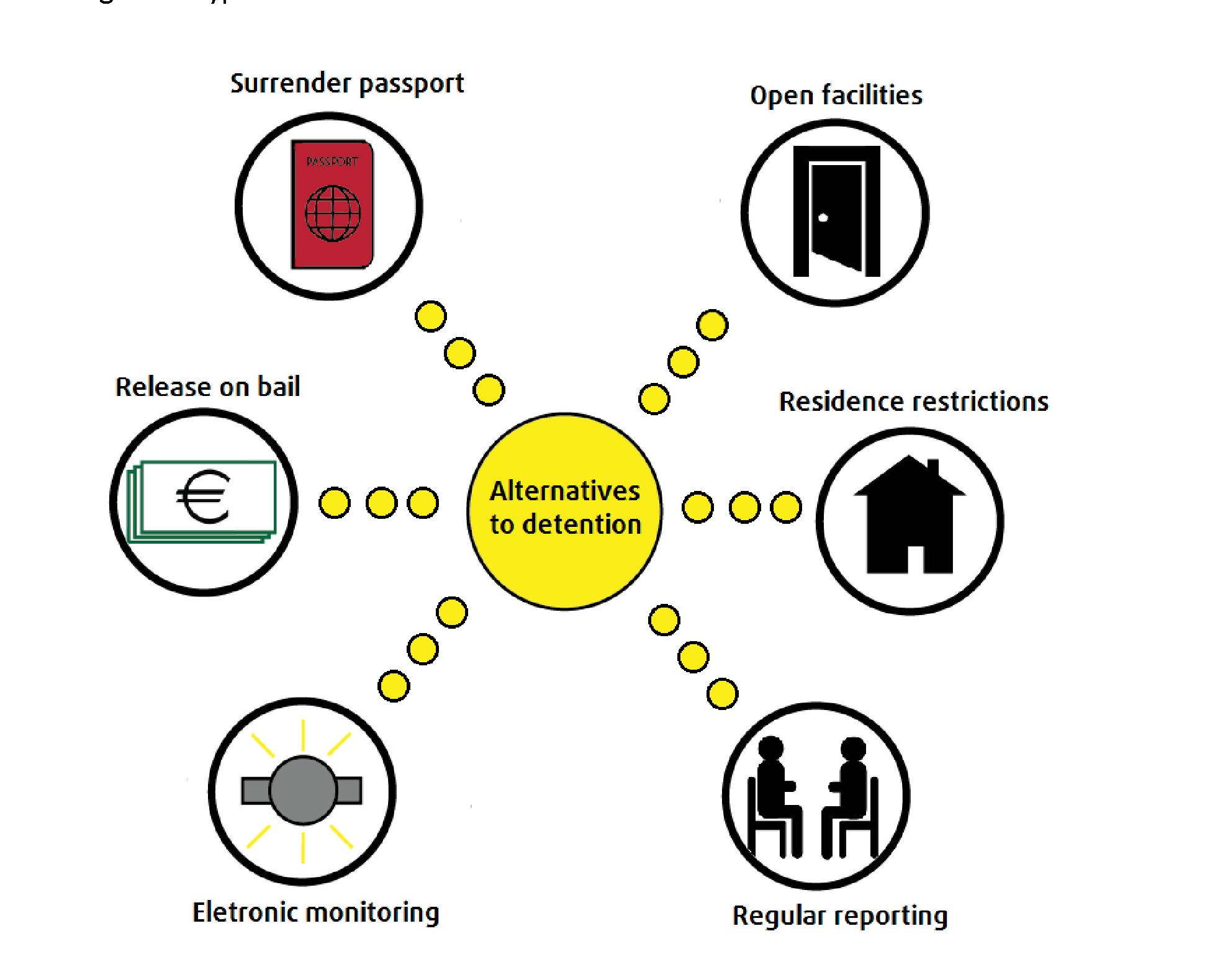
AlternativeDetention

Source: FRA (2015)

Significant attention has been devoted to alternatives to immigration detention in recent years. This has resulted both in a great deal of comparative research and in the developments of tools and other guidance to promote the use of alternatives. This compilation is aimed at policy makers and practitioners entrusted with the task of promoting the use of alternatives to detention and seeks to facilitate the usage of existing materials. It presents various instruments and research material, together with the general human rights and EU legal framework. The first section covers the international framework that safeguards the right to liberty, while those that follow focus specifically on alternatives to detention. The compilation sets out selected:

  • instruments on the right to liberty
  • non-binding United Nations instruments on alternatives to detention
  • non-binding Council of Europe instruments on alternatives to detention
  • European Union law provisions relating to alternatives to detention
  • case law from the European Court of Human Rights, the Court of Justice of the EU and the United Nations Human Rights Committee on alternatives to detention
  • recently developed tools
  • research publications.

The selected instruments are presented by category, beginning with legal instruments (binding and non-binding), and then continuing to case law, expert guidelines and research papers. The left column of each table lists the documents in question with an embedded hyperlink to the full text. The right column reproduces key excerpts from these documents, with additional explanations in italics where relevant. A short introduction precedes each table.

Using alternatives to detention benefits both the state and migrants, as on the one hand they are more cost-effective and on the other they are less intrusive and more respectful of fundamental right than deprivation of liberty. Although virtually all EU Member States provide for the possibility of alternatives to detention (current reforms in Malta are expected to introduce fully-fledged alternatives in the near future), they are still too little applied and when they are, it is primarily in cases involving particularly vulnerable people. Several EU Member States do not yet collect statistics on alternatives to detention, which makes it difficult to assess the extent to which they are used in reality.

Compilation of key resources to promote the use of alternatives to immigration detention in practice
1. Right to liberty: selected instruments
2. Alternatives to detention: selected instruments
2.1.  Selected non-binding United Nations (UN) instruments relating to alternatives to detention
– United Nations General Assembly
– General comments by UN treaty bodies
– Executive Committee of the High Commissioner’s Programme (ExCom)
– UN Working Group on Arbitrary Detention
– Special Rapporteur on the human rights of migrants
– Special Rapporteur on torture and other cruel, inhuman or degrading treatment or punishment…
– Selected non-binding Council of Europe instruments relating to alternatives to detention
– Selected European Union law on alternatives to detention
3. Alternatives to detention: selected case law
– European Court of Human Rights (ECtHR)
– Court of Justice of the European Union (CJEU)
– United Nations Human Rights Committee (HRC)
4. Alternatives to detention: tools
5.Selected research documents
Useful links CONTINUE READING (from page 6 of the FRA Study…)

THE CJEU’S RULING IN CELAJ: CRIMINAL PENALTIES, ENTRY BANS AND THE RETURNS DIRECTIVE

ORIGINAL PUBLISHED ON EU LAW ANALYSIS (Tuesday, 6 October 2015)

By Izabella Majcher, Associate Researcher at Global Detention Project and PhD candidate in International Law at the Graduate Institute of International and Development Studies is Geneva.

In its ruling in the Skerdjan Celaj case (C-290/14), rendered on 1st October 2015, the Court of Justice of the European Union (CJEU) addressed once again the relation between immigration and criminal law and in particular the compatibility of national penal measures imposed as a punishment for irregular migration with the EU Returns Directive. In the previous cases touching upon this issue, the Court assessed whether the Directive allowed states to penalize non-compliance with a return order or irregular stay itself with imprisonment (El Dridi andAchughbabian, respectively) and with home detention (Sagor) as a criminal law penalty (as distinct from administrative law detention, which is expressly regulated by the Directive). In turn, in Celaj the Luxembourg judges were requested to consider whether a criminal law sentence of imprisonment imposed for a breach of a re-entry ban was compatible with the Returns Directive.

As defined in Article 3(6) of the Directive, an “entry ban” means an “administrative or judicial decision or act prohibiting entry into and stay on the territory of the Member States for a specified period, accompanying a return decision.”

The Case

Mr Celaj was arrested by Italian police in August 2011 for attempted robbery. In April 2012 he was issued a removal order accompanied by a three-year entry ban and left Italian territory some five months later. Subsequently Mr Celaj re-entered Italy and was apprehended by the police in February 2014. The public prosecutor then brought criminal law proceedings against him and sought a term of imprisonment of eight months for the breach of the entry-ban. The District Florence Court, before whom the proceedings were brought, decided to stay the proceedings and refer the question to the Luxembourg Court for a preliminary ruling. The referring court asked the CJEU whether the Returns Directive precludes domestic legislation penalizing re-entry in breach of an entry ban with a prison sentence up to four years. The Court found that it does not.

The Court did not follow the Opinion of Advocate General (AG) Szpunar, issued in April 2015. The AG based his Opinion on the effectiveness and the main objective of the Returns Directive, which is the return of undocumented non-EU citizens. These arguments had been developed by the Court in a line of case-law addressing the relation between domestic penal sanctions and the Directive. Indeed, in El Dridi (§ 58) the Court ruled that imprisonment as a criminal law penalty for the failure to leave the country during the voluntary departure period was not compatible with the Returns Directive. In Achughbabian (§ 45) it found that the Directive also precluded imprisonment as a criminal law penalty for irregular stay itself if ordered prior to starting removal proceedings or during such proceedings. The underlying justification of the Court’s conclusions in both cases was that a term of imprisonment as a criminal law penalty would delay the removal of the person concerned and thus jeopardize the objective pursued by the Directive (El Dridi, § 59; Achughbabian, § 45). The ruling in Sagor (§ 45) shows that not only prison sentences but even home detention during return proceedings as a criminal law penalty risks delaying deportation and thus should not be imposed. The AG thus invited the Court to follow its well-established case-law and declare that imprisonment for a breach of entry ban as a criminal law penalty is incompatible with the Directive because it would delay return of the person concerned (§ 6).

Yet, the Court ruled that the Returns Directive does not preclude domestic legislation which provides for a prison sentence as a criminal law penalty for non-EU citizens who unlawfully re-enter the country in breach of an entry ban (§25 and 33). The CJEU did reiterate that the objective of the Directive would be undermined if removal would be delayed by a criminal prosecution leading to a term of imprisonment, as ruled in El Dridi, Achughbabian, and Sagor (§ 26). However, it found that the circumstances in the Celaj case were “clearly distinct” from those inEl Dridi and Achughbabian. This distinction, in the Court’s opinion, was due to the fact that, unlike Mr Celaj, the non-citizens concerned in El Dridi and Achughbabianwere subject to a first return procedure (§ 28). The Court also added that, in line with the second indent of its ruling in Achughbabian, the Directive does not preclude penal sanctions as a criminal law penalty to be imposed on a migrant who has been subject to a return procedure but stays in an irregular manner in the member state (§ 29).

Comments

Were the circumstances in Celaj so “clearly distinct” from those in El Dridi andAchughbabian to justify such a different conclusion? Does it fundamentally matter that those cases dealt with a first return procedure? Every return procedure regulated by the Directive has essentially the same goal – the swift removal of the non-EU citizen concerned. It appears thus irrelevant whether return is pursued because of irregular entry or irregular re-entry.

Under Article 6(1) of the Directive member states are required to issue a return decision to every migrant in irregular situation, subject to some exceptions. As highlighted by the AG (§ 42, 49, and 50), this duty is persistent and continuous. This means that each time a non-EU citizen finds himself or herself on the State territory without permission, the authorities should start a return procedure by issuing a return decision. Thus, in line with the rules under the Directive, a non-EU citizen who has re-entered the Member State unlawfully should be liable to a new return decision rather than criminal proceedings which may postpone his or her ultimate removal. This finding is also supported by the Court’s ruling inAchughbabian (§ 45) where it held that the obligation incumbent on states to conduct removal shall be fulfilled as soon as possible and thus states should not carry out criminal proceedings involving custodial penalties not only prior to theimplementation of the return decision, but also prior to the adoption of such a decision.

Strikingly, the CJEU did not consider at all whether criminal proceedings against Mr Celaj would delay his return. This omission is hardly consistent with the Court’s well established case-law which attaches pivotal importance to the effectiveness of the procedures regulated under the Directive (El Dridi, § 55; Achughbabian, § 39;Sagor, § 32). It is easily foreseeable that after serving his prison sentence, Mr Celaj will be issued with a return decision. The term of imprisonment as a criminal law penalty will inevitably delay his return and thus jeopardize the very objective of the Returns Directive.

Likewise, the second, somehow auxiliary, argument advanced by the Luxembourg judges is not wholly convincing. True, in line with the second indent of the ruling inAchughbabian (§ 51) states may impose a criminal law prison sentence on a non-EU citizen to whom a return procedure has been applied but who stays in an irregular manner in the Member State. However, as pointed out by the AG (§ 61), to be compatible with the main part of the ruling, this conclusion should only cover situations where authorities did not succeed in returning the person concerned, who then continues to stay on the state’s territory. The second indent in the judgment in Achughbabian should thus have no bearing on Celaj where the non-EU citizen concerned left the country, thus return proceedings reached their goal. Following his irregular re-entry, he should be liable to a new return procedure.

The judgment in Celaj appears not consistent with the CJEU’s well-established jurisprudence on the interplay between domestic penal sanctions and the effectiveness of return policy as laid down in the Returns Directive. The Court relied on an apparent clear distinction between return proceedings imposed for irregular entry and subsequent re-entry in breach of an entry ban. As discussed above, the wording of the provisions of the Returns Directive, supported by the underlying objective of the Directive repetitively stressed in the Court’s previous rulings, does not warrant finding such a distinction. The “distinction” argument had been advanced by the European Commission and intervening governments during the proceedings. They stressed that the circumstances in re-entry cases are distinct because penal sanctions could be imposed to dissuade migrants from breaching re-entry bans (AG’s Opinion, § 46). So the “distinction” argument – which was central to the Court’s conclusion – relies on states’ deterrence-oriented concerns rather than considerations based on the provisions and objective of the Returns Directive. The ruling in Celaj seems thus to compromise on the effectiveness of the Directive in order to accord discretion to states to apply their domestic criminal provisions to deter and punish migrants for breaching re-entry ban.

What is the nature of the entry ban whose breach states are now explicitly allowed to punish with criminal law imprisonment? As noted above, Article 3(6) of the Directive defines an entry ban as a prohibition of re-entry to the host state (or other Member States) for a specified period of time. In Article 11(1) the Directive obliges states to impose an entry ban on a non-EU citizen who has not been granted the possibility of voluntary departure or has not complied with a return decision. Since the Directive provides for broad circumstances for refusal of a voluntary departure period (Article 7(4); see discussion of the case law on this issue here) and does not explicitly prohibit states from issuing a return decision on non-refoulement and family or private life grounds (the Directive merely allows states grant a residence permit on humanitarian or other reasons, in Article 6(4)), in practice Article 11(1) may entail that entry bans are imposed in a systematic way. This risk is amplified by the same provision as it allows states to apply a ban on re-entry also in “other cases.”

In practice, as the Evaluation on the application of the Returns Directive, commissioned by the European Commission, shows, the legislation of almost 40 percent of the countries bound by the Directive provides for an automatic application of entry bans on all return decisions. A recent European Migration Network’s study Good Practices in the return and reintegration of irregular migrants demonstrates the scale of the use of entry bans. In 2013 more than 125,000 entry bans were imposed in the EU. Compared to the total number of return decisions that year (see Eurostat), these figures evince that the member states accompany a considerable proportion of return decisions with entry bans, including Greece (almost 100 %), Poland (80 %), or Sweden (70 %). It appears thus that entry bans are systematically applied in practice.

States are free not to impose or withdraw an entry ban for humanitarian or other reasons (article 11(3)). They are however not obligated to waive the entry ban requirement in such cases – it lies within their discretion. While the Directive clarifies that entry bans shall not prejudice the right to international protection (Article 11(5)), this assertion should be translated into a clear obligation on states not to impose the ban where the protection from non-refoulement could be impaired. The severity of this entry ban is further strengthened by its length. The Directive allows a five-year duration of an entry ban (article 11(2)). The above mentioned Commission study highlights that the majority of states issue entry bans for this maximum permitted period of time. In addition, states may apply a longer ban (the time period of which is not limited by the Directive), if they judge that the person concerned represents a serious threat to public policy or national security (Article 11(2)).

Thus, potentially the majority of non-EU citizens liable to return are prohibited for prolonged periods to re-enter the host state or even the whole EU, if the entry ban has been registered in the Schengen Information System (SIS). An entry ban is thus a harsh and coercive measure, which is a deterrent in itself and potentially conflicts with migrants’ fundamental rights. It cannot be ruled out that a non-EU citizen will be obliged to re-enter, where prompted by his family links, disrupted by deportation, or changes in the situation in his country of origin. While, as noted above, states may withdraw an entry ban, they are nevertheless not obliged to do so. Imposition of a criminal law prison sentence for breach of an entry ban, as permitted in Celaj, appears thus disproportionate and unnecessary. States may use other available methods to punish this breach, such as an extension of an existing ban. More generally, criminalization of breaches of (administrative) immigration law risks creating a conflation between (non-punitive) immigration law and criminal law, with negative consequences for migrants, and an undue overburden to the criminal justice system.

Barnard & Peers: chapter 26

Safe Harbor – No Future? How the General Data Protection Regulation and the rulings of the Court of Justice of the European Union (CJEU) will influence transatlantic data transfers

(ORIGINAL Posted on 1. Oktober 2015  in PETER SCHAAR. Der Blog. )

Ladies and gentlemen,

One week ago, the Advocate General at the Court of Justice of the European Union (CJEU) issued his vote on the Safe Harbor case of Max Schrems vs. the Irish Data Protection Commissioner.

Since 1995 when the General European Directive on Data Protection came into force, data transfers from the European Union and its member states to non-EU countries have been subject to specific privacy and security restrictions. Such restrictions do not exist only in Europe.

For example in the US several legal acts and decisions of regulatory authorities constitute the obligation to store specific data in the own country, in particular data, which have been generated by public bodies and providers of critical infrastructures. The US Federal Trade Commission has stated that a company subject to privacy obligations under US law is not allowed to avoid such obligations by outsourcing their data processing activities to offshore service providers.

The key message of Art. 25 of the 1995 GD is that transfer of personal data to a third country may take place only if the recipient in question ensures an adequate level of data protection. The adequacy shall be assessed in the light of all the circumstances surrounding the data transfer operation.

The main road to adequacy are the so-called adequacy decisions of the European Commission, that the said country ensures an adequate level of data protection. These decisions are binding for the member states. They shall take the measures necessary to comply with the Commission’s decision.

One of the most discussed adequacy decisions concerns the United States – the decision on Safe Harbor, although the Commission was of the opinion, that the US in general failed to provide an adequate level of data protection for the private sector, because of the lack of any comprehensive data protection legislation.

The Safe Harbor principles, negotiated between the Commission and the US government in the late 1990s should bridge this obstacle. The SH arrangement has been aimed at guaranteeing the adequate level of protection required by EU law for those companies, committing themselves to comply with the SH principles.

From the beginning, since the Safe Harbor was agreed in the year 2000 there has been some criticism against it. The main critical argument was that the principles do not meet the high EU data protection standards defined by the General Directive.

A scientific implementation study on SH done 2004 on behalf of the Commission came to the result that „Key concepts such as ‚US organization‘, ’personal data’,’deceptive practices’ lack clarity. Moreover, the jurisdiction of the FTC with regard to certain types of data transfers is dubious.“

It also has been criticized, that companies which declare compliance with the principles at once may profit from the Safe Harbor privileges, even if their privacy practices were not yet subject to an independent audit.

These issues remain important until our days. But after the vote the Advocate General at the CJEU (GA) issued recently, the focus lays on another question: How far practices and powers of US authorities have been ignored in the adequacy assessments.

At the first glance, law enforcement authorities, police and intelligence do not fall within the scope of the Safe Harbor agreement and therefore they do not have to be subject to the assessment. But this first impression is wrong.

As Art. 25 of the GD is pointing out, the assessment is to be done in the light of „all circumstances“ surrounding a data transfer to the third country. Even activities of authorities in the third country have to be examined. It is unclear how far this happened during the Safe Harbor assessment in the late 1990s.

But even if such assessment once took place, the result may be invalid today, because things changed dramatically after 9/11 2001. As we have learnt from Edward Snowden and other whistleblowers, US government has obtained broad access to private companies’ databases, telecommunications and Internet services.

Many companies which have co-operated with the NSA – voluntarily or based on legal obligations – have been safe harborists and there is no doubt that NSA and other services have got access to big amounts of data stemming from Europe or related to EU citizens.

The PATRIOT ACT and secret Presidential Orders, issued after 9/11 provided intelligence and law enforcement agencies with a lot of new powers and simultaneously demolished many safeguards which have been introduced in the 1970s to protect civil rights and privacy.

For years it seemed that many of these changes were not on the screen of the European Commission and other European stakeholders. The implementation study on SH of 2004 came to the conclusion: „Since the new US legislation only rarely contradicts the SH principles for data covered by SH, these conflicts do not appear to undermine the level of protection for any significant flows of personal data to the United States. The controversial provisions of the USA PATRIOT Act are essentially irrelevant for SH data flows.“ (p. 101)

But 2013, after the the beginning of the Snowdon revelations, nobody can ignore any more, that the practices of NSA, CIA and FBI introduced after 9/11 have impact on the level of data protection in the United States: The legal provisions on Government access to personal information, especially the Foreign Intelligence Surveillance Act (FISA), do not meet the basic standards of the rule of law at least so far data of non-US-persons are concerned. The practices disclosed in the last two years and the commitments of US officials on mass surveillance provided the public with loads of evidence that the NSA and others are involved in bulk collection of personal data coming from Europe. Therefore it seems evident, that these practices have to be taken into account by the CJEU.

Another change happened in Europe: The Lisbon Treaty came into force in 2009, and at least since then privacy and data protection, including the independent oversight, have been fundamental rights of the European Union, as parts of the European primary law. European secondary law and European Commission’s decisions have to fulfill these requirements. Even older legislation, agreements with third countries as to PNR or TFTP and Commission’s decisions have to be reviewed in the light of Art. 7 and 8 of the EU Charter of Fundamental Rights.

Acknowledging this, the vote of Advocate General Bot (AG) in the case of Maximilian Schrems versus the Irish Data Protection Commissioner, issued last week, is not really surprising. The vote touches two big points:

Even if the Commission decides that the level of data protection in a country is adequate, this does not prevent national data protection authorities from suspending the transfer of the data, it they are of the opinion, that in the concrete case adequacy criteria are not met by the recipient. As we have learnt from the Snowden revelations, Facebook and other Internet companies cooperated closely with the NSA and provided them with broad access to personal data stored on their servers.
The AG is of the opinion that the Safe Harbor arrangement itself is invalid, because the US, especially the intelligence services, do not provide adequate protection for the personal data coming from Europe. Therefore he proposes to suspend the Safe Harbor.

Nobody knows how the European Court of Justice will decide the case. The ruling is expected on 6 October. Perhaps you know the sentence „How the judge decides depends what he ate for breakfast“. It is correct: The vote of the advocate general is only an opinion and it does not bind anybody.

But for me it seems likely that the judges will acknowledge the vote, at least in the result. In two earlier cases, the court decided last year, on data retention and on the right to be forgotten, the judges underlined the high importance of European fundamental rights on privacy and data protection. In these cases the court went beyond the Advocate general’s vote. In the Schrems’ case the AG adapted this recent orientation of the judges.

If the CJEU will decide as proposed by the AG, this does not mean automatically the end of Safe Harbor. But the Safe Harbor arrangement must be renegotiated and at the end there might be a better safe Harbor System, meeting the principles of fundamental rights and complying with the new EU Data Protection Regulation.

Art. 41 of the Commissions proposal contains criteria, conditions and procedures for adequacy assessments, more specific than the current Art. 25 of the GD from 1995: The criteria which shall be taken into account for the Commission’s assessment of an adequate or not adequate level of protection include expressly the rule of law, judicial redress and independent supervision. The new article confirms explicitly the possibility for the Commission to assess the level of protection afforded by a territory or a processing sector within a third country.

My conclusion for today: Safe Harbor will be possible even in the future. But such a „happy end“ requires changes in the SH arrangement. And it requires effective legal guarantees for EU citizens in the US.

Also necessary is a new thinking in Europe, in particular on the fields of law enforcement and intelligence. If we urge the US to respect our privacy, European secret services have to respect fundamental rights of all EU citizens and citizens of third countries as well.

(MEIJERS COMMITTEE) Military action against human smugglers: legal questions concerning the EUNAVFOR Med operation

ORIGINAL PUBLISHED HERE ON 23 September 2015

  1. The EUNAVFOR Med operation

On 22 June 2015, the Council of Ministers of the European Union adopted a Common Foreign Security Policy (CFSP) Decision establishing a military crisis management operation with the aim of combatting fighting people smuggling: EUNAVFOR Med.1 This mission is currently in its first phase, focusing on intelligence gathering, i.e. surveillance and the   assessment of existing smuggling networks.

A second phase would involve searching and possibly diverting vessels on the high seas and territorial waters, either under a mandate of the UN Security Council or with the consent of the appropriate coastal state. The Foreign Affairs Council has recently established that the conditions for the second phase have been met insofar as operations in international waters are concerned.2 During the third phase, vessels and related assets of human smugglers would be destroyed and smugglers apprehended.

The mission will operate in a complex legal environment of overlapping rules of refugee law, international human rights law, the law of the sea, and international rules on the use of force. This note discusses some of the most pressing legal questions raised by this operation.

  1. General remarks

At the outset, the Meijers Committee would like to raise a general point regarding the focus on people smuggling as a response to the loss of life at sea. In the absence of safe and legal access to the right to seek asylum in Europe, together with routes for legal migration, people will turn to human smugglers as a last resort. Increased border controls have resulted in higher casualties as people are forced to take more dangerous routes.

The Meijers Committee questions the appropriateness of the approach taken under EUNAVFOR Med to stop the loss of life at sea. The Committee would like to point to the shift from saving lives at sea under  the  Italian-led  Mare  Nostrum  Operation,  to  border management  (Triton),  to  military  action (EUNAVFOR Med). The Meijers Committee emphasizes that the legal obligation to save lives at sea should have primacy in all Union action at sea and that a long-term solution must also involve improving legal access to asylum and legal employment.

  1. Human smuggling as a threat to international peace and
    security

The Meijers Committee notes that the decision establishing the EUNAVFOR Med operation refers explicitly to the need for a UN Security Council Resolution or consent of the coastal states concerned before the second phase of the operation can enter into force.

In this respect the Meijers Committee notes a fundamental difference from the EUNAVFOR operation Atalanta against piracy off the Somalian coast, which was taken as a model for EUNAVFOR Med. The Atalanta operation was explicitly supported by a UN Security Council Resolution, and had the consent of the coastal state involved.3

Articles 39 and 42 UN Charter stipulate that the Security Council shall only authorize the use of force if ‘necessary to maintain or restore international peace and security’. The Meijers Committee is not convinced that the EUNAVFOR MED mission meets this standard. Although the humanitarian crisis may meet this standard, the activities of human smugglers – unlike piracy do not qualify. Although the Security Council has previously adopted resolutions in response to refugee crises in Iraq and Haiti, these were intended to stabilize the countries of origin and not to prevent persons from seeking refuge elsewhere.

  1. Phase 2: search and diversion of ships

The Second Phase of the operation would involve the search and diversion of ships in third-country territorial waters, which requires the consent of the flag state or a UN Security Council Resolution.

The Meijers Committee recalls that on the high seas, Article 87 UN Convention on the Law of the Sea (UNCLOS) ensures the right to freedom of navigation. Article 110 permits a warship to board and inspect a vessel if, inter alia, it has no nationality. As regards the vessel, a finding of statelessness should allow states to exercise jurisdiction in order to ensure compliance with the ‘minimum public order on the high seas’, namely, the duties that normally fall on the flag state (Art. 94 UNCLOS).4 This could include a state’s power to escort the vessel into harbor for inspection. As regards the people on board, UNCLOS does not seem to provide a basis for the exercise of jurisdiction.

Although Article 110(1) UNCLOS expressly allows that grounds of interference may be established by Treaty, the UN Smuggling Protocol seems to impose a duty of cooperation only on the contracting parties, while maintaining the requirement of flag state authorization. Article 8(7) of the Smuggling Protocol provides a firmer legal basis for interference with stateless vessels than Article 110 UNCLOS. The wording ‘suppressing the use of the vessel’ or ‘take appropriate measures’ implies the possible use of force. Nevertheless, such force should be used as a means of last resort and will be subject to the requirement of necessity and proportionality. It is noted, however, that the Migrant Smuggling Protocol lacks the precision of, for instance, the UN drug trafficking regime, which explicitly sets out the measures that an intercepting power may take against a drug transport.5 Accordingly, no clear legal basis for action is provided in international law.

Diversions on the high seas may not result in the refoulement of people on board. It is important to stress that States cannot relieve themselves of this obligation by labelling an operation as ‘search and rescue’. The IMO Guidelines on the treatment of persons rescued at sea state that ‘[disembarkation of asylum-seekers and refugees recovered at sea, in territories where their lives and freedom would be threatened should be avoided.’ This approach has been confirmed by the European Court of Human Rights in the Hirsi case.6 Member States remain bound by their obligations under international human rights law, independently of the nature and location of their intervention. In this regard it is particularly problematic that Libya one of the most important coastal states whose cooperation is sought is currently a notoriously dangerous and unstable country.

It is unclear how the EU intends to give practical effect to these obligations in the course of the EUNAVFOR Med mission. The Meijers Committee would recommend that clear guidelines be put in place, comparable to the rules applicable in the framework of Frontex coordinated operations at sea.7

  1. Phase 3: destruction of vessels and apprehension of smugglers

The Third Phase of the Operation would entail the destruction of vessels and related assets, and the apprehension of smugglers. The Meijers Committee argues that clear, binding, publicly available rules should be adopted prior to the commencement of Phase 3.

As regards the smugglers it must be noted that unlike piracy and international crimes, international law does not establish universal criminal jurisdiction over human smuggling. As with diversions, the interference with vessels believed to be engaged in human smuggling requires the consent of the flag state (or a UN SC Resolution). In case the ship is sailing without a flag, Article 8 of the Protocol allows a party to take ‘appropriate measures in accordance with relevant domestic and international law’. The extent to which this includes the exercise of criminal jurisdiction over human smugglers is not clear, however.

The Council decision establishing EUNAVFOR Med is silent about the possible detention and prosecution of smugglers. The Meijers Committee points out that even though EUNAVFOR Med is executed by military forces, the EU is not acting as party to an armed conflict and thus normal peace­time law applies. This means that after arrest, those suspected of migrant smuggling should be brought promptly before a judge8. In the case of subsequent criminal prosecution, jurisdiction should be established in one of the Member States. In this respect it is noted that not all Member States have established universal jurisdiction over human smuggling. If smugglers are to be extradited or released to third countries, their fundamental rights should be guaranteed.

The Meijers Committee notes that EUNAVFOR Med is aimed at the destruction of vessels used or suspected of being used for migrant smuggling, possibly even inside third-country territory, yet it remains unclear what legal standard is applied to identify such vessels. The Meijers Committee cautions that the destruction of vessels cannot be arbitrary. Unlike UNCLOS, which provides for clear rules on the seizure and liability for seizure of pirate ships, there is no explicit legal basis in international law for the seizure of migrant smuggling boats. The right to property as enshrined in Article 1 of Protocol 1 ECHR, which will apply to the Member States acting extra-territorially, prescribes that any destruction of property must be provided for by law and must be necessary and proportionate.

  1. Unclear division of responsibility between the EU and its
    Member States

The Meijers Committee recalls that Article 21 TEU requires CFSP actions to be based on human rights. This includes respect for human dignity, including the prohibition of torture and inhuman treatment; personal security and liberty; and protection from arbitrary detention and arrest.9 It also notes, however, that the Court of Justice of the EU has no authority to ensure this respect for fundamental rights as it lack jurisdiction over the CFSP.10 This means that legal remedies would have to be provided under the national law of the participating Member States.

The experience with joint operations under the coordination of Frontex shows that in case of violations of fundamental rights, it is unclear to whom wrongful conduct must be attributed. Although the operation is coordinated by the EU, it is the Member States that provide the assets and personnel, over which they maintain operational command.

Case law issuing from the European Court of Human Rights on the obligations of the Member States as contracting parties to the European Convention on Human Rights clearly indicates with regard to the Member States that they cannot escape their responsibilities under the Convention by acting outside the Convention’s territorial scope. The situation is more complicated, however, when Member States act as agents for the European Union (Bosphorus) or within the context of UN Peace Keeping Operations (Al Jeddah, Behrami, and Saramati). The Meijers Committee therefore stresses that it is fundamentally important that questions of international responsibility and responsibility under the European Convention for Human Rights are addressed prior to commencement of Phases 2 and 3.

Conclusions and recommendations

I. There are no indications that combating migrant smuggling contributes to the restoration of international peace and security or to ending the ongoing humanitarian crises;

II.      Without express consent from third states or authorization from the UN Security Council, the EU lacks jurisdiction over   vessels or assets in third-country territorial waters;
III.      Without express consent from third-country coastal states or   authorization from the UN Security Council, there is no clear legal basis for coercive measures against vessels or assets on the high seas;
IV Despite the unclear legal framework covering interdiction on the high seas, international human rights law does apply;
V.      Should a legal basis for action on the high seas and in territorial waters be provided, clear rules of engagement and proper safeguards should be in place to prevent indiscriminate destruction of civilian property; any undue loss should be compensated;
VI.      An unambiguous legal basis for the arrest and detention of suspected smugglers is needed, and also for the seizure and destruction of any personal property. Suspects should either be prosecuted, extradited or released, the last action having due regard to the right to asylum and the prohibition of refoulement;
VII.      Clear attribution rules and accountability mechanisms for human rights violations committed by EUNAVFOR assets should be in place;
VIII.      The right to apply for asylum, access to asylum procedures on land with proper language and legal assistance, and the prohibition of refoulement should be respected and subject to judicial oversight;
IX.       Outsourcing migration control to third countries, even though outside Member State jurisdiction, should take place with assurances and safeguards against human rights violations.

Notes

1 Council Decision (CFSP) 2015/972 of 22 June 2015 launching the European Union military operation in the southern Central Mediterranean (EUNAVFOR MED), OJ 2015, L157/51.

2 Council of the European Union, “EUNAVFOR Med: Council adopts a positive assessment on the conditions to move to the first step of phase 2 on the high seas”, Press Release, 14 September 2015, no. 643/15.
3 http://www.un.org/Depts/los/piracy/piracy_documents.htm
4 E. Papastavridis, ‘Enforcement Jurisdictions in the Mediterranean Sea: Illicit Activities and the Rule of Law on the High Seas’, International Journal of Marine and Coastal Law, Vol. 25, 2010, p. 585.
5 See Council of Europe Agreement on Illicit Traffic by Sea, implementing article 17 of the United Nations Convention against Illicit Traffic in Narcotic Drugs and Psychotropic Substances.
6 ECHR, Hirsi Jamaa and others v. Italy, Grand Chamber, Judgment, 23 February 2012, Application no. 27765/09.
7 Regulation (EU) No 656/2014 of the European Parliament and of the Council of 15 May 2014 establishing rules for the surveillance of the external sea borders in the context of operational cooperation coordinated by the European Agency for the Management of Operational Cooperation at the External Borders of the Member States of the European Union, L 189, 27 June 2014.
8 ECHR, Medvedyev v France, 9 March 2010, appl. no. 3394/03.
9 The promotion and protection of human rights during common security and defence policy operations. In-between a spreading state of mind and an unsolved concern. M L Sánchez Barrueco, in The EU as a ”Global Player” in human rights?, J E Wetzel (edit.), 2011, pp. 158-160.
10 See also Case T-271/10, under appeal C-455/14 P.

About : The Meijers Committee is an independent group of legal scholars, judges and lawyers that advises on European and International Migration, Refugee, Criminal, Privacy, Anti-discrimination and Institutional Law. The Committee aims to promote the protection of fundamental rights, access to judicial remedies and democratic decision-making in EU legislation.

The Meijers Committee is funded by the Dutch Bar Association (NOvA), Foundation for Democracy and Media (Stichting Democratie en Media) the Dutch Refugee Council (VWN), Foundation for Migration Law Netherlands (Stichting Migratierecht Nederland), the Dutch Section of the International Commission of Jurists (NJCM), Art. 1 Anti-Discrimination Office, and the Dutch Foundation for Refugee Students UAF.

Contact info: Louis Middelkoop Executive secretary post@commissie-meijers.nl +31(0)20 362 0505

Please visit www.commissie-meijers.nl

AMERICAN MASS SURVEILLANCE OF EU CITIZENS: IS THE END NIGH?

ORIGINAL PUBLISHED ON EU LAW ANALYSIS  (Wednesday, 23 September 2015)

by Steve PEERS

*This blog post is dedicated to the memory of the great privacy campaigner Caspar Bowden, who passed away recently. What a tragedy he did not leave to see the developments in this case. To continue his work, you can donate to the Caspar Bowden Legacy Fund here.


A brilliant university student takes on the hidebound establishment – and ultimately wins spectacularly. That was Mark Zuckerberg, founding Facebook, in 2002. But it could be Max Schrems, taking on Zuckerberg and Facebook, in the near future – if the Court of Justice decides to follow the Advocate-General’s opinion in the Schrems case, released today.

In fact, Facebook is only a conduit in this case: Schrems’ real targets are the US government (for requiring Facebook and other Internet companies to hand over personal data to intelligence agencies), as well as the EU Commission and the Irish data protection authority for going along with this. In the Advocate-General’s opinion, the Commission’s decision to allow EU citizens’ data to be subject to mass surveillance in the US is invalid, and the national data protection authorities in the EU must investigate these flows of data and prohibit them if necessary. The case has the potential to change much of the way that American Internet giants operate, and to complicate relations between the US and the EU in this field.

Background

There’s more about the background to this litigation here, and Simon McGarr has summarised the CJEU hearing in this case here. But I’ll summarise the basics of the case again here briefly.

Max Schrems is an Austrian Facebook user who was disturbed by Edward Snowden’s revelations about mass surveillance by US intelligence agencies. Since such mass surveillance is put into effect by imposing obligations to cooperate upon Internet companies, he wanted to complain about Facebook’s transfers of his personal data to the USA. Since Facebook’s European operations are registered in Ireland, he had to bring his complaints to the Irish data protection authority.

The legal regime applicable to such transfers of personal data is the ‘Safe Harbour’ agreement between the EU and the USA, agreed in 2000 – before the creation of Facebook and some other modern Internet giants, and indeed before the 9/11 terrorist attacks which prompted the mass surveillance. This agreement was put into effect in the EU by a decision of the Commission, which used the power conferred by the EU’s current data protection Directive to declare that transfers of personal data to the USA received an ‘adequate level of protection’ there.

The primary means of enforcing the arrangement was self-certification of the companies concerned (not all transfers to the USA fall within the scope of the Safe Harbour decision), enforced by the US authorities.  But it was also possible (not mandatory) for the national data protection authorities which enforce EU data protection law to suspend transfers of personal data, if the US authorities or enforcement system have found a breach of the rules, or on the following further list of limited grounds set out in the decision:

there is a substantial likelihood that the Principles are being violated; there is a reasonable basis for believing that the enforcement mechanism concerned is not taking or will not take adequate and timely steps to settle the case at issue; the continuing transfer would create an imminent risk of grave harm to data subjects; and the competent authorities in the Member State have made reasonable efforts under the circumstances to provide the organisation with notice and an opportunity to respond.

In fact, Irish law prevents the national authorities from taking up this option. So the national data protection authority effectively refused to consider Schrems’ complaint. He challenged that decision before the Irish High Court, which doubted that this system was compatible with EU law (or indeed the Irish constitution). So that court asked the CJEU to rule on whether national data protection authorities (DPAs) should have the power to prevent data transfers in cases like these.

The Opinion

The Advocate-General first of all answers the question which the Irish court asks, and then goes on to examine whether the Safe Harbour decision is in fact valid. I’ll address those two issues in turn.

In the Advocate-General’s view, national data protection authorities have to be able to consider claims that flows of personal data to third countries are not compatible with EU data protection laws, even if the Commission has adopted a decision declaring that they are. This stems from the powers and independence of those authorities, read in light of the EU Charter of Fundamental Rights, which expressly refers to DPAs’ role and independence. (On the recent CJEU case law on DPA independence, see discussion here). It’s worth noting that the new EU data protection law under negotiation, the data protection Regulation, will likely confirm and even enhance the powers and independence of DPAs. (More on that aspect of the proposed Regulation here).

On the second point, the opinion assesses whether the Safe Harbour Decision correctly decided that there was an ‘adequate level of protection’ for personal data in the USA. Crucially, it argues that this assessment is dynamic: it must take account of the protection of personal data now, not just when the Decision was adopted back in 2000.

As for the meaning of an ‘adequate level of protection’, the opinion argues that this means that third countries must ensure standards ‘essentially equivalent to that afforded by the Directive, even though the manner in which that protection is implemented may differ from that’ within the EU, due to the importance of protecting human rights within the EU. The assessment of third-country standards must examine both the content of those standards and their enforcement, which entailed ‘adequate guarantees and a sufficient control mechanism’, so there was no ‘lower level of protection than processing within the European Union’. Within the EU, the essential method of guaranteeing data protection rights was independent DPAs.

Applying these principles, the opinion accepts that personal data transferred to the USA by Facebook is subject to ‘mass and indiscriminate surveillance and interception’ by intelligence agencies, and that EU citizens have ‘no effective right to be heard’ in such cases. These findings necessarily mean that the Safe Harbour decision was invalid for breach of the Charter and the data protection Directive.

More particularly, the derogation for the national security rules of US law set out in the Safe Harbour principles was too general, and so the implementation of this derogation was ‘not limited to what is strictly necessary’. EU citizens had no remedy against breaches of the ‘purpose limitation’ principle in the US either, and there should be an ‘independent control mechanism suitable for preventing the breaches of the right to privacy’.

The opinion then assesses the dispute from the perspective of the EU Charter of Rights. It first concludes that the transfer of the personal data in question constitutes interference with the right to private life. As in last year’s Digital Rights Ireland judgment (discussed here), on the validity of the EU’s data retention directive, the interference with rights was ‘particularly serious, given the large numbers of users concerned and the quantities of data transferred’. In fact, due to the secret nature of access to the data, the interference was ‘extremely serious’. The Advocate-General was also concerned about the lack of information about the surveillance for EU citizens, and the lack of an effective remedy, which breaches Article 47 of the Charter.

However, interference with these fundamental rights can be justified according to Article 52(1) of the Charter, as long as the interference is ‘provided for by law’, ‘respect[s] the essence’ of the right, satisfies the ‘principle of proportionality’ and is ‘necessary’ to ‘genuinely meet objectives of general interest recognized by’ the EU ‘or the need to protect the rights and freedoms of others’.

In the Advocate-General’s view, the US law does not respect the ‘essence’ of the Charter rights, since it extends to the content of the communications. (In contrast, the data collected pursuant to the data retention Directive which the CJEU struck down last year concerned only information on the use of phones and the Internet, not the content of phone calls and Facebook posts et al). On the same basis, he objected to the ‘broad wording’ of the relevant derogations on national security grounds, which did not clearly define the ‘legitimate interests’ at stake. Therefore, the derogation did not comply with the Charter, ‘since it does not pursue an objective of general interest defined with sufficient precision’. Moreover, it was too easy under the rules to escape the limitation that the derogation should only apply when ‘strictly necessary’.

Only the ‘national security’ exception was sufficiently precise to be regarded as an objective of general interest under the Charter, but it is still necessary to examine the ‘proportionality’ of the interference. This was a case (like Digital Rights Ireland) where the EU legislature’s discretion was limited, due to the importance of the rights concerned and the extent of interference with them. The opinion then focusses on whether the transfer of data is ‘strictly necessary’, and concludes that it is not: the US agencies have access to the personal data of ‘all persons using electronic communications services, without any requirement that the persons concerned represent a threat to national security’.

Crucially, the opinion concludes that ‘[s]uch mass, indiscriminate surveillance is inherently disproportionate and constitutes an unwarranted interference’ with Charter rights. The Advocate-General agreed that since the EU and the Member States cannot adopt legislation allowing for mass surveillance, non-EU countries ‘cannot in any circumstances’ be considered to ensure an ‘adequate level of protection’ of personal data if they permit it either.

Furthermore, there were not sufficient guarantees for protection of the data. Following the Digital Rights Ireland judgment, which stressed the crucial importance of such guarantees, the US system was not sufficient. The Federal Trade Commission could not examine breach of data protection laws for non-commercial purposes by government security agencies, and nor could specialist dispute resolution bodies. In general, the US lacks an independent supervisory authority, which is essential from the EU’s perspective, and the Safe Harbour decision was deficient for not requiring one to be set up. A third country cannot be considered to have ‘an adequate level of protection’ without it. Furthermore, only US citizens and residents had access to the judicial system for challenging US surveillance, and EU citizens cannot obtain remedies for access to or correction of data (among other things).

So the Commission should have suspended the Safe Harbour decision. Its own reports suggested that the national security derogation was being breached, without sufficient safeguards for EU citizens. While the Commission is negotiating revisions to that agreement with the USA, that is not sufficient: it must be possible for the national supervisory authority to stop data transfers in the meantime.

Comments

The Advocate-General’s analysis of the first point (the requirement that DPAs must be able to stop data flows if there is a breach of EU data protection laws) is self-evidently correct. In the absence of a mechanism to hear complaints on this issue and to provide for an effective remedy, the standards set out in the Directive could too easily be breached. Having insisted that the DPAs must be fiercely independent of national governments, the CJEU should not now accept that they can be turned into the tame poodles of the Commission.

On the other hand, his analysis of the second point (the validity of the Safe Harbour Decision) is more problematic – although he clearly arrives at the correct conclusion. With respect, there are several flaws in his reasoning. Although EU law requires strong and independent DPAs within the EU to ensure data protection rights, there is more than one way to skin this particular cat. The data protection Directive notably does not expressly require that third countries have independent DPAs. While effective remedies are of course essential to ensure that data protection law (likely any other law) is actually enforced in practice, those remedies do not necessarily have to entail an independent DPA. They could also be ensured by an independent judiciary. After all, Americans are a litigious bunch; Europeans could join them in the courts. But having said that, it is clear that in national security cases like this one, EU citizens have neither an administrative nor a judicial remedy worth the name in the USA. So the right to an effective remedy in the Charter has been breached; and it is self-evident that processing information from Facebook interferes with privacy rights.

Is that limitation of rights justified, however? Here the Advocate-General has muddled up several different aspects of the limitation rules. For one thing, the precision of the law limiting rights and the public interest which it seeks to protect are too separate things. In other words, the public interest does not have to be defined precisely; but the law which limits rights in order to protect the public interest has to be. So the opinion is right to say that national security is a public interest which can justify limitation of rights in principle, but it fails to undertake an examination of the precision of the rules limiting those rights. As such, it omits to examine some key questions: should the precision of the law limiting rights be assessed as regards the EU law, the US law, or both?  Should the US law be held to the same standards of clarity, foreseeability and accessibility as European states’ laws must be, according to the ECHR jurisprudence?

Next, it’s quite unconvincing to say that processing the content of communications interferes with the ‘essence’ of the privacy and data protection rights. The ECHR case law and the EU’s e-privacy directive expressly allow for interception of the content of communications in specific cases, subject to strict safeguards. So it’s those two aspects of the US law which are problematic: its nature as mass surveillance, plus the inadequate safeguards.

On these vital points, the analysis in the opinion is correct. The CJEU’s ruling inDigital Rights Ireland suggests, in my view, that mass surveillance is inherently a problem, regardless of the safeguards in place to limit its abuse. This is manifestly the Advocate-General’s approach in this case; and the USA obviously has in place mass surveillance well in excess of the EU’s data retention law. The opinion is also right to argue that EU rules banning mass surveillance apply to the Member States too, as I discuss here. But even if this interpretation is incorrect, and mass surveillance is only a problem if there are weak safeguards, then the Safe Harbour decision still violates the Charter, due to the lack of accessible safeguards for EU citizens as discussed above. Hopefully, the Court of Justice will confirm whether mass surveillance is intrinsically problematic or not: it is a key issue for Member States retaining data by way of derogation from the e-privacy Directive, for the validity of EU treaties (and EU legislation) on specific issues such as retaining passenger data (see discussion here of a pending case), and for the renegotiation of the Safe Harbour agreement itself.

This brings us neatly to the consequences of the CJEU’s forthcoming judgment (if it follows the opinion) for EU/US relations. Since the opinion is based in large part upon the EU Charter of Rights, which is primary EU law, it can’t be circumvented simply by amending the data protection Directive (on the proposed new rules on external transfers under the planned Regulation, see discussion here). Instead, the USA must, at the very least, ensure that adequate remedies for EU citizens and residents are in place in national security cases, and that either a judicial or administrative system is in place to enforce in practice all rights which are supposed to be guaranteed by the Safe Harbour certification. Facebook and others might consider moving the data processing of EU residents to the EU, but it’s hard to see how this could work for any EU resident with (for instance) Facebook friends living in the USA. Surely in such cases processing of the EU data in the USA is unavoidable.

Moreover, arguably it would not be sufficient for the forthcoming EU/US trade and investment agreement (known as ‘TTIP’) to provide for a qualified exemption for EU data protection law, along the lines of the WTO’s GATS. Only a complete immunity of EU data protection law from the TTIP – and any other EU trade and investment agreements – would be compatible with the Charter. Otherwise, companies like Facebook and Google might try to invoke the controversial investor dispute settlement system (ISDS) every time a judgment like Google Spain or (possibly) Schrems cost them money.

Schrems Versus Facebook: is the end of Safe Harbor approaching ?

by Emilio De Capitani

Today Advocate General Yves Bot has presented his long-awaited conclusions on the Case C‑362/14 Maximillian Schrems v Data Protection Commissioner. This case better described by the press as the “Schrems v Facebook” Case (why not “David V Goliath” ?)  put in question the so called Safe harbor “agreement” which frame the conditions under which personal data of the people under the EU jurisdiction can be transferred or treated by servers of US Companies (such as Facebook, Google, E-Bay) on the US territory.
As the protection of personal data is a fundamental right under EU law (notably after the entry into force of the art.8 of the EU Charter)  art. 25 of Directive 95/46 foresees that the transfer of these data to a third country is legitimate only if the data are “adequately” protected.
The problem is that in the US there is no comprehensive legal protection framework comparable to the one existing in the EU so that in 2000 the Commission negotiated with the US the establishment of a specific voluntary regime (the “Safe Harbor Principles”) which could had been considered granting an “adequate” protection of personal data  having regard to the standard applicable in Europe.

At the time the European Parliament voted against this regime but was unable to obtain stronger safeguards because of the unwillingness of the US authorities and moreover by the Commission which was more interested to the transfer of data than of their protection.

Since then the transatlantic flow of data has grown every day and with them the economic benefices of the US Companies without any real re-assesment of the compliance of the Safe Harbor principles on the US side (by the Federal Trade Commission) or on the EU side (by the Commission) even after the entry into force of the Lisbon Treaty which changed the legal basis of EU policies linked with the protection of personal data.

However when the Snowden revelations made clear to everybody that all these EU personal data could be massively analyzed without judicial overview by the US Intelligence Services someone in the EU  woke up.

Between the EU Institutions the European Parliament asked the suspension of the Safe Harbor agreement but its initiative was not followed by the Commission (as unfortunately happens more and more frequently); but it is thanks to the obstinacy of Maximilian Schrems, an Austrian law student that the case was finally been brought, first before to the Irish Data Protection Commissioner, then before the Irish High Court and now before the Court of Justice.

This case is extremely interesting  not only because it confirms that in a democracy someone has to …watch the watchers be they at national or European level (notably if they are sleeping or hiding behind each other…) but also because it shows that also an “ordinary” Citizen can dare to do in name of the EU law and of his rights what the EU Institutions are less and less willing to do.

Enjoy now the reading the instructive and very detailed Yves BOT arguments drawing him to declare that the Commission initial “adequacy finding” was not adequate at all (as also the EP wrote in its 2000 resolution) and that National Authorities should fully play their role and not hiding behind the Commission “Adequacy decisions”.

Such a strong reasoning if endorsed by the Luxembourg Judges should inspire

  • a re-assessment of other EU-US ‘executive’ agreements dealing with data protection (the draft “Umbrella agreement” included)
  • a revision of the Data Protection package at least as far as the regime of Commission “adequacy finding” is concerned (which due to its large marge of discretion could no more be considered a simple “implementing measure” but at least a “delegated” power …) and a stronger role of the Data Protection Board which should have a direct jurisdiction at least for Data controller “over the top” such as Facebook, Google, E-Bay and so on…

It is only unfortunate that the European Parliament which on these issues was on the right side between 1999 and 2004 is now slowly sliding away notwithstanding a much stronger constitutional framework and a binding Charter …

Anyway many thanks Max!! Hope that 10, 100, 1000 of European citizens could follow your example…


CONTINUE READING : OPINION OF ADVOCATE GENERAL BOT 

delivered on 23 September 2015 (1Case C‑362/14 Maximillian Schrems Data Protection Commissioner

Continue reading “Schrems Versus Facebook: is the end of Safe Harbor approaching ?”

A quest for accountability? EU and Member State inquiries into the CIA Rendition and Secret Detention Programme

EXCERPTS FROM A STUDY FOR THE EP LIBE COMMITTEE 

Authors: Prof. Didier Bigo, Dr Sergio Carrera, Prof. Elspeth Guild, and Dr Raluca Radescu.

At the request of the LIBE Committee, this study assesses the extent to which EU Member States have delivered accountability for their complicity in the US CIA-led extraordinary rendition and secret detention programme and its serious human rights violations. It offers a scoreboard of political inquiries and judicial investigations in supranational and national arenas in relation to Italy, Lithuania, Poland, Romania and the United Kingdom. The study takes as a starting point two recent and far-reaching developments in delivering accountability and establishing the truth: the publication of the executive summary of the US Senate Intelligence Committee (Feinstein) Report and new European Court of Human Rights judgments regarding EU Member States’ complicity with the CIA. The study identifies significant obstacles to further accountability in the five EU Member States under investigation: notably the lack of independent and effective official investigations and the use of the ‘state secrets doctrine’ to prevent disclosure of the facts, evade responsibility and hinder redress to the victims. The study puts forward a set of policy recommendations for the European Parliament to address these obstacles to effective accountability.

EXECUTIVE SUMMARY

Although much has been done over the last ten years to overcome major obstacles to ensuring democratic and judicial accountability in respect of EU Member States’ complicity in the unlawful US CIA-led extraordinary rendition and secret detention programme, much remains to be done to uncover the truth and hold those responsible accountable for their actions.

This study takes as a starting point two recent and highly significant developments that have helped to shed light on, and establish accountability for, the actions of EU Member States engaged in the Central Intelligence Agency (CIA) rendition and detention programme. The first is the U.S. Senate Intelligence Committee “Study of the Central Intelligence Agency’s Detention and Interrogation Program” (also known as the Feinstein Report) published in December 2014, which provided further evidence of the nature of the relationship between the CIA and several European state authorities and their wrongdoing. The second is the collection of recent judgments of the European Court of Human Rights (ECtHR), particularly in the Al Nashiri and Abu Zubaydah cases, which have helped to provide substantive rule of law standards against which to measure national political inquiries and judicial investigations.

Through the prism of these two important recent developments, this study builds on the 2012 European Parliament study on “The results of inquiries into the CIA’s programme of extraordinary rendition and secret prisons in European states in light of the new legal framework following the Lisbon treaty”. First (section 2), it pinpoints the critical findings of the Feinstein Report and their relevance for EU Member State inquiries, in particular the new revelations that: the CIA was isolated both nationally and internationally; European states that collaborated with the CIA were quick to withdraw assistance when scrutiny increased, leaving the CIA on the run; the UK failed to refute unfounded CIA claims about the intelligence value of information extracted by torture; and the CIA paid large sums of money to cooperative Member States. The study also examines the media controversy provoked by the release of the Feinstein Report and the efforts made by certain actors to undermine its findings.

The study then (section 3) offers an up-to-date account of political inquiries and judicial investigations in five Member States (Italy, Lithuania, Poland, Romania and the United Kingdom). It argues that, while political inquiries and domestic judicial investigations have been or are being conducted in all five Member States and there have been ECtHR cases regarding all but the UK, they have all been beset by obstacles to accountability. The response of the EU institutions is also analysed. While it is acknowledged that the European Commission has taken tentative steps to encouraging accountability (notably in sending letters to Member States in 2013 to request information on investigations underway), it is found that neither the Commission nor the Council have properly followed up on the European Parliament’s recommendations.

After providing a detailed analysis of the recent ECtHR judgments in the Al Nashiri and Abu Zubaydah cases (section 4) and detailing the rule of law benchmarks against which the effectiveness of national investigations can be tested, the study then measures the national political inquiries and judicial investigations and finds them wanting, either because of a lack of independence or because national security or state secrets have been invoked to prevent disclosure of the facts (section 5).

Finally, the study examines what has prevented EU institutions from taking effective action in response to the CIA programme (section 6). It finds a general lack of political will exacerbated by an absence of a clear enforcement mechanism to ensure compliance with the rule of law as laid down in Article 2 TEU, meaning that the important step taken by the Commission to send letters to Member States is bereft of a clear legal framework.

In light of the above considerations, the Study formulates the following policy recommendations to the European Parliament:

Recommendation 1: The Parliament, particularly the LIBE Committee, should establish regular structured dialogue with relevant counterparts in the U.S. Congress and Senate, which would provide a new framework for sharing information and cooperating more closely on interrelated inquiries in the expanding policy field of Justice and Home Affairs.

Recommendation 2: The Parliament should use the recent LIBE Committee decision to draw up a Legislative Own-Initiative Report on an EU mechanism on democracy, the rule of law and fundamental rights to develop and bring further legal certainty to the activation phases preceding the use of Article 7 TEU. Parliament should also insist that the Commission periodically evaluate Member States’ compliance with fundamental rights and the rule of law under a new ‘Copenhagen Mechanism’ to feed into a new EU Policy Cycle on fundamental rights and rule of law in the Union.

Recommendation 3: The Parliament should adopt a Professional Code for the transnational management and accountability of data in the EU. The Code would outline where ‘national security’ and ‘state secrets’ cannot be invoked (i.e. define what national security is not). It would additionally lay down clear rules aimed at preventing the use and processing of information originating from torture or any related human rights violations.

Recommendation 4: The Parliament should demand that the Commission properly follow up on its resolutions and recommendations.

Recommendation 5: The Parliament should call on the President of the European Council to issue an official statement on the rendition programme to the Plenary, stating clearly the degree of Member States’ complicity and detailing obstacles to proper accountability and justice for the victims.

Recommendation 6: The Parliament should call for effective judicial investigations into the Feinstein Report’s findings that the CIA paid large sums of money to Member States for their complicity in the rendition programme, which amount to allegations of corruption.

The EU-US Umbrella agreement on Data Protection just presented to the European Parliament. All people apparently happy, but….

ORIGINAL PUBLISHED BY EU-LOGOS

by Paola Tavola (EU LOGOS Trainee)

“For the first time ever, the EU citizens will be able to know, by looking at one single set of rules, which minimum rights and protection they are entitled to, with regards to data share with the US in the law enforcement sector”. These are the words of P. Michou, chief negotiator in charge of the negotiation process of the so called EU-US “Umbrella Agreement”, who gave a public overview on the lately finalized transatlantic data protection framework in the field of law enforcement cooperation. The speech, delivered during the last meeting of the LIBE committee of the European Parliament, has met a warm welcome by the MEPs. Great congratulations have been expressed by all the political groups, for the work done by the negotiating team of the Commission that, from its side, has thanked the LIBE committee for its strong support and pressures. As Mrs. Michou said, they “helped us to be stronger in our negotiations”. Negotiations that were dealt with a partner that is far from being an easy one. The words of Michou, however, have not completely reassured all the MEPs, who have called for a legal opinion on the text of the agreement to be delivered by the legal department of the European Parliament. Legal certainties about the potential benefits or detrimental effects that this agreement could have on the existing EU data protection rules, as well as on past and future agreements, have been asked by the majority of the deputies, as a necessary precondition for the vote.

Historical context

An EU-US agreement in the field of protection of personal data was already called by the European Parliament in the year 2009. At that time, in a resolution on the state of transatlantic relation, the Parliament underlined the necessity of a “proper legal framework, ensuring adequate protection of civil liberties, including the right to privacy”, to be agreed on the base of a binding international agreement. The Commission then, on the invitation of the European Council, proposed a draft mandate for starting the negotiations with the United States, on a high standard system of data protection. The final mandate, being adopted by the Council in December 2010, opened the negotiation procedure among the two partners, that formally started on March 2011.

The negotiations have been though, mainly because of a great cultural difference existing among the two partners in terms of data protection, but after four years of work, the agreement has been initialed in Luxembourg, last September 8th. The final text, that can be signed only with the authorization of the Council and the consent of the Parliament, represents a huge step forward: “if we look back to some years ago, it was clear that some of the issues that have been now achieved in the text, couldn’t even have been theoretically possible”, Jan Philippe Albrecht (Greens/EFA) said, by opening the debate after Mrs. Michou speech.

The european Commissioner for Justice, Consumers and Gender Equality, Věra Juorová, by declaring full satisfaction for the conclusion of the discussions, affirmed: “robust cooperation between the EU and the US to fight crime and terrorism is crucial to keep Europeans safe. But all exchanges of personal data, such as criminal records, names or address, need to be governed by strong data protection rules. This is what the Umbrella Agreement will ensure.”

Terrorism or organized crime are phenomena that definitely constitute serious threats to security. However, leaving aside the narrow concept of security, as many theories and authors consider nowadays, a threat to security can be identified as any threat to the “cherished values” of our society: thus also to those values such as the right of privacy and the data protection.

The issue concerns how security and law enforcement are able to positively and constructively interact with new technology, but also to clash with it.

On one side, the information and data sharing is now a fundamental and crucial aspect of policy and judicial inter-state cooperation, since major threats and criminal phenomena have assumed a transnational connotation. On the other side however, it is necessary to ensure the protection and the fair and limited treatment of information, that is transferred as part of the transatlantic cooperation in criminal matters, in order to avoid abuses and the setting up of mass surveillance systems.

The two transatlantic partner, have already settled a substantial framework of data transfer rules. In 2010 they signed an agreement on the processing and transfer of financial messaging data from the EU to the US, for the purposes of the Terrorist Finance Tracking Program (TFTP); while in 2012 they concluded a bilateral agreement for the exchange of PNR (Passenger Name Records) data.

“Data protection is a fundamental right of particular importance in the digital age. In addition to swiftly finalizing the legislative work on common data protection rules within the European Union, we also need to uphold this right in our external relations.” This principle was included by Jean-Claude Juncker in the political priorities of the European Commission agenda, presented in July 2014.

A look inside the “Umbrella Agreement” Continue reading “The EU-US Umbrella agreement on Data Protection just presented to the European Parliament. All people apparently happy, but….”

The Italian Job: the CJEU strengthens criminal law protection of the EU’s finances (Comment to ‘Taricco’ Case)

ORIGINAL PUBLISHED ON EU LAW ANALYSIS

by  Steve Peers

The stereotype of fraud against the EU budget is a sleazy EU official in Brussels receiving manila envelopes stuffed full of bribe money, spending his ill-gotten gains to ensure that his lavish lifestyle becomes ever more decadent. But according to the EU’s annual reports on such fraud, the typical offender is actually rather different: it’s an individual or company who finds ways to get hands on EU money being spent by the Member States, since they are largely in charge of the day-to-day management of EU spending. Furthermore, not all the breaches concern EU spending: some concern the reduction of EU income, for instance by avoiding the customs duties which apply to many goods coming from third countries.

Agreeing and enforcing EU-wide rules for such behaviour has long been a challenge. But in its recent judgment in Taricco, the Court of Justice has made a major effort to strengthen the law in this field.

Background

The CJEU ruled back in the 1980s (in the Greek maize judgment) that Member States could not simply ignore fraud against the EU budget, but had to take effective measures to stop it. This rule was later added to the Treaties, and now forms Article 325 TFEU, which reads in part as follows:

  1. The Union and the Member States shall counter fraud and any other illegal activities affecting the financial interests of the Union through measures to be taken in accordance with this Article, which shall act as a deterrent and be such as to afford effective protection in the Member States, and in all the Union’s institutions, bodies, offices and agencies.
  2. Member States shall take the same measures to counter fraud affecting the financial interests of the Union as they take to counter fraud affecting their own financial interests.

As regards criminal law, the current legal rules on the topic date back to 1995, and were adopted in the form of an international Convention (the ‘PFI Convention’) between the Member States, which came into force in 2002. This treaty applies to all Member States except for Croatia (although the Commission has just proposed its application to that State), and the UK – which was initially a party but no longer has legal obligations to apply the Convention since it opted out of many pre-Lisbon criminal law measures as from 1 December 2014 (on that process, see further here). Among other things, the PFI Convention obliges all Member States to impose criminal sanctions for serious cases of fraud against the EU budget.

The Commission proposed a Directive to replace the Convention in 2012, and this is currently in the late stages of negotiation between the Council and the European Parliament (for an update, see here; on the legal basis, see here). It’s evident that one of the main issues remaining in the negotiations is whether the proposed Directive should apply to VAT fraud, given that a small amount of VAT revenue goes to the EU budget. The Commission and the European Parliament argue that it should, while the Council argues against, presumably because the far larger part of the losses from VAT fraud affects national budgets, not the EU budget. There are other issues in the proposed legislation, such as a more precise possible penalty for fraud, and a rule on ‘prescription’ periods (ie the time limit after which a prosecution can no longer be brought or continued).

The proposed Directive is closely connected to another piece of proposed EU legislation: the Regulation establishing the European Public Prosecutor’s Office (EPPO). That’s because the EPPO will have jurisdiction only over EU fraud, and so it’s necessary to have a definition of that concept. (On the defence rights aspects of the EPPO proposal, see discussion here); for an update on negotiations, see here). And the EPPO Regulation is in turn linked to a third legislative proposal: the Regulation refounding Eurojust, the EU’s agency for coordinating national prosecutions. That’s because there will be close links between Eurojust and the EPPO, and so the Eurojust Regulation can’t be finalized before the EPPO Regulation is agreed. (The Council has agreed all of the Eurojust Regulation except for the bits relating to EPPO links: see the agreed text here. This will still have to be negotiated with the European Parliament, however).

Judgment

The recent CJEU judgment in Taricco concerns alleged VAT fraud against a national budget, and in particular the question of prescription periods. Italian rules on the breaks in prescription periods mean few cases involving VAT fraud are ever seen through to completion, since time simply runs out during the proceedings.  A frustrated Italian court therefore asked the CJEU whether these national rules infringed the economic law of the EU: namely the rules on competition, state aids, economic and monetary union and the main VAT Directive.

According to the CJEU, the national law does not infringe EU competition law, because inadequate enforcement of criminal law does not as such promote cartels. It does not infringe state aid law, because the Italian government was not waiving tax obligations as such. Furthermore, it does not infringe monetary union rules, since it was not closely enough linked to the obligation to maintain sound public finances.

That left the VAT Directive. In fact, that Directive sets out the scope of VAT (ie which goods and services have to be taxed), but does not include any rules on criminal law issues. The Court therefore assumed that the national court was asking it questions about EU law more generally, and proceeded to interpret Article 325 TFEU and the PFI Convention. According to the Court, building on the previous case law such as Fransson, there was not only an obligation pursuant to the VAT Directive and Article 325 TFEU to take effective measures in general against VAT fraud to defend the EU budget, there was also a specific obligation to criminalise such activity, where it was ‘essential to combat certain serious cases of VAT evasion in an effective and dissuasive manner’. This was consistent with obligations under the PFI Convention; the Court confirmed that the Convention applied to VAT fraud, despite the absence of express provisions to this effect under the Convention. Given the size of the alleged fraud in this case (several million euros), it had to be considered serious.

Furthermore, the Court ruled that the operation of the limitation periods in Italian law infringed Article 325 TFEU. A limitation period was not objectionable as such, but national law made it effectively possible to prosecute offences because the way in which it calculated breaks in the prosecution. Also, the national law infringed the principle of equality set out in Article 325, since other national laws on similar types of economic crime did not contain the same problematic rules on calculation of breaks.

The Court then ruled on the consequences of this breach of EU law. In the Court’s view, the national court has to disapply the relevant national law. This obligation was based on Article 325 TFEU, which sets out precise and unconditional rules on effective and equal protection of the EU’s financial interests. So the ‘precedence’ (ie, primacy or supremacy) of EU law required national law to be disapplied.

Finally, the CJEU dismissed a human rights objection to its ruling. While Article 49 of the EU Charter of Fundamental Rights does ban the retroactive application of more stringent criminal penalties than those in force when a crime was committed, the CJEU ruled (following the case law of the European Court of Human Rights on the equivalent Article 7 ECHR) that a limitation period was distinct from a substantive criminal offence. The acts which the defendants were accused of committing were undoubtedly criminal offences in national law at the time of their alleged commission, so there was no retroactivity of criminal law in the sense prohibited by the Charter.

Comments

“You were only supposed to blow the bloody doors off!” This classic quote from The Italian Job aptly summarises the CJEU’s approach to the relationship between national law and EU law in this judgment. Asked only to rule on the interpretation of EU economic law, the Court decided instead to strengthen the constitutional foundations of EU law in the criminal field.

Substantively, the Court’s judgment is significant because it extends EU criminal law obligations to VAT fraud. This is, in the Court’s view, a pre-existing obligation not only in the PFI Convention, but also in the TFEU itself. To overturn it, Member States would therefore have to amend the Treaty, not just the Convention (in the form of the proposed Directive). Also, Member States’ obligations extend not only to criminalisation of serious cases of VAT fraud, but to prescription (and so potentially other procedural issues) as well.  So if Member States (in the Council) do insist on excluding VAT from the scope of the EU fraud Directive, that would have limited impact. Indeed, the Council Presidency has already asked Member States if there is any point maintaining their opposition on this point after the Taricco judgment.

Presumably the Court’s rulings on prescription and criminalisation apply to other forms of EU fraud too. This means that including prescription rules in the Directive (as all of the EU institutions are willing to do) simply confirms the status quo – although the final Directive will likely be more precise on this issue than the CJEU’s ruling. Furthermore, since the Taricco judgment could help to unblock talks on the PFI Directive, this could have a knock-on effect on the negotiations on the EPPO and Eurojust.

Moreover, the Court’s ruling limits the effect of various opt-outs. Ireland and Denmark have opted out of the proposed Directive, but will remain bound by the PFI Convention; the UK has opted out of both. But they remain bound by the Court’s interpretation of the Convention (for Ireland and Denmark) and the Treaty (for all three Member States). This has limited practical impact, as long as national law remains compliant (assuming that it is already compliant) with these measures as interpreted by the Court. While the UK is no longer free to decriminalise fraud against the EU budget, it was never likely to use that ‘freedom’ anyway, particularly as regards VAT fraud, where the main loss would be to the British government’s revenue, not the EU’s.

More fundamentally, the Taricco judgment strengthens the constitutional foundations of criminal law obligations in the EU legal order. While this may only be relevant for EU fraud cases, the Court has already broadened that concept to include VAT fraud. In such cases, there is an obligation for national courts to disapply incompatible national law as regards the procedural aspects of criminal proceedings. Conversely, there is no obligation to disapply incompatible substantive national criminal law, since this would lead to a breach of Article 49 of the Charter.

The ruling is based on the legal effect of the Treaties – the Court does not rule on the legal effect of the ‘third pillar’ Convention. It sets out a test for primacy similar to the test for direct effect (the Court refers to the precise and unconditional nature of the rules in Article 325 TFEU). It is not clear how this rule fits into the EU’s overall constitutional architecture – as a clarification of the general rules or as a special rule relating to protection of the EU’s financial interests. But in any event, the Taricco judgment is a significant contribution toward strengthening the EU’s role in this particular field.


EU Anti-Money Laundering legal framework: the race has started again…

by Dalila DELORENZI (FREE Group Trainee)

After two years, the revision of the new EU Anti-Money Laundering (AML) framework has finally come to an end. The 20th May the European Parliament at its second reading has adopted the Fourth Directive AML  (Directive (EU) 2015/849) along with the new Regulation on information on the payer accompanying transfers of funds (Regulation (EU) 2015/847).

The revision was triggered by the necessity to adapt the legal framework to counter new threats of money laundering and terrorist financing and to reflect recent changes due to revised Financial Actiont Task Force (FATF)  Recommendations. In the following lines the new legal framework is presented by including some crucial measures which could represent a real step-up in the fight against money laundering, financing terrorism and tax evasion.

  1. Introduction of an European register of beneficial ownership

The creation of an European register of beneficial ownership has been one of the sticking point and the reason why the text has attracted much more political attention than the latest directives and the negotiations have taken much longer than it was expected.

1.1 Definition of beneficial ownership and the problems caused by “phantom firms”

A beneficial owner  is a natural person – a real, live human being and not another company or trust – who stands behind a company (or trust) as the ultimate owner and controller, directly or indirectly exercising substantial control over the company or receiving substantial economic benefits (such as receipt of income) from the company. If the true owner’s name is disguised, we deal with “anonymous companies”. In a majority of countries, keeping unknown the true owner’s name is perfectly legal and there is typically no requirement to disclose that the names listed are merely front-people.

Such anonymous companies can be created by using “nominees”, people who front the company in place of the true owner, or by incorporating one or more of the companies in a country which does not make details of the beneficial owners publicly available. Also called “phantom firms”, they exist only on paper, with no real employees or office.

Now, it’s certainly true that such entities can also have legitimate uses, but the untraceable company can also be a vehicle of choice for crimes such as money laundering, tax evaders and financier of terrorism.

1.2 The role of anonymous companies in money laundering

Although there are countless ways to launder money, money laundering can be broken down into three stages:

  • Placement: the initial entry of illicit money into the financial system. This might be done by breaking up large amounts of cash into less conspicuous smaller sums that are then deposited directly into a bank account.
  • Layering: the second step consists in the process of separating the funds from their source. This purpose is often followed by using anonymous shell companies: for instance, wiring money to account owned by anonymous shell company.
  • Integration: money re-enter the legitimate economy. For instance, by investing the funds into real estate and luxury assets.
  • That being said, it is clear that these secretive “shell” companies and trusts play a central role in laundering and channelling funds, concealing behind a veil of secrecy the identity of corrupt individuals and irresponsible businesses involved in activities, including tax evasion, terrorist financing, and the trafficking of drugs and people. More precisely, it is impossible for law enforcement officials go back to the real individuals ultimately responsible for the company’s actions and to track the origin of illicit funds.
  • 1.3 The importance of central registers

Continue reading “EU Anti-Money Laundering legal framework: the race has started again…”