
UNSC RESOLUTION 2240(215) (NB:fighting smugglers and traffickers in the Mediterranean Sea)

NOTA BENE : After UNSC Resolution 2178(2014) on Foreign Fighters aiming to address a problem raised notably by the EU, UNSC Resolution 2240(2015) paves now the way for a strenghtened  EU intervention against smugglers and traffickers in the South Mediterranean currently conducted in the framework of the Operation EUNAVFOR -Sophia. Emphasis have been added to the original text and comment will follow in the coming days 

UNITED NATIONS 

Resolution 2240(2015) Adopted by the Security Council at its 7531st meeting, on 9 October 2015

The Security Council,

Recalling  its press statement of 21 April on the maritime tragedy in the Mediterranean Sea,

Reaffirming its strong commitment to the sovereignty, independence, territorial integrity and national unity of Libya,

Recalling that international law, as reflected in the United Nations Convention on the Law of the Sea of 10 December 1982, sets out the legal framework applicable to activities in the ocean,

Reaffirming also the United Nations Convention against Transnational Organized Crime (UNTOC Convention) and its Protocol against the Smuggling of Migrants by Land, Air and Sea, as the primary international legal instruments to combat the smuggling of migrants and related conduct, and the Protocol to Prevent, Suppress and Punish Trafficking in Persons,

Especially Women and Children, supplementing the UNTOC Convention, as the primary international legal instruments to combat trafficking in persons,

Underlining that, although the crime of smuggling of migrants may share, in some cases, some common features with the crime of trafficking in persons, Member States need to recognise that they are distinct crimes, as defined by the UNTOC Convention and its Protocols, requiring differing legal, operational, and policy responses,

Deploring the continuing maritime tragedies in the Mediterranean Sea that have resulted in hundreds of casualties, and noting with concern that such casualties were, in some cases, the result of exploitation and misinformation by transnational criminal organisations which facilitated the illegal smuggling of migrants via dangerous methods for personal gain and with callous disregard for human life,

Expressing grave concern at the recent proliferation of, and endangerment of lives by, the smuggling of migrants in the Mediterranean Sea, in particular off the coast of Libya and recognizing that among these migrants may be persons who meet the definition of a refugee under the 1951 Convention relating to the Status of Refugees and the 1967 Protocol thereto,

Emphasizing in this respect that migrants, including asylum-seekers and regardless of their migration status, should be treated with humanity and dignity and that their rights should be fully respected, and urging all States in this regard to comply with their obligations under international law, including international human rights law and international refugee law, as applicable, stressing also the obligation of States, where applicable, to protect the human rights of migrants regardless of their migration status, including when implementing their specific migration and border security policies,

Reaffirming in this respect the need to promote and protect effectively the human rights and fundamental freedoms of all migrants, regardless of their migration status, especially those of women and children, and to address international migration through international, regional or bilateral cooperation and dialogue and through a comprehensive and balanced approach, recognizing the roles and responsibilities of countries of origin, transit and destination in promoting and protecting the human rights of all migrants, and avoiding approaches that might aggravate their vulnerability,

Further recalling the International Convention for the Safety of Life at Sea and the International Convention on Maritime Search  and Rescue,

Expressing further concern that the situation in Libya is exacerbated by the smuggling of migrants and human trafficking into, through and from the Libyan territory, which could provide support to other organised crime and terrorist networks in Libya,

Mindful of its primary responsibility for the maintenance of international peace and security under the Charter of the United Nations,

Underlining the primary responsibility of the Libyan Government to take appropriate action to prevent the recent proliferation of, and endangerment of lives by, the smuggling of migrants and human trafficking through the territory of Libya and its territorial sea,

Mindful of the need to support further efforts to strengthen Libyan border management, considering the difficulties of the Libyan Government to manage effectively the migratory flows in transit through Libyan territory, and noting its concern for the repercussions of this phenomenon on the stability of Libya and of the Mediterranean region,

Welcoming support already provided by the most concerned Member States, including Member States of the European Union (EU), taking into account inter alia the role of FRONTEX and the specific mandate of EUBAM Libya in support of the Libyan Government, and by neighbouring States,

Acknowledging the European Council statement of 23 April 2015 and the press statement of the African Union Peace and Security Council of 27 April, which underlined the need for effective international action to address both the immediate and long-term aspects of human trafficking towards Europe,

Taking note of the Decision of the Council of the European Union of 18 May 2015 setting up ‘EUNAVFOR Med’ which underlined the need for effective international action to address both the immediate and long-term aspects of migrant smuggling and human trafficking towards Europe,

Taking further note of the ongoing discussions between the EU and the Libyan Government on migration related issues,

Expressing also strong support to the States in the region affected by the smuggling of migrants and human trafficking, and emphasizing the need to step up coordination of efforts in order to strengthen an effective multidimensional response to these common challenges in the spirit of international solidarity and shared responsibility, to tackle their root causes and to prevent people from being exploited by migrant smugglers and human traffickers,

Acknowledging the need to assist States in the region, upon request, in the development of comprehensive and integrated regional and national strategies, legal frameworks, and institutions to counter terrorism, transnational organised crime, migrant smuggling, and human trafficking, including mechanisms to implement them within the framework of States’ obligations under applicable international law,

Stressing that addressing both migrant smuggling and human trafficking, including dismantling smuggling and trafficking networks in the region and prosecuting migrant smugglers, and human traffickers requires a coordinated, multidimensional approach with States of origin, of transit, and of destination, and further acknowledging the need to develop effective strategies to deter migrant smuggling and human trafficking in States of origin and transit,

Emphasizing that migrants should be treated with humanity and dignity and that their rights should be fully respected, and urging all States in this regard to comply with their obligations under international law, including international human rights law and international refugee law, as applicable,

Bearing in mind the obligations of States under applicable international law to exercise due diligence to prevent and combat migrant smuggling and human trafficking, to investigate and punish perpetrators, to identify and provide effective assistance to victims of trafficking and migrants and to cooperate to the fullest extent possible to prevent and suppress migrant smuggling and human trafficking,

Affirming the necessity to put an end to the recent proliferation of, and endangerment of lives by, the smuggling of migrants and trafficking of persons in the Mediterranean Sea off the coast of Libya, and, for these specific purposes, acting under Chapter VII of the Charter of the United Nations,

  1. Condemns all acts of migrant smuggling and human trafficking into, through and from the Libyan territory and off the coast of Libya, which undermine further the process of stabilisation of Libya and endanger the lives of thousands of people;
  1. Calls on Member States acting nationally or through regional organisations, including the EU, to assist Libya, upon request, in building needed capacity including to secure its borders and to prevent, investigate and prosecute acts of smuggling of migrants and human trafficking through its territory and in its territorial sea; in order to prevent the further proliferation of, and endangerment of lives by, the smuggling of migrants and human trafficking into, through and from the territory of Libya and off its coast;
  1. Urges Member States and regional organisations, in the spirit of international solidarity and shared responsibility, to cooperate with the Libyan Government, and with each other, including by   sharing   information about acts of migrant smuggling and human trafficking in Libya’s territorial sea and on the high seas off the coast of Libya, and rendering assistance to migrants and victims of human trafficking recovered at sea, in accordance with international law;
  1. Urges States and regional organisations whose naval vessels and aircraft operate on the high seas and airspace off the coast of Libya, to be vigilant for acts of migrant smuggling and human trafficking, and in this context, encourages States and regional organisations to increase and coordinate their efforts to deter acts of migrant smuggling and human trafficking, in cooperation with Libya;
  2. Calls upon Member States acting nationally or through regional organisations that are engaged in the fight against migrant smuggling and human trafficking to inspect, as permitted under international law, on the high seas off the coast of Libya, any unflagged vessels that they have reasonable grounds to believe have been, are being, or imminently will be used by organised criminal enterprises for migrant smuggling or human trafficking from Libya, including inflatable boats, rafts and dinghies;
  1. Further calls upon such Member States to inspect, with the consent of the flag State, on the high seas off the coast of Libya, vessels that they have reasonable grounds to believe have been, are being, or imminently will be used by organised criminal enterprises for migrant smuggling or human trafficking from Libya;
  1. Decides, with a view to saving the threatened lives of migrants or of victims of human trafficking on board such vessels as mentioned above, to authorise, in these exceptional and specific circumstances, for a period of one year from the date of the adoption of this resolution, Member States, acting nationally or through regional organisations that are engaged in the fight against migrant smuggling and human trafficking, to inspect on the high seas off the coast of Libya vessels that they have reasonable grounds to suspect are being used for migrant smuggling or human trafficking from Libya, provided that such Member States and regional organisations make good faith efforts to obtain the consent of the vessel’s flag State prior to using the authority outlined in this paragraph;
  1. Decides to authorise for a period of one year from the date of the adoption of this resolution, Member States acting nationally or through regional organisations to seize vessels inspected under the authority of paragraph 7 that are confirmed as being used for migrant smuggling or human trafficking from Libya, and underscores that further action with regard to such vessels inspected under the authority of paragraph 7, including disposal, will be taken in accordance with applicable international law with due consideration of the interests of any third parties who have acted in good faith;
  1. Calls upon all flag States involved to cooperate with respect to efforts under paragraphs 7 and 8, and decides that Member States acting nationally or through regional organisations under the authority of those paragraphs shall keep flag States informed of actions taken with respect to their vessels, and calls upon flag States that receive such requests to review and respond to them in a rapid and timely manner;
  1. Decides to authorise Member States acting nationally or through regional organisations to use all measures commensurate to the specific circumstances in confronting migrant smugglers or human traffickers in carrying out activities under paragraphs 7 and 8 and in full compliance with international   human   rights   law,   as applicable, underscores that the authorizations in paragraph 7 and 8 do not apply with respect to vessels entitled to sovereign immunity under international law, and calls upon Member States and regional organisations carrying out activities under paragraphs 7, 8 and this paragraph, to provide for the safety of persons on board as an utmost priority and to avoid causing harm to the marine environment or to the safety of navigation;
  1. Affirms that the authorisations provided in paragraphs 7 and 8 apply only with respect to the situation of migrant smuggling and human trafficking on the high seas off the coast of Libya and shall not affect the rights or obligations or responsibilities of Member States under international law, including any rights or obligations under UNCLOS, including the general principle of exclusive jurisdiction of a flag State over its vessels on the high seas, with respect to any other situation, and further affirms that the authorisation provided in paragraph 10 applies only in confronting migrant smugglers and human traffickers on the high seas off the coast of Libya;
  1. Underscores that this resolution is intended to disrupt the organised criminal enterprises engaged in migrant smuggling and human trafficking and prevent loss of life and is not intended to undermine the human rights of individuals or prevent them from seeking protection under international human rights law and international refugee law;
  1. Emphasises that all migrants, including asylum-seekers, should be treated with humanity and dignity and that their rights should be fully respected, and urges all States in this regard to comply with their obligations under international law, including international human rights law and international refugee law, as applicable;
  1. Urges Member States and regional organisations acting under the authority of this resolution to have due regard for the livelihoods of those engaged in fishing or other legitimate activities;
  1. Calls upon all States, with relevant jurisdiction under international law and national legislation, to investigate and prosecute persons responsible for acts of migrant smuggling and human trafficking at sea, consistent with States’ obligations under international law, including international human rights law and international refugee law, as applicable;
  1. Calls for Member States to consider ratifying or acceding to, and for States Parties to effectively implement the Protocol against the Smuggling of Migrants by Land, Sea and Air, supplementing the United Nations Convention against Transnational Organized Crime, and as well as the Protocol to Prevent, Suppress and Punish Trafficking in Persons, Especially Women and Children;
  1. Requests States utilising the authority of this resolution to inform the Security Council within three months of the date of adoption of this resolution and every three months thereafter on the progress of actions undertaken in exercise of the authority provided in paragraphs 7 to 10 above;
  1. Requests the Secretary-General to report to the Security Council eleven months after the adoption of this resolution on its implementation, in particular with regards to the implementation of paragraphs 7 to 10 above;
  1. Expresses its intention to review the situation and consider, as appropriate, renewing the authority provided in this resolution for additional periods;
  1. Decides to remain seized of the matter.
(Amnesty International Briefing ) FENCED OUT : HUNGARY’S VIOLATIONS OF THE RIGHTS OF REFUGEES AND MIGRANTS

ORIGINAL PUBLISHED HERE 

INTRODUCTION

“[W]e would like Europe to be preserved for the Europeans. But there is something we would not just like but we want because it only depends on us: we want to preserve a Hungarian Hungary” Viktor Orbán, Prime Minister of Hungary, 25 July 20151

“We are also humans. Before we lived in peace and we have had our lives and dreams torn apart by wars and greed of the governments.” Hiba Almashhadani, an Iraqi refugee, 21 September 20152

In the first eight months of 2015, 161,000 people claimed asylum in Hungary. The Office for Immigration and Nationality has estimated that two thirds of those arriving3 were asylum-seekers from Syria, Afghanistan and Iraq who entered the country irregularly.4 These are, unquestionably, large numbers and they have presented Hungary with considerable, if not entirely unforeseeable, challenges. Hungary’s response to these challenges has, however, been hugely problematic. While Hungary is bearing much of the brunt of the EU’s structurally unbalanced asylum regime, it has also shown a singular unwillingness to engage in collective EU efforts to address these shortcomings and participate in initiatives designed to redistribute the responsibility for receiving and processing asylum seekers, notably the relocation and “hotspot” processing schemes that the European Commission and Council have been proposing.

Instead, Hungary has moved in recent months to construct fences along its southern borders, criminalise irregular entry to its territory and expedite the return of asylum seekers and refugees to Serbia, through its inclusion on a list of safe countries of transit. The cumulative effect, and desired consequence, of these measures will be to render Hungary a refugee protection free zone. Ultimately, Hungary’s attempts to insulate itself against a regional, and wider global, refugee crisis can only be achieved at the expense of the respect its international human rights and refugee law obligations. In fact, this is already happening; only the completion of a fence along the Croatian border is preventing Hungary’s isolationist migration policies from reaching fruition.

Hungary’s determination to avoid its responsibilities towards refugees is not just a Hungarian problem. It is also an EU problem. Hungary’s policies are not preventing entry to the EU, they are merely displacing the routes refugees and migrants are taking to reach it. Hungary’s policies also represent a structural threat to the rule of law and the respect for human rights that other member states and EU institutions cannot afford to ignore. The EU should therefore engage Hungary in a formal discussion, as foreseen by Article 7 of the Treaty of the European Union, with a view to bringing its migration and asylum policies in line with EU and other international law obligations and ensuring that Hungary participates fully in collective EU initiatives and reforms designed to address the current refugee crisis, while receiving the considerable support it needs to do so.

THE UNFOLDING OF THE “CRISIS”

On 15 September 2015 the Hungarian government declared a “crisis situation caused by mass immigration”.5 On the same day, the construction of a fence on the border with Serbia was finished and amendments to the Criminal Code and Asylum Law, making it an offence to enter the country through the border fence and establishing “transit zones” at the border, entered into effect.

On 21 September, the Hungarian Parliament adopted further amendments to the Police Act and the Act on National Defence. These extend the powers of the police in situations of “crisis caused by mass immigration” to block roads, ban or restrain the operation of public institutions, shut down areas and buildings and restrain or ban the entering and leaving of such places. The new measures authorise the army to support the police securing the border in the crisis situation and to use rubber bullets, tear gas grenades and pyrotechnical devices.6

On 22 September, the Hungarian Parliament adopted a resolution which stated, among other things, that Hungary should defend its borders by “every necessary means” against “waves of illegal immigration”. The resolution stated: “[W]e cannot allow illegal migrants to endanger the jobs and social security of the Hungarian people. We have the right to defend our culture, language, and values.”7

The number of asylum seekers in Hungary in 2015, represents a significant increase on the 42,777 applications registered in 2014. 8 The Hungarian government had, however, long been received signals of an expected increase in asylum applications. As early as 2012 the United Nations High Commissioner for Refugees (UNHCR, the UN Refugee Agency) as well as NGOs were calling for an improvement of the reception facilities for asylum-seekers in Hungary and the need to bring them in line with the EU reception standards.9

Instead of introducing measures in line with these calls, the government started to work on measures to keep refugees and migrants out of the country. In 2015 it spent 3.2 million Euros10 on a “national consultation on immigration and terrorism”11 in the course of which it distributed a questionnaire to over eight million citizens seeking answers to questions such as whether or not those who cross the borders illegally should be detained for a period longer than 24 hours.12 Another 1.3 million Euros was spent on an anti-refugee billboard campaign that included messages such as “If you come to Hungary, don’t take the jobs of Hungarians” or “If you come to Hungary, you have to respect our culture!”.13 98 million Euros was spent on the construction of the border fence with Serbia.14 The 2015 budget of the Office of Immigration and Nationality responsible for reception of asylum seekers and processing applications was 27.5 million Euros.15

The government did however move swiftly with the adoption of measures aiming at keeping refugees and migrants out and facilitating their return. On 1 August 2015, an amendment of the Asylum Law16 entered into force which authorized the government to issue a lists of safe countries of origin and safe third countries of transit. Serbia, Macedonia and EU member states, including Greece, are considered safe by the Hungarian authorities as a result of these changes, meaning that asylum applications by people transiting through from these countries can be sent back to them following expedited proceedings.17 On 15 September another set of amendments came into effect. They criminalized “illegal entry” through the border fence and introduced “transit zones” for asylum-seekers at the border and other changes.18

On 17 September, the Minister of Interior ordered a “partial border closure” of the border crossings at the Röszke/Horgoš motorway and at the express road for a period of 30 days. It justified it as a measure “in the interest of the protection of public security”.19 During the period of the partial border closure, it was not possible for passengers, vehicles and cargo to cross the state border between Hungary and Serbia. The border was re-opened on 20 September after the Hungarian and Serbian Ministries of Interior “succeeded in finding a solution to opening the border crossing station and ensuring the continued flow of passenger and cargo traffic.”20

Following the effective sealing off of the border with Serbia in mid-September, refugees and migrants started entering Hungary through the border with Croatia through the crossings at Beremend21 and Zakány.22 By the beginning of October an average of about 4,000 people were entering on a daily basis according to the Hungarian police.23 The measures taken by the Hungarian government have therefore served primarily to redirect the flow of refugees and migrants, not stop it. However, Hungary has already begun constructing a similar fence along the Croatian border, and has already almost completed the laying of barbed wire along its entirety.24 Once a full-scale fence has been constructed, asylum-seekers will effectively no longer be able to access Hungarian territory and protection proceedings. Those that do succeed in crossing the fence will be liable to prosecution – and return to Serbia or Croatia.25

INTERNATIONAL CRITICISM OF HUNGARY’S MIGRATION POLICIES

Hungary’s draconian response to the increase of the number of refugees and migrants entering the country has been roundly criticised by international human rights bodies.

On 15 September, the Secretary General of the Council of Europe, Thorbjørn Jagland wrote to the Hungarian Prime Minister, Viktor Orbán, expressing concerns over the legislation adopted “in the context of the migration crisis“. He asked for assurances that Hungary is still committed to its obligations under the European Convention on Human Rights. The Secretary General also warned that Hungary cannot derogate from its obligation to protect the right to life, prohibition of torture and other rights.26

On 17 September, the UN Human Rights Commissioner Zeid Ra’ad Al Hussein said that amendments of the Criminal Code and the Asylum Law which entered into force on 15 September are incompatible with the human rights commitments binding on Hungary. “This is an entirely unacceptable infringement of the human rights of refugees and migrants. Seeking asylum is not a crime, and neither is entering a country irregularly.” The UN Human Rights Commissioner further observed that some of the actions carried out by the Hungarian authorities, such as denying entry, arresting, summarily rejecting and returning refugees, using disproportionate force on migrants and refugees, as well as reportedly assaulting journalists and seizing video documentation, amounted to clear violations of international law.27 He also noted “the xenophobic and anti-Muslim views that appear to lie at the heart of current Hungarian Government policy”.

The response of the EU institutions has been less unequivocal. The EU Commissioner for Migration, Home Affairs and Citizenship, Dimitris Avramopolous, declared during his visit to Hungary on 17 September that “[The EU] will work collectively to protect the Union’s external borders.” Hungary, he noted, “is doing part in this work… [although the EC does] not always agree with the means used.” Commissioner Avramopolous expressed a commitment “to work with [EU’s] neighbours – establishing a common list of safe countries of origin and intensifying cooperation with the Western Balkan countries and Turkey.” At the same time, however, he acknowledged a “moral duty… inscribed in international and European laws” to offer protection to those who need it.28

METHODOLOGY AND PURPOSE OF THIS BRIEFING Continue reading “(Amnesty International Briefing ) FENCED OUT : HUNGARY’S VIOLATIONS OF THE RIGHTS OF REFUGEES AND MIGRANTS”

A comparison between US and EU data protection legislation for law enforcement purposes

by  Franziska      Boehm (Prof. Dr.,University of Münster, Institute for Information, Telecommunication and Media Law,  Germany)

NOTA BENE THIS STUDY COMPLEMENT ANOTHER PREVIOUS STUDY ON THE SAME SUBJECT  (Bignami, The US legal system on data protection in the field of law enforcement. Safeguards, rights and remedies for EU citizens)

THE FULL  VERSION OF THE NEW STUDY FOR THE EP CIVIL LIBERTIES COMMITEE IS ACCESSIBLE HERE.

EXECUTIVE SUMMARY : This study compares EU and US data protection guarantees in the field of law enforcement. The legal approaches to regulate data protection guarantees in law enforcement, in both the EU and the US legal order, vary from their very outset, leading to structural, legal and in  particular  constitutional  differences.

Generally, it can be concluded that the EU data protection framework in the law enforcement sector is shaped by comprehensive data protection guarantees, which are codified in EU primary and secondary law and are accompanied by EU and ECtHR case law. In contrast, US data protection guarantees in the law enforcement and national security contexts are sector specific and are therefore contained within the specific instruments which empower US agencies to process personal data. They vary according to the instruments in  place and  are  far  less  comprehensive.

Above all, constitutional protection is limited. US citizens may invoke protection through the Fourth Amendment and the Privacy Act, but the data protection rights granted in the law enforcement sector are limitedly interpreted with a general tendency to privilege law enforcement and national security interests. Moreover, restrictions to data protection in the law enforcement sector are typically not restricted by proportionality considerations, reinforcing the structural and regular preference of law enforcement and national security interests over the interests of individuals. Regarding the scope and applicability of rights, non-US persons are usually not protected by the existing, already narrowly interpreted, guarantees. The same is true with regards to other US law. When data protection guarantees do exist in federal law, they usually do not include protection for non-US persons.

A majority of the EU data protection standards cannot be found in US law. For instance, rules limiting inter-agency data exchange, exchanges with other third parties, completely independent oversight, strict proportionality rules and effective judicial review possibilities and information requirements for non-US persons on surveillance or data breaches or effective access, and correction and deletion rights simply do not exist at all or are, at best, very limited. These shortcomings are also visible regarding existing data exchange agreements between the US and the EU, such as, for instance, the Safe Harbor regime. Its principles do not  necessarily comply  with the current  EU  data  protection standards.

In particular, the approach to data sharing is fundamentally different. Whereas in EU law every transfer of data to other agencies interferes with fundamental rights and requires specific justification, data sharing in the US between law enforcement authorities and the intelligence community  seems to  be the rule rather  than  the  exception.

Recently introduced US laws such as the Draft Judicial Redress Act or the FREEDOM Act do not fundamentally alter these findings. Whilst the Draft Judicial Redress Act is limited in scope and requires some clarification, the FREEDOM Act is mainly designed to improve the protection of US citizens in the framework of intelligence collection activities. Furthermore, only three out of the four remedies of the Privacy Act are available to EU individuals in the framework of the Draft Judicial Review Act, leaving an individual with no judicial review possibilities in case an agency fails to provide an accurate, relevant, timely and complete treatment  of  the individual’s data. (EMPHASIS ADDED EDC)

Nonetheless, the introduction of stricter access requirements in the FREEDOM Act using a specific selection term for the collection of tangible things and metadata for foreign intelligence   purposes    is    an   improvement    compared    to   the   former   provisions.    Regrettably, this newly introduced restriction does not affect Section 702 of the FISA Amendment Act or Executive Order 12333, which still authorize far-reaching surveillance of foreign intelligence information, including the accessing of communications, content, metadata or other records by governmental agencies. A future instrument regulating EU-US data exchange should address the mentioned issues, as serious concerns about their compatibility with EU fundamental   rights arise.

It can be also deduced, from the comparison, that even if all existing US data protection guarantees in the law enforcement and national security framework were applicable to EU citizens, there would still remain a considerable shortcoming regarding the level of privacy and personal data protection compared to the protection through EU law. Recent proposals and changes through the Draft Judicial Redress Act of 2015 and the FREEDOM Act only partially improve the current situation. The recently initialized “Umbrella Agreement” could lead to changes with regards to data protection guarantees in the law enforcement and national security sectors, but it remains to be seen which specific material rights and guarantees will be included in such an agreement. A leaked version of the Umbrella Agreement was published after the finalization of this study. A brief analysis of the agreement’s  text  is therefore added  in  the  end.

(EMPHASIS ADDED – EDC) 

CONTINUE READING FROM PAGE 9

Alternatives to detention for asylum seekers and people in return procedures

EU FUNDAMENTAL RIGHTS AGENCY (full document accessible here)

Alternatives to detention for asylum seekers and people in return procedures

For asylum and return (i.e. expulsion) procedures to be implemented effectively, people need to be at the disposal of the authorities so that any measure requiring their presence can be taken without delay. To achieve this, EU Member States may decide to hold people in closed facilities. Less intrusive measures, which are usually referred to as alternatives to detention, reduce the risk that deprivation of liberty is resorted to excessively.

In light of the significant number of asylum seekers and migrants reaching the EU’s external borders and moving onward to other EU Member States, there is a danger that deprivation of liberty may be resorted to excessively and in cases where it is not necessary. With this compilation of legal instruments and other resources, FRA seeks to provide guidance to policy makers and practitioners on the use of non-custodial measures for asylum seekers and people in return procedures.

According to EU law, as well as Article 5 of the European Convention of Human Rights, deprivation of liberty for immigration-related reasons can only be used as a measure of last resort. An assessment needs to be made in each individual case to determine whether all the preconditions required to prevent arbitrary detention are fulfilled. Under Article 8 of the Reception Conditions Directive 2013/33/EU and Article 15 of the Return Directive 2008/115/EC, detention must not be used when less intrusive measures are sufficient to achieve the legitimate objective pursued.

Most of the wide array of alternatives to detention imply some restrictions on freedom of movement and/or other fundamental rights. Any restrictions to these rights must be in conformity with Article 52 (1) of the EU Charter of Fundamental Rights. This means that limitations must be provided for by law, must genuinely meet objectives of general interest recognised by the Union or the need to protect the rights and freedoms of others, respect the essence of the right, and be proportionate. Alternatives to detention must, therefore, be distinguished from unconditional release from detention or unrestricted placement in open facilities.

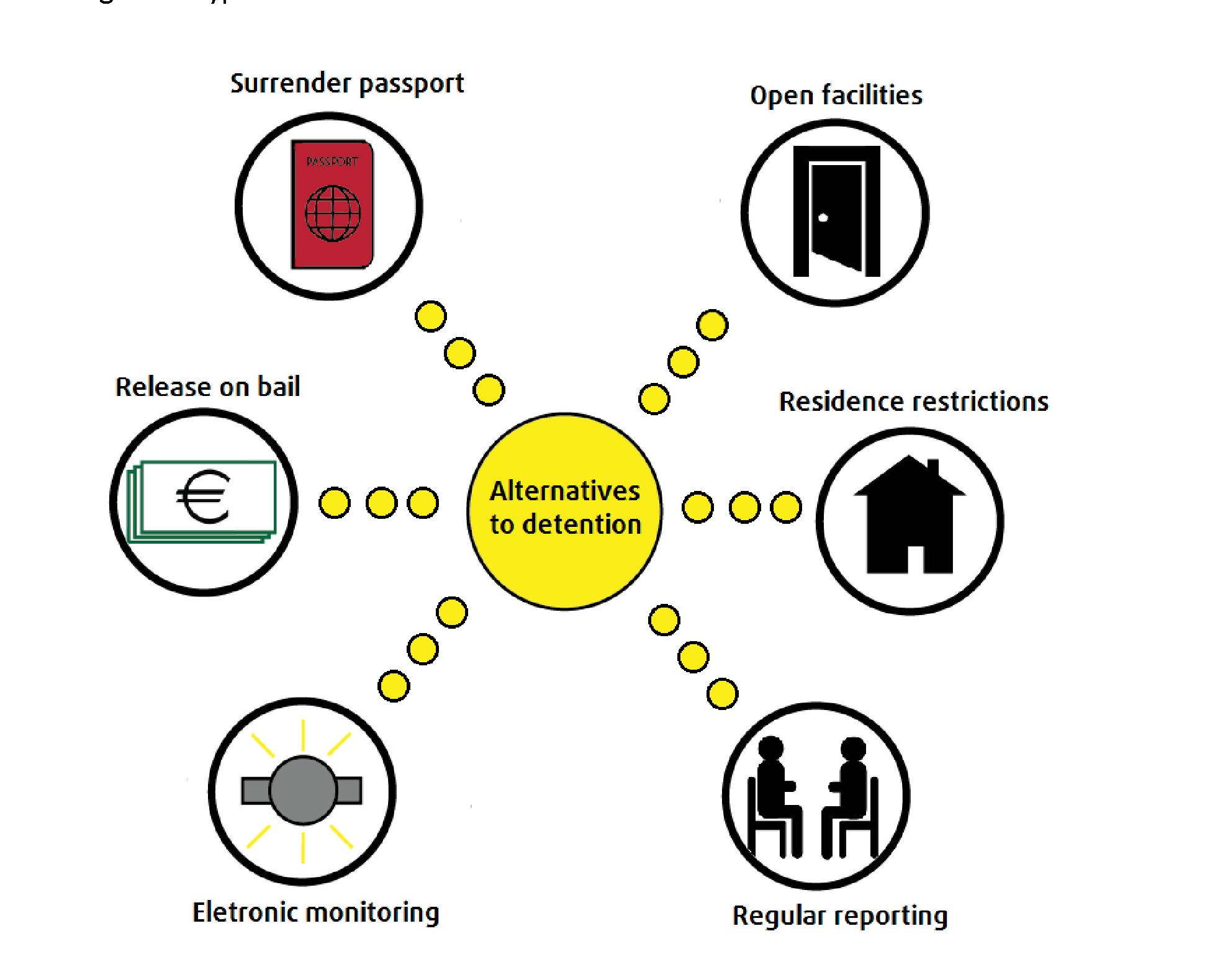
The alternatives, many of which can be used in combination with each other, can be broadly grouped under the following categories:

Obligation to surrender passports or travel documents
This obligation may be imposed alone or together with other alternatives, such as the duty to stay in a particular location or area. It is a soft measure that essentially serves to ensure that valid identity and travel documents are not lost or destroyed during the time required to prepare the return and removal process.

Residence restrictions
Such restrictions impose the duty of remaining at a particular address or residing within a specific geographical area, often combined with regular reporting requirements. The designated places can be open or semi-open facilities run by the government or NGOs, as well as hotels, hostels or private addresses. The regime imposed can vary, but people generally have to be present at the designated location at certain times, while absences are usually only allowed with a well-founded justification.

Release on bail and provision of sureties by third parties
In the context of criminal law, it is not uncommon to allow the release of a detained person on condition of bail, which will be forfeited if the person does not report to the authorities. Release based on financial guarantees is infrequently used in asylum and pre-removal proceedings, partly because it is assumed that many asylum seekers or third-country nationals in return procedures would not have the necessary means to put up bail.

Regular reporting to the authorities
This alternative obliges people to report to the police or immigration authorities at regular intervals, and is one of the more frequent alternatives to detention found in national legislation. Reporting duties on a daily, bi-weekly, weekly or even less frequent basis may also be imposed as an additional requirement to the obligation to reside in a specified area or location.

Placement in open facilities with caseworker support
This is an innovative alternative to detention that combines classical social work with time spent at designated places. Asylum seekers or people in return procedures are placed in open facilities and provided with individual coaches or counsellors to inform and advise them about their situation and options. This form of alternative was established following evidence that compliance with a return decision depends on the level of trust the person affected by the decision has in the authorities of the host country. Such trust is created through individual counselling and contacts with external actors, such as NGOs.

Electronic monitoring
Electronic monitoring or tagging is primarily used in the context of criminal law. Its use as a substitute for immigration detention is limited. Electronic monitoring is the most intrusive of the various alternatives to detention, as it substantially interferes with a person’s right to privacy, restricts freedom of movement and can have a negative impact on their dignity. It can also lead to discrimination through the potential association of people wearing an electronic device with criminals.

AlternativeDetention

Source: FRA (2015)

Significant attention has been devoted to alternatives to immigration detention in recent years. This has resulted both in a great deal of comparative research and in the developments of tools and other guidance to promote the use of alternatives. This compilation is aimed at policy makers and practitioners entrusted with the task of promoting the use of alternatives to detention and seeks to facilitate the usage of existing materials. It presents various instruments and research material, together with the general human rights and EU legal framework. The first section covers the international framework that safeguards the right to liberty, while those that follow focus specifically on alternatives to detention. The compilation sets out selected:

  • instruments on the right to liberty
  • non-binding United Nations instruments on alternatives to detention
  • non-binding Council of Europe instruments on alternatives to detention
  • European Union law provisions relating to alternatives to detention
  • case law from the European Court of Human Rights, the Court of Justice of the EU and the United Nations Human Rights Committee on alternatives to detention
  • recently developed tools
  • research publications.

The selected instruments are presented by category, beginning with legal instruments (binding and non-binding), and then continuing to case law, expert guidelines and research papers. The left column of each table lists the documents in question with an embedded hyperlink to the full text. The right column reproduces key excerpts from these documents, with additional explanations in italics where relevant. A short introduction precedes each table.

Using alternatives to detention benefits both the state and migrants, as on the one hand they are more cost-effective and on the other they are less intrusive and more respectful of fundamental right than deprivation of liberty. Although virtually all EU Member States provide for the possibility of alternatives to detention (current reforms in Malta are expected to introduce fully-fledged alternatives in the near future), they are still too little applied and when they are, it is primarily in cases involving particularly vulnerable people. Several EU Member States do not yet collect statistics on alternatives to detention, which makes it difficult to assess the extent to which they are used in reality.

Compilation of key resources to promote the use of alternatives to immigration detention in practice
1. Right to liberty: selected instruments
2. Alternatives to detention: selected instruments
2.1.  Selected non-binding United Nations (UN) instruments relating to alternatives to detention
– United Nations General Assembly
– General comments by UN treaty bodies
– Executive Committee of the High Commissioner’s Programme (ExCom)
– UN Working Group on Arbitrary Detention
– Special Rapporteur on the human rights of migrants
– Special Rapporteur on torture and other cruel, inhuman or degrading treatment or punishment…
– Selected non-binding Council of Europe instruments relating to alternatives to detention
– Selected European Union law on alternatives to detention
3. Alternatives to detention: selected case law
– European Court of Human Rights (ECtHR)
– Court of Justice of the European Union (CJEU)
– United Nations Human Rights Committee (HRC)
4. Alternatives to detention: tools
5.Selected research documents
Useful links CONTINUE READING (from page 6 of the FRA Study…)

THE PARTY’S OVER: EU DATA PROTECTION LAW AFTER THE SCHREMS SAFE HARBOUR JUDGMEN

ORIGINAL PUBLISHED ON EU LAW ANALYSIS (on Wednesday, 7 October 2015)

by Steve Peers

The relationship between intelligence and law enforcement agencies (and companies like Google and Facebook) and personal data is much like the relationship between children and sweets at a birthday party. Imagine you’re a parent bringing out a huge bowl full of sweets (the personal data) during the birthday party – and then telling the children (the agencies and companies) thatthey can’t have any. But how can you enforce this rule? If you leave the room, even for a moment, the sweets will be gone within seconds, no matter how fervently you insist that the children leave them alone while you’re out. If you stay in the room, you will face incessant and increasingly shrill demands for access to the sweets, based on every conceivable self-interested and guilt-trippy argument. If you try to hide the sweets, the children will overturn everything to find them again.

When children find their demands thwarted by a strict parent, they have a time-honoured circumvention strategy: “When Mummy says No, ask Daddy”. But in the Safe Harbour case, things have happened the other way around. Mummy (the Commission) barely even resisted the children’s demands. In fact, she said Yes hours ago, and retired to the bath with an enormous glass of wine, occasionally shouting out feeble admonitions for the children to tone down their sugar-fuelled rampage. Now Daddy (the CJEU) is home, shocked at the chaos that results from lax parenting. He has immediately stopped the supply of further sweets. But the house is full of other sugary treats, and all the children are now crying. What now?

In this post, I’ll examine the reasons why the Court put its foot down, and invalidated the Commission’s ‘Safe Harbour’ decision which allows transfers of personal data to the USA, in the recent judgment in Schrems. Then I will examine the consequences of the Court’s ruling. But I should probably admit for the record that my parenting is more like Mummy’s than Daddy’s in the above example.

Background

For more on the background to the Schrems case, see here; on the hearing, see Simon McGarr’s summary here; and on the Advocate-General’s opinion, seehere. But I’ll summarise the basics of the case again briefly.

Max Schrems is an Austrian Facebook user who was disturbed by Edward Snowden’s revelations about mass surveillance by US intelligence agencies. Since he believed that transfers of his data to Facebook were subject to such mass surveillance, he complained to the Irish data protection authority, which regulates Facebook’s transfers of personal data from the EU to the USA.

The substantive law governing these transfers of personal data was the ‘Safe Harbour’ agreement between the EU and the USA, agreed back in 2000. This agreement was put into effect in the EU by a decision of the Commission, which was adopted pursuant to powers conferred upon the Commission by the EU’s current data protection Directive. The latter law gives the Commission the power to decide that transfers of personal data outside the EU receive an ‘adequate level of protection’ in particular countries.

The ‘Safe Harbour’ agreement was enforced by self-certification of the companies that have signed up for it (note that not all transfers to the USA fell within the scope of the Safe Harbour decision, since not all American companies signed up). Those promises were in turn meant to be enforced by the US authorities. But it was also possible (not mandatory) for the national data protection authorities which enforce EU data protection law to suspend transfers of personal data under the agreement, if the US authorities or enforcement system found a breach of the rules, or on a list of limited grounds set out in the decision.

The Irish data protection authority refused to consider Schrems’ complaint, so he challenged that decision before the Irish High Court, which doubted that this system was compatible with EU law (or indeed the Irish constitution). So that court asked the CJEU to rule on whether national data protection authorities (DPAs) should have the power to prevent data transfers in cases like these.

The judgment

The CJEU first of all answers the question which the Irish court asks about DPA jurisdiction over data transfers (the procedural point), and then goes on to rule that the Safe Harbour decision is invalid (the substantive point).

Following the Advocate-General’s view, the Court ruled that national data protection authorities have to be able to consider claims that flows of personal data to third countries are not compatible with EU data protection laws if there is an inadequate level of data protection in those countries, even if the Commission has adopted a decision (such as the Safe Harbour decision) declaring that the level of protection is adequate. Like the Advocate-General, the Court based this conclusion on the powers and independence of those authorities, read in light of the EU Charter of Fundamental Rights, which expressly refers to DPAs’ role and independence. (On the recent CJEU case law on DPA independence, see discussion here). In fact, the new EU data protection law currently under negotiation (the data protection Regulation) will likely confirm and even enhance the powers and independence of DPAs. (More on that aspect of the proposed Regulation here).

The Court then elaborates upon the ‘architecture’ of the EU’s data protection system as regards external transfers. It points out that either the Commission or Member States can decide that a third country has an ‘adequate’ level of data protection, although it focusses its analysis upon what happens if (as in this case) there is a Commission decision to this effect. In that case, national authorities (including DPAs) are bound by the Commission decision, and cannot issue a contrary ruling.

However, individuals like Max Schrems can still complain to the DPAs about alleged breaches of their data protection rights, despite the adoption of the Commission decision. If they do so, the Court implies that the validity of the Commission’s decision is therefore being called into question. While all EU acts must be subject to judicial review, the Court reiterates the usual rule that national courts can’t declare EU acts invalid, since that would fragment EU law: only the CJEU can do that. This restriction applies equally to national DPAs.

So how can a Commission decision on the adequacy of third countries’ data protection law be effectively challenged? The Court explains that DPAs must consider such claims seriously. If the DPA thinks that the claim is unfounded, the disgruntled complainant can challenge the DPA’s decision before the national courts, who must in turn refer the issue of the validity of the decision to the CJEU if they think it may be well founded. If, on the other hand, the DPA thinks the complaint is well-founded, there must be rules in national law allowing the DPA to go before the national courts in order to get the issue referred to the CJEU.

The Court then moves on to the substantive validity of the Safe Harbour decision. Although the national court didn’t ask it to examine this issue, the Court justifies its decision to do this by reference to its overall analysis of the architecture of EU data protection law, as well as the national court’s doubts about the Safe Harbour decision. Indeed, the Court is effectively putting its new architecture into use for the first time, and it’s quite an understatement to say that the national court had doubts about Safe Harbour (it had compared surveillance in the USA to that of Communist-era East Germany).

So what is an ‘adequate level of protection’ for personal data in third countries? The Court admits that the Directive is not clear on this point, so it has to interpret the rules. In the Court’s view, there must be a ‘high’ level of protection in the third country; this does not have to be ‘identical’ to the EU standard, but must be ‘substantially equivalent’ to it.  Otherwise, the objective of ensuring a high level of protection would not be met, and the EU’s internal standards for domestic data protection could easily be circumvented. Also, the means used in the third State to ensure data protection rights must be ‘effective…in practice’, although they ‘may differ’ from that in the EU. Furthermore, the assessment of adequacy must be dynamic, with regular automatic reviews and an obligation for a further review if evidence suggests that there are ‘doubts’ on this score; and the general changes in circumstances since the decision was adopted must be taken into account.

The Court then establishes that in light of the importance of privacy and data protection, and the large number of persons whose rights will be affected if data is transferred to a third country with an inadequate level of data protection, the Commission has reduced discretion, and is subject to ‘strict’ standards of judicial review. Applying this test, two provisions of the ‘Safe Harbour’ decision were invalid.

First of all, the basic decision declaring adequate data protection in the USA (in the context of Safe Harbour) was invalid. While such a decision could, in principle, be based on self-certification, this had to be accompanied by ‘effective detection and supervision mechanisms’ ensuring that infringements of fundamental rights had to be ‘identified and punished in practice’. Self-certification under the Safe Harbour rules did not apply to US public authorities; there was not a sufficient finding that the US law or commitments met EU standards; and the rules could be overridden by national security requirements set out in US law.

Data protection rules apply regardless of whether the information is sensitive, or whether there were adverse consequences for the persons concerned. The Decision had no finding concerning human rights protections as regards the national security exceptions under US law (although the CJEU acknowledged that such rules pursued a legitimate objective), or effective legal protection in that context. This was confirmed by the Commission’s review of the Safe Harbour decision, which found (a) that US authorities could access personal data transferred from the EU, and then process it for purposes incompatible with the original transfer ‘beyond what was strictly necessary and proportionate for the purposes of national security’, and (b) that there was no administrative or judicial means to ensure access to the data and its rectification or erasure.

Within the EU, interference with privacy and data protection rights requires ‘clear and precise rules’ which set out minimum safeguards, as well as strict application of derogations and limitations.  Those principles were breached where, ‘on a generalised basis’, legislation authorises ‘storage of all the personal data of all the persons whose data has been transferred’ to the US ‘without any differentiation, limitation or exception being made in light of the objective pursued’ and without any objective test limiting access of the public authorities for specific purposes. General access to the content of communications compromises the ‘essence’ of the right to privacy. On these points, the Court expressly reiterated the limits on mass surveillance set out in last year’s Digital Rights judgment (discussed here) on the validity of the EU’s data retention Directive. Furthermore, the absence of legal remedies in this regard compromises the essence of the right to judicial protection set out in the EU Charter. But the Commission made no findings to this effect.

Secondly, the restriction upon DPAs taking action to prevent data transfers in the event of an inadequate level of data protection in the USA (in the context of Safe Harbour) was also invalid. The Commission did not have the power under the data protection Directive (read in light of the Charter) to restrict DPA competence in that way. Since these two provisions were inseparable from the rest of the Safe Harbour decision, the entire Decision is invalid. The Court did not limit the effect of its ruling.

Comments

The Court’s judgment comes to the same conclusion as the Advocate-General’s opinion, but with subtle differences that I’ll examine as we go along. On the first issue, the Court’s finding that DPAs must be able to stop data flows if there is a breach of EU data protection laws in a third country, despite an adequacy Decision by the Commission, is clearly the correct result. Otherwise it would be too easy for the standards in the Directive to be undercut by means of transfers to third countries, which the Commission or national authorities might be willing to accept as a trade-off for a trade agreement or some other quid pro quowith the country concerned.

As for the Court’s discussion of the architecture of the data protection rules, the idea of the data protection authorities having to go to a national court if they agree with the complainant that the Commission’s adequacy decision is legally suspect is rather convoluted, since it’s not clear who the parties would be: it’s awkward that the Commission itself would probably not be a party.  It’s unfortunate that the Court did not consider the alternative route of the national DPA calling on the Commission to amend its decision, and bringing a ‘failure to act’ proceeding directly in the EU courts if it did not do so. In the medium term, it would be better for the future so-called ‘one-stop shop’ system under the new data protection Regulation (see discussion here) to address this issue, and provide for a centralised process of challenging the Commission directly.

It’s interesting that the CJEU finds that there can be a national decision on adequacy of data flows to third States, since there’s no express reference to this possibility in the Directive. If such a decision is adopted, or if Member States apply the various mandatory and optional exceptions from the general external data protection rules set out in Article 26 of the data protection Directive, much of the Court’s Schrems ruling would apply in the same way by analogy. In particular, national DPAs must surely have the jurisdiction to examine complaints about the validity of such decisions too. But EU law does not prohibit the DPAs from finding the national decisions invalid; the interesting question is whether it obliges national law to confer such power upon the DPAs. Arguably it does, to ensure the effectiveness of the EU rules. Any decisions on these issues could still be appealed to the national courts, which would have the option (though not the obligation, except for final courts) to ask the CJEU to interpret the EU rules.

As for the validity of the Safe Harbour Decision, the Court’s interpretation of the meaning of ‘adequate’ protection in third States should probably be sung out loud, to the tune of ‘We are the World’. The global reach of the EU’s general data protection rules was already strengthened by last year’s Google Spain judgment (discussed here); now the Court declares that even the separate regime for external transfers is very similar to the domestic regime anyway. There must be almost identical degrees of protection, although the Court does hint that modest differences are permissible: accepting the idea of self-certification, and avoiding the issue of whether third States need an independent DPA (the Advocate-General had argued that they did).

It’s a long way from the judgment in Lindqvist over a decade ago, when the Court anxiously insisted that the external regime should not be turned into a copy of the internal rules; now it’s insistent that there should be as little a gap as possible between them. With respect, the Court’s interpretation is not convincing, since the word ‘adequate’ suggests something less than ‘essentially equivalent’, and the EU Charter does not bind third States.

But having said that, the American rules on mass surveillance would violate even a far more generous interpretation of the meaning of the word ‘adequate’. It’s striking that (unlike the Advocate-General), the Court does not engage in a detailed interpretation of the grounds for limiting Charter rights, but rather states that general mass surveillance of the content of communications affects the ‘essence’ of the right to privacy. That is enough to find an unjustifiable violation of the Charter.

So where does the judgment leave us in practice? Since the Court refers frequently to the primary law rules in the Charter, there’s no real chance to escape what it says by signing new treaties (even the planned TTIP or TiSA), by adopting new decisions, or by amending the data protection Directive. In particular, the Safe Harbour decision is invalid, and the Commission could only replace it with a decision that meets the standards set out in this judgment. While the Court refers at some points to the inadequacy or non-existence of the Commission’s findings in the Decision, it’s hard to believe that a new Decision which purports to claim that the American system now meets the Court’s standards would be valid if the Commission were not telling the truth (or if circumstances subsequently changed).

What standards does the US have to meet? The Court reiterates even more clearly that mass surveillance is inherently a problem, regardless of the safeguards in place to limit its abuse. Indeed, as noted already, the Court ruled that mass surveillance of the content of communications breaches the essence of the right to privacy and so cannot be justified at all. (Surveillance of content which is targeted on suspected criminal activities or security threats is clearly justifiable, however). In addition to a ban on mass surveillance, there must also be detailed safeguards in place. The US might soon be reluctantly willing to address the latter, but it will be even more unwilling to address the former.

Are there other routes which could guarantee that external transfers to the USA take place, at least until the US law is changed? In principle, yes, since (as noted above) there are derogations from the general rule that transfers can only take place to countries with an ‘adequate’ level of data protection. A first set of derogations is mandatory (though Member States can have exceptions in ‘domestic law governing particular cases’): where the data subject gives ‘consent unambiguously’; where the transfer is necessary to perform a contract with (or in the interest of) the data subject, or for pre-contractual relations; where it’s ‘necessary or legally required on important public interest grounds’, or related to legal claims; where it’s ‘necessary to protect the vital interests of the data subject’; or where it’s made from a public register. A second derogation is optional: a Member State may authorise transfers where the controller offers sufficient safeguards, possibly in the form of contractual clauses. The use of the latter derogation can be controlled by the Commission.

It’s hard to see how the second derogation can be relevant, in light of the Court’s concerns about the sufficiency of safeguards under the current law. US access to the data is not necessary in relation to a contract, to protect the data subject, or related to legal claims.  An imaginative lawyer might argue that a search engine (though not a social network) is a modern form of public register; but the record of an individual’s use of a search engine is not.

This leaves us with consent and public interest grounds. Undoubtedly (as the CJEU accepted) national security interests are legitimate, but in the context of defining adequacy, they do not justify mass surveillance or insufficient safeguards. Would the Court’s ruling in Schrems still apply fully to the derogation regarding inadequate protection? Or would it apply in a modified way, or not at all?

As for consent, the CJEU ruled last year in a very different context (credibility assessment in LGBT asylum claims) that the rights to privacy and dignity could not be waived in certain situations (see discussion here). Is that also true to some extent in the context of data protection? And what does unambiguous consent mean exactly? Most people believe they are consenting only to (selected) people seeing what they post on Facebook, and are dimly aware that Facebook might do something with their data to earn money. They may be more aware of mass surveillance since the Snowden revelations; some don’t care, but some (like Max Schrems) would like to use Facebook without such surveillance. Would people have to consent separately to mass surveillance? In that case, would Facebook have to be accessible for those who did not want to sign that separate form? Or could a ‘spy on me’ clause be added at the end of a long (and unread) consent form?  Consent is a crucial issue also in the context of the purely domestic EU data protection rules.

The Court’s ruling has addressed some important points, but leaves an enormous number of issues open. It’s clear that it will take a long time to clear up the mess left from this particular poorly supervised party.

Barnard and Peers: chapter 9

THE CJEU’S RULING IN CELAJ: CRIMINAL PENALTIES, ENTRY BANS AND THE RETURNS DIRECTIVE

ORIGINAL PUBLISHED ON EU LAW ANALYSIS (Tuesday, 6 October 2015)

By Izabella Majcher, Associate Researcher at Global Detention Project and PhD candidate in International Law at the Graduate Institute of International and Development Studies is Geneva.

In its ruling in the Skerdjan Celaj case (C-290/14), rendered on 1st October 2015, the Court of Justice of the European Union (CJEU) addressed once again the relation between immigration and criminal law and in particular the compatibility of national penal measures imposed as a punishment for irregular migration with the EU Returns Directive. In the previous cases touching upon this issue, the Court assessed whether the Directive allowed states to penalize non-compliance with a return order or irregular stay itself with imprisonment (El Dridi andAchughbabian, respectively) and with home detention (Sagor) as a criminal law penalty (as distinct from administrative law detention, which is expressly regulated by the Directive). In turn, in Celaj the Luxembourg judges were requested to consider whether a criminal law sentence of imprisonment imposed for a breach of a re-entry ban was compatible with the Returns Directive.

As defined in Article 3(6) of the Directive, an “entry ban” means an “administrative or judicial decision or act prohibiting entry into and stay on the territory of the Member States for a specified period, accompanying a return decision.”

The Case

Mr Celaj was arrested by Italian police in August 2011 for attempted robbery. In April 2012 he was issued a removal order accompanied by a three-year entry ban and left Italian territory some five months later. Subsequently Mr Celaj re-entered Italy and was apprehended by the police in February 2014. The public prosecutor then brought criminal law proceedings against him and sought a term of imprisonment of eight months for the breach of the entry-ban. The District Florence Court, before whom the proceedings were brought, decided to stay the proceedings and refer the question to the Luxembourg Court for a preliminary ruling. The referring court asked the CJEU whether the Returns Directive precludes domestic legislation penalizing re-entry in breach of an entry ban with a prison sentence up to four years. The Court found that it does not.

The Court did not follow the Opinion of Advocate General (AG) Szpunar, issued in April 2015. The AG based his Opinion on the effectiveness and the main objective of the Returns Directive, which is the return of undocumented non-EU citizens. These arguments had been developed by the Court in a line of case-law addressing the relation between domestic penal sanctions and the Directive. Indeed, in El Dridi (§ 58) the Court ruled that imprisonment as a criminal law penalty for the failure to leave the country during the voluntary departure period was not compatible with the Returns Directive. In Achughbabian (§ 45) it found that the Directive also precluded imprisonment as a criminal law penalty for irregular stay itself if ordered prior to starting removal proceedings or during such proceedings. The underlying justification of the Court’s conclusions in both cases was that a term of imprisonment as a criminal law penalty would delay the removal of the person concerned and thus jeopardize the objective pursued by the Directive (El Dridi, § 59; Achughbabian, § 45). The ruling in Sagor (§ 45) shows that not only prison sentences but even home detention during return proceedings as a criminal law penalty risks delaying deportation and thus should not be imposed. The AG thus invited the Court to follow its well-established case-law and declare that imprisonment for a breach of entry ban as a criminal law penalty is incompatible with the Directive because it would delay return of the person concerned (§ 6).

Yet, the Court ruled that the Returns Directive does not preclude domestic legislation which provides for a prison sentence as a criminal law penalty for non-EU citizens who unlawfully re-enter the country in breach of an entry ban (§25 and 33). The CJEU did reiterate that the objective of the Directive would be undermined if removal would be delayed by a criminal prosecution leading to a term of imprisonment, as ruled in El Dridi, Achughbabian, and Sagor (§ 26). However, it found that the circumstances in the Celaj case were “clearly distinct” from those inEl Dridi and Achughbabian. This distinction, in the Court’s opinion, was due to the fact that, unlike Mr Celaj, the non-citizens concerned in El Dridi and Achughbabianwere subject to a first return procedure (§ 28). The Court also added that, in line with the second indent of its ruling in Achughbabian, the Directive does not preclude penal sanctions as a criminal law penalty to be imposed on a migrant who has been subject to a return procedure but stays in an irregular manner in the member state (§ 29).

Comments

Were the circumstances in Celaj so “clearly distinct” from those in El Dridi andAchughbabian to justify such a different conclusion? Does it fundamentally matter that those cases dealt with a first return procedure? Every return procedure regulated by the Directive has essentially the same goal – the swift removal of the non-EU citizen concerned. It appears thus irrelevant whether return is pursued because of irregular entry or irregular re-entry.

Under Article 6(1) of the Directive member states are required to issue a return decision to every migrant in irregular situation, subject to some exceptions. As highlighted by the AG (§ 42, 49, and 50), this duty is persistent and continuous. This means that each time a non-EU citizen finds himself or herself on the State territory without permission, the authorities should start a return procedure by issuing a return decision. Thus, in line with the rules under the Directive, a non-EU citizen who has re-entered the Member State unlawfully should be liable to a new return decision rather than criminal proceedings which may postpone his or her ultimate removal. This finding is also supported by the Court’s ruling inAchughbabian (§ 45) where it held that the obligation incumbent on states to conduct removal shall be fulfilled as soon as possible and thus states should not carry out criminal proceedings involving custodial penalties not only prior to theimplementation of the return decision, but also prior to the adoption of such a decision.

Strikingly, the CJEU did not consider at all whether criminal proceedings against Mr Celaj would delay his return. This omission is hardly consistent with the Court’s well established case-law which attaches pivotal importance to the effectiveness of the procedures regulated under the Directive (El Dridi, § 55; Achughbabian, § 39;Sagor, § 32). It is easily foreseeable that after serving his prison sentence, Mr Celaj will be issued with a return decision. The term of imprisonment as a criminal law penalty will inevitably delay his return and thus jeopardize the very objective of the Returns Directive.

Likewise, the second, somehow auxiliary, argument advanced by the Luxembourg judges is not wholly convincing. True, in line with the second indent of the ruling inAchughbabian (§ 51) states may impose a criminal law prison sentence on a non-EU citizen to whom a return procedure has been applied but who stays in an irregular manner in the Member State. However, as pointed out by the AG (§ 61), to be compatible with the main part of the ruling, this conclusion should only cover situations where authorities did not succeed in returning the person concerned, who then continues to stay on the state’s territory. The second indent in the judgment in Achughbabian should thus have no bearing on Celaj where the non-EU citizen concerned left the country, thus return proceedings reached their goal. Following his irregular re-entry, he should be liable to a new return procedure.

The judgment in Celaj appears not consistent with the CJEU’s well-established jurisprudence on the interplay between domestic penal sanctions and the effectiveness of return policy as laid down in the Returns Directive. The Court relied on an apparent clear distinction between return proceedings imposed for irregular entry and subsequent re-entry in breach of an entry ban. As discussed above, the wording of the provisions of the Returns Directive, supported by the underlying objective of the Directive repetitively stressed in the Court’s previous rulings, does not warrant finding such a distinction. The “distinction” argument had been advanced by the European Commission and intervening governments during the proceedings. They stressed that the circumstances in re-entry cases are distinct because penal sanctions could be imposed to dissuade migrants from breaching re-entry bans (AG’s Opinion, § 46). So the “distinction” argument – which was central to the Court’s conclusion – relies on states’ deterrence-oriented concerns rather than considerations based on the provisions and objective of the Returns Directive. The ruling in Celaj seems thus to compromise on the effectiveness of the Directive in order to accord discretion to states to apply their domestic criminal provisions to deter and punish migrants for breaching re-entry ban.

What is the nature of the entry ban whose breach states are now explicitly allowed to punish with criminal law imprisonment? As noted above, Article 3(6) of the Directive defines an entry ban as a prohibition of re-entry to the host state (or other Member States) for a specified period of time. In Article 11(1) the Directive obliges states to impose an entry ban on a non-EU citizen who has not been granted the possibility of voluntary departure or has not complied with a return decision. Since the Directive provides for broad circumstances for refusal of a voluntary departure period (Article 7(4); see discussion of the case law on this issue here) and does not explicitly prohibit states from issuing a return decision on non-refoulement and family or private life grounds (the Directive merely allows states grant a residence permit on humanitarian or other reasons, in Article 6(4)), in practice Article 11(1) may entail that entry bans are imposed in a systematic way. This risk is amplified by the same provision as it allows states to apply a ban on re-entry also in “other cases.”

In practice, as the Evaluation on the application of the Returns Directive, commissioned by the European Commission, shows, the legislation of almost 40 percent of the countries bound by the Directive provides for an automatic application of entry bans on all return decisions. A recent European Migration Network’s study Good Practices in the return and reintegration of irregular migrants demonstrates the scale of the use of entry bans. In 2013 more than 125,000 entry bans were imposed in the EU. Compared to the total number of return decisions that year (see Eurostat), these figures evince that the member states accompany a considerable proportion of return decisions with entry bans, including Greece (almost 100 %), Poland (80 %), or Sweden (70 %). It appears thus that entry bans are systematically applied in practice.

States are free not to impose or withdraw an entry ban for humanitarian or other reasons (article 11(3)). They are however not obligated to waive the entry ban requirement in such cases – it lies within their discretion. While the Directive clarifies that entry bans shall not prejudice the right to international protection (Article 11(5)), this assertion should be translated into a clear obligation on states not to impose the ban where the protection from non-refoulement could be impaired. The severity of this entry ban is further strengthened by its length. The Directive allows a five-year duration of an entry ban (article 11(2)). The above mentioned Commission study highlights that the majority of states issue entry bans for this maximum permitted period of time. In addition, states may apply a longer ban (the time period of which is not limited by the Directive), if they judge that the person concerned represents a serious threat to public policy or national security (Article 11(2)).

Thus, potentially the majority of non-EU citizens liable to return are prohibited for prolonged periods to re-enter the host state or even the whole EU, if the entry ban has been registered in the Schengen Information System (SIS). An entry ban is thus a harsh and coercive measure, which is a deterrent in itself and potentially conflicts with migrants’ fundamental rights. It cannot be ruled out that a non-EU citizen will be obliged to re-enter, where prompted by his family links, disrupted by deportation, or changes in the situation in his country of origin. While, as noted above, states may withdraw an entry ban, they are nevertheless not obliged to do so. Imposition of a criminal law prison sentence for breach of an entry ban, as permitted in Celaj, appears thus disproportionate and unnecessary. States may use other available methods to punish this breach, such as an extension of an existing ban. More generally, criminalization of breaches of (administrative) immigration law risks creating a conflation between (non-punitive) immigration law and criminal law, with negative consequences for migrants, and an undue overburden to the criminal justice system.

Barnard & Peers: chapter 26

The Court of Justice declares that the Commission’s US Safe Harbour Decision is invalid

Court of Justice of the European Union PRESS RELEASE No 117/15

SEE THE TEXT OF JUDGMENT HERE

Luxembourg, 6 October 2015

Judgment in Case C-362/14 Maximillian Schrems v Data Protection Commissioner

Whilst the Court of Justice alone has jurisdiction to declare an EU act invalid, where a claim is lodged with the national supervisory authorities they may, even where the Commission has adopted a decision finding that a third country affords an adequate level of protection of personal data, examine whether the transfer of a persons data to the third country complies with the requirements of the EU legislation on the protection of that data and, in the same way as the person concerned, bring the matter before the national courts, in order that the national courts make a reference for a preliminary ruling for the purpose of examination of that decisions validity

The Data Protection Directive1 provides that the transfer of personal data to a third country may, in principle, take place only if that third country ensures an adequate level of protection of the data. The directive also provides that the Commission may find that a third country ensures an adequate level of protection by reason of its domestic law or its international commitments. Finally, the directive provides that each Member State is to designate one or more public authorities responsible for monitoring the application within its territory of the national provisions adopted on the basis of the directive (‘national supervisory authorities’).

Maximillian Schrems, an Austrian citizen, has been a Facebook user since 2008. As is the case with other subscribers residing in the EU, some or all of the data provided by Mr Schrems to Facebook is transferred from Facebook’s Irish subsidiary to servers located in the United States, where it is processed. Mr Schrems lodged a complaint with the Irish supervisory authority (the Data Protection Commissioner), taking the view that, in the light of the revelations made in 2013 by Edward Snowden concerning the activities of the United States intelligence services (in particular the National Security Agency (‘the NSA’)), the law and practice of the United States do not offer sufficient protection against surveillance by the public authorities of the data transferred to that country. The Irish authority rejected the complaint, on the ground, in particular, that in a decision of 26 July 20002 the Commission considered that, under the ‘safe harbour’ scheme,3 the United States ensures an adequate level of protection of the personal data transferred (the Safe Harbour Decision).

The High Court of Ireland, before which the case has been brought, wishes to ascertain whether that Commission decision has the effect of preventing a national supervisory authority from investigating a complaint alleging that the third country does not ensure an adequate level of protection and, where appropriate, from suspending the contested transfer of data.

In today’s judgment, the Court of Justice holds that the existence of a Commission decision finding that a third country ensures an adequate level of protection of the personal data transferred cannot eliminate or even reduce the powers available to the national supervisory authorities under the Charter of Fundamental Rights of the European Union and the directive. The Court stresses in this regard the right, guaranteed by the Charter, to the protection of personal data and the task with which the national supervisory authorities are entrusted under the Charter.

The Court states, first of all, that no provision of the directive prevents oversight by the national supervisory authorities of transfers of personal data to third countries which have been the subject of a Commission decision. Thus, even if the Commission has adopted a decision, the national supervisory authorities, when dealing with a claim, must be able to examine, with complete independence, whether the transfer of a persons data to a third country complies with the requirements laid down by the directive. Nevertheless, the Court points out that it alone has jurisdiction to declare that an EU act, such as a Commission decision, is invalid. Consequently, where a national authority or the person who has brought the matter before the national authority considers that a Commission decision is invalid, that authority or person must be able to bring proceedings before the national courts so that they may refer the case to the Court of Justice if they too have doubts as to the validity of the Commission decision. It is thus ultimately the Court of Justice which has the task of deciding whether or not a Commission decision is valid.

The Court then investigates whether the Safe Harbour Decision is invalid. In this connection, the Court states that the Commission was required to find that the United States in fact ensures, by reason of its domestic law or its international commitments, a level of protection of fundamental rights essentially equivalent to that guaranteed within the EU under the directive read in the light of the Charter. The Court observes that the Commission did not make such a finding, but merely examined the safe harbour scheme.

Without needing to establish whether that scheme ensures a level of protection essentially equivalent to that guaranteed within the EU, the Court observes that the scheme is applicable solely to the United States undertakings which adhere to it, and United States public authorities are not themselves subject to it. Furthermore, national security, public interest and law enforcement requirements of the United States prevail over the safe harbour scheme, so that United States undertakings are bound to disregard, without limitation, the protective rules laid down by that scheme where they conflict with such requirements. The United States safe harbour scheme thus enables interference, by United States public authorities, with the fundamental rights of persons, and the Commission decision does not refer either to the existence, in the United States, of rules intended to limit any such interference or to the existence of effective legal protection against the interference.

The Court considers that that analysis of the scheme is borne out by two Commission communications,4 according to which the United States authorities were able to access the personal data transferred from the Member States to the United States and process it in a way incompatible, in particular, with the purposes for which it was transferred, beyond what was strictly necessary and proportionate to the protection of national security. Also, the Commission noted that the persons concerned had no administrative or judicial means of redress enabling, in particular, the data relating to them to be accessed and, as the case may be, rectified or erased.

As regards a level of protection essentially equivalent to the fundamental rights and freedoms guaranteed within the EU, the Court finds that, under EU law, legislation is not limited to what is strictly necessary where it authorises, on a generalised basis, storage of all the personal data of all the persons whose data is transferred from the EU to the United States without any differentiation, limitation or exception being made in the light of the objective pursued and without an objective criterion being laid down for determining the limits of the access of the public authorities to the data and of its subsequent use. The Court adds that legislation permitting the public     authorities     to     have      access     on      a      generalised      basis     to      the     content      of      electronic communications must be regarded as compromising the essence of the fundamental right to respect for private life.

Likewise, the Court observes that legislation not providing for any possibility for an individual to pursue legal remedies in order to have access to personal data relating to him, or to obtain the rectification or erasure of such data, compromises the essence of the fundamental right to effective judicial protection, the existence of such a possibility being inherent in the existence of the rule of law.

Finally, the Court finds that the Safe Harbour Decision denies the national supervisory authorities their powers where a person calls into question whether the decision is compatible with the protection of the privacy and of the fundamental rights and freedoms of individuals. The Court holds that the Commission did not have competence to restrict the national supervisory authorities powers in that way.

For all those reasons, the Court declares the Safe Harbour Decision invalid. This judgment has the consequence that the Irish supervisory authority is required to examine Mr Schremscomplaint with all due diligence and, at the conclusion of its investigation, is to decide whether, pursuant to the directive, transfer of the data of Facebooks European subscribers to the United States should be suspended on the ground that that country does not afford an adequate level of protection of personal data.

NOTES

1 Directive 95/46/EC of the European Parliament and of the Council of 24 October 1995 on the protection of individuals with regard to the processing of personal data and on the free movement of such data (OJ 1995 L 281, p. 31).
2 Commission Decision 2000/520/EC of 26 July 2000 pursuant to Directive 95/46/EC of the European Parliament and of the Council on the adequacy of the protection provided by the safe harbour privacy principles and related frequently asked questions issued by the US Department of Commerce (OJ 2000 L 215, p. 7).
3 The safe harbour scheme includes a series of principles concerning the protection of personal data to which United States undertakings may subscribe voluntarily.
4 Communication from the Commission to the European Parliament and the Council entitled ‘Rebuilding Trust in EU-US Data Flows’ (COM(2013) 846 final, 27 November 2013) and Communication from the Commission to the European Parliament and the Council on the Functioning of the Safe Harbour from the Perspective of EU Citizens and Companies Established in the EU (COM(2013) 847 final, 27 November 2013).

NOTE: A reference for a preliminary ruling allows the courts and tribunals of the Member States, in disputes which have been brought before them, to refer questions to the Court of Justice about the interpretation of European Union law or the validity of a European Union act. The Court of Justice does not decide the dispute itself. It is for the national court or tribunal to dispose of the case in accordance with the Court’s decision, which is similarly binding on other national courts or tribunals before which a similar issue is raised.

Unofficial document for media use, not binding on the Court of Justice. The full text of the judgment is published on the CURIA website on the day of delivery. Press contact: Christopher Fretwell S (+352) 4303 3355 


Protection des données et relations transatlantiques : les conclusions de l’Avocat général dans l’affaire Schrems. Une fusée à plusieurs étages et une bombe à retardement…

PUBLISHED ON CDRE SITE ON 30 SEPTEMBRE 2015

par Sylvie Peyrou, (CDRE)

Les références imagées se pressent à l’esprit tant les conclusions de l’Avocat général Yves Bot s’avèrent riches – et lourdes de conséquences si la Cour de Justice s’avise de les suivre – dans cette affaire (C-362/14), où les mots « Facebook », « Prism », « NSA », protection des données, droit fondamental, qui émaillent le texte révèlent l’importance du contexte qui le sous-tend.

L’étudiant autrichien à l’origine du contentieux, Max Schrems, s’est plaint auprès de l’autorité irlandaise de protection des données de ce que ses données personnelles fournies à Facebook soient transférées, à partir de la filiale irlandaise de Facebook, sur des serveurs situés sur le territoire des Etats-Unis. Il estime en effet, eu égard aux révélations faites en 2013 par Edward Snowden dans le cadre de l’affaire « Prism », relative aux activités des services de renseignement des Etats-Unis (la NSA en particulier), que tant le droit que la pratique des Etats-Unis n’offrent aucune protection contre la surveillance par l’Etat américain des données transférées vers ce pays. Sa plainte toutefois a été rejetée au motif que la Commission européenne, par une décision du 26 juillet 2000 (2000/520/CE), a estimé que, dans le cadre du régime dit de la « sphère de sécurité (« Safe Harbor »), les Etats-Unis assurent un niveau adéquat de protection aux données personnelles transférées. La High Court of Ireland (Haute Cour de Justice irlandaise), saisie de l’affaire, a alors posé à la CJUE les questions de savoir si la décision « d’adéquation » de la Commission empêche nécessairement et obligatoirement une autorité nationale de contrôle d’enquêter sur une plainte alléguant qu’un pays tiers n’assure pas un niveau de protection adéquat, et éventuellement d’ordonner la suspension du transfert des données contestées.

Dans ses conclusions du 23 septembre, jouissant déjà d’un grand retentissement, l’Avocat général estime dans un premier temps que l’existence d’une décision de la Commission, constatant qu’un pays tiers assure un niveau de protection adéquat aux données à caractère personnel transférées, ne saurait annihiler ni même réduire les pouvoirs dont disposent les autorités nationales de contrôle en vertu de la directive 95/46/CE sur le traitement des données à caractère personnel. Et surtout, dans un second temps, et alors même que la question n’a pas été posée à la Cour, il considère que ladite décision de la Commission est invalide.

Ces conclusions aux raisonnements très logiques qui s’empilent comme les compartiments d’une même fusée, fourmillent de questions de principes auxquelles l’Avocat général apporte des réponses de principe, en convoquant tout le ban et l’arrière-ban des grandes jurisprudences de la Cour de ces dernières années : Kadi, N.S., Google Spain, Digital Rights Ireland…avec un point focal central : la protection des droits fondamentaux. Quel que soit l’angle d’attaque, le dossier semble donner raison à l’étudiant autrichien, car l’Avocat général constate clairement dans un premier temps que la décision d’adéquation ne lie pas les autorités nationales de contrôle en matière de protection des données, et – dans un contrôle à double détente – verrouille ensuite le dossier en estimant que, de toute façon, la décision d’adéquation de la Commission est invalide. Ces conclusions, si elles sont suivies, constituent une véritable bombe à retardement pour la matière.

I) Le caractère non contraignant de la décision « d’adéquation » de la Commission pour les autorités nationales de contrôle

Les questions soulevées dans cette affaire nécessitent d’analyser le cadre juridique existant s’agissant du transfert de données à caractère personnel vers des pays tiers à l’Union européenne. Celui-ci est fourni par la directive 95/46/CE relative à la protection des personnes physiques à l’égard du traitement des données à caractère personnel, texte fondamental en la matière pour le volet « marché intérieur » de l’UE. C’est en fait l’articulation entre diverses dispositions de ce texte que l’Avocat général est amené à mettre en lumière, occasion pour lui de réaffirmer la pleine indépendance des autorités nationales de contrôle.

   1. La question de l’articulation entre diverses dispositions de la directive 95/46/CE Continue reading “Protection des données et relations transatlantiques : les conclusions de l’Avocat général dans l’affaire Schrems. Une fusée à plusieurs étages et une bombe à retardement…”

Safe Harbor – No Future? How the General Data Protection Regulation and the rulings of the Court of Justice of the European Union (CJEU) will influence transatlantic data transfers

(ORIGINAL Posted on 1. Oktober 2015  in PETER SCHAAR. Der Blog. )

Ladies and gentlemen,

One week ago, the Advocate General at the Court of Justice of the European Union (CJEU) issued his vote on the Safe Harbor case of Max Schrems vs. the Irish Data Protection Commissioner.

Since 1995 when the General European Directive on Data Protection came into force, data transfers from the European Union and its member states to non-EU countries have been subject to specific privacy and security restrictions. Such restrictions do not exist only in Europe.

For example in the US several legal acts and decisions of regulatory authorities constitute the obligation to store specific data in the own country, in particular data, which have been generated by public bodies and providers of critical infrastructures. The US Federal Trade Commission has stated that a company subject to privacy obligations under US law is not allowed to avoid such obligations by outsourcing their data processing activities to offshore service providers.

The key message of Art. 25 of the 1995 GD is that transfer of personal data to a third country may take place only if the recipient in question ensures an adequate level of data protection. The adequacy shall be assessed in the light of all the circumstances surrounding the data transfer operation.

The main road to adequacy are the so-called adequacy decisions of the European Commission, that the said country ensures an adequate level of data protection. These decisions are binding for the member states. They shall take the measures necessary to comply with the Commission’s decision.

One of the most discussed adequacy decisions concerns the United States – the decision on Safe Harbor, although the Commission was of the opinion, that the US in general failed to provide an adequate level of data protection for the private sector, because of the lack of any comprehensive data protection legislation.

The Safe Harbor principles, negotiated between the Commission and the US government in the late 1990s should bridge this obstacle. The SH arrangement has been aimed at guaranteeing the adequate level of protection required by EU law for those companies, committing themselves to comply with the SH principles.

From the beginning, since the Safe Harbor was agreed in the year 2000 there has been some criticism against it. The main critical argument was that the principles do not meet the high EU data protection standards defined by the General Directive.

A scientific implementation study on SH done 2004 on behalf of the Commission came to the result that „Key concepts such as ‚US organization‘, ’personal data’,’deceptive practices’ lack clarity. Moreover, the jurisdiction of the FTC with regard to certain types of data transfers is dubious.“

It also has been criticized, that companies which declare compliance with the principles at once may profit from the Safe Harbor privileges, even if their privacy practices were not yet subject to an independent audit.

These issues remain important until our days. But after the vote the Advocate General at the CJEU (GA) issued recently, the focus lays on another question: How far practices and powers of US authorities have been ignored in the adequacy assessments.

At the first glance, law enforcement authorities, police and intelligence do not fall within the scope of the Safe Harbor agreement and therefore they do not have to be subject to the assessment. But this first impression is wrong.

As Art. 25 of the GD is pointing out, the assessment is to be done in the light of „all circumstances“ surrounding a data transfer to the third country. Even activities of authorities in the third country have to be examined. It is unclear how far this happened during the Safe Harbor assessment in the late 1990s.

But even if such assessment once took place, the result may be invalid today, because things changed dramatically after 9/11 2001. As we have learnt from Edward Snowden and other whistleblowers, US government has obtained broad access to private companies’ databases, telecommunications and Internet services.

Many companies which have co-operated with the NSA – voluntarily or based on legal obligations – have been safe harborists and there is no doubt that NSA and other services have got access to big amounts of data stemming from Europe or related to EU citizens.

The PATRIOT ACT and secret Presidential Orders, issued after 9/11 provided intelligence and law enforcement agencies with a lot of new powers and simultaneously demolished many safeguards which have been introduced in the 1970s to protect civil rights and privacy.

For years it seemed that many of these changes were not on the screen of the European Commission and other European stakeholders. The implementation study on SH of 2004 came to the conclusion: „Since the new US legislation only rarely contradicts the SH principles for data covered by SH, these conflicts do not appear to undermine the level of protection for any significant flows of personal data to the United States. The controversial provisions of the USA PATRIOT Act are essentially irrelevant for SH data flows.“ (p. 101)

But 2013, after the the beginning of the Snowdon revelations, nobody can ignore any more, that the practices of NSA, CIA and FBI introduced after 9/11 have impact on the level of data protection in the United States: The legal provisions on Government access to personal information, especially the Foreign Intelligence Surveillance Act (FISA), do not meet the basic standards of the rule of law at least so far data of non-US-persons are concerned. The practices disclosed in the last two years and the commitments of US officials on mass surveillance provided the public with loads of evidence that the NSA and others are involved in bulk collection of personal data coming from Europe. Therefore it seems evident, that these practices have to be taken into account by the CJEU.

Another change happened in Europe: The Lisbon Treaty came into force in 2009, and at least since then privacy and data protection, including the independent oversight, have been fundamental rights of the European Union, as parts of the European primary law. European secondary law and European Commission’s decisions have to fulfill these requirements. Even older legislation, agreements with third countries as to PNR or TFTP and Commission’s decisions have to be reviewed in the light of Art. 7 and 8 of the EU Charter of Fundamental Rights.

Acknowledging this, the vote of Advocate General Bot (AG) in the case of Maximilian Schrems versus the Irish Data Protection Commissioner, issued last week, is not really surprising. The vote touches two big points:

Even if the Commission decides that the level of data protection in a country is adequate, this does not prevent national data protection authorities from suspending the transfer of the data, it they are of the opinion, that in the concrete case adequacy criteria are not met by the recipient. As we have learnt from the Snowden revelations, Facebook and other Internet companies cooperated closely with the NSA and provided them with broad access to personal data stored on their servers.
The AG is of the opinion that the Safe Harbor arrangement itself is invalid, because the US, especially the intelligence services, do not provide adequate protection for the personal data coming from Europe. Therefore he proposes to suspend the Safe Harbor.

Nobody knows how the European Court of Justice will decide the case. The ruling is expected on 6 October. Perhaps you know the sentence „How the judge decides depends what he ate for breakfast“. It is correct: The vote of the advocate general is only an opinion and it does not bind anybody.

But for me it seems likely that the judges will acknowledge the vote, at least in the result. In two earlier cases, the court decided last year, on data retention and on the right to be forgotten, the judges underlined the high importance of European fundamental rights on privacy and data protection. In these cases the court went beyond the Advocate general’s vote. In the Schrems’ case the AG adapted this recent orientation of the judges.

If the CJEU will decide as proposed by the AG, this does not mean automatically the end of Safe Harbor. But the Safe Harbor arrangement must be renegotiated and at the end there might be a better safe Harbor System, meeting the principles of fundamental rights and complying with the new EU Data Protection Regulation.

Art. 41 of the Commissions proposal contains criteria, conditions and procedures for adequacy assessments, more specific than the current Art. 25 of the GD from 1995: The criteria which shall be taken into account for the Commission’s assessment of an adequate or not adequate level of protection include expressly the rule of law, judicial redress and independent supervision. The new article confirms explicitly the possibility for the Commission to assess the level of protection afforded by a territory or a processing sector within a third country.

My conclusion for today: Safe Harbor will be possible even in the future. But such a „happy end“ requires changes in the SH arrangement. And it requires effective legal guarantees for EU citizens in the US.

Also necessary is a new thinking in Europe, in particular on the fields of law enforcement and intelligence. If we urge the US to respect our privacy, European secret services have to respect fundamental rights of all EU citizens and citizens of third countries as well.

Repetita Juvant ? The EDPS 2nd Opinion on the EU system of collection of passenger name records (PNR)

Foreword:
The systematic collection for prevention of terrorism of Air traveller’s personal data (PNR) from Airlines, Travel Agencies and Computer Reservation Systems started in the US, Australia, Canada after 9/11 and was considered illegal by the European Data Protection authorities as well by the European Parliament who challenged in 2004 before the Court of Justice the first EU-US agreement in this matter as well as the Commission Declaration (“Adequacy Finding”) which considered the adequate the condition of treatment of EU passengers data on the other side of the Atlantic.

The Court of Justice Judgment recognized in 2006 that the Commission’s “Adequacy Finding” and the EU-US Agreement were not founded on the correct legal basis but did not examined the EP plea on the fact that the agreement could had infringed the fundamental right to protection of personal data because of lack of clarity and of its incompatibility with a democratic society (at the time required by art.8 of the ECHR)

Therefore it has to be noted that already in 2004 the Commission considered that also the EU should develop its own PNR system for security purposes and after the CJ ruling decided to renegotiate with the US (on a security related legal basis) a new PNR agreements which explicitly made reference to the possibility of exchanging PNR data as soon as the EU would had has its own PNR related System.
In the absence of an EU internal legal framework for PNR data some EU Countries started building their own national systems with a more or less open support by the Commission notwithstanding the (vocal) opposition of the European Parliament.

Quite surprisingly it is after the entry into force of the LISBON Treaty and of the Charter of Fundamental Rights which recognize a self-standing fundamental right of protection of personal data that the Gericho Walls have fallen and the European Parliament has approved a transatlantic agreement in this matter (even if there was not yet an internal EU legal framework in this matter and the level of protection of Personal data in the agreement was much lower than the one that the same Parliament challenged before the Court of Justice in 2004…).

This change of strategy (due to an clear change of political majority) was seized by the Commission as the right signal to create an EU internal PNR system. After a first badly written proposal the Bruxelles Executive came back with a legislative proposal to authorise the collection of PNR data also by the EU Member States.

Needless to say this move was contested by the national data protection authorities and less convincingly by the European Parliament. Even if it blocked in the last legislature the legislative procedure it has finally decided to reopen the negotiations this year. This is probably due to the converging pressure of the European Council, of the Council Interior Ministers as well as by the convergence of the two biggest political groups (also thanks to the good offices of the EP President..).

From a procedural point of view, the legislative proposal is still in its first phase (parliamentary first reading) but the new majority (covering also the ALDE and ECR) has decided to try to obtain an early agreement with the Council in the framework of the so called “first reading agreements”.
As usual the informal (secret) dialogue has started and there is a clear political will to reach an agreement in the coming months (still under the Luxembourg Presidency).

This being the case both the National Data Protection Authorities and the European Data Protection Supervisor EDPS) are trying to slow down the process by repeating the constitutional, legislative and operational reservations which have also been summarized in the EDPS opinion adopted last week and published below.

Most of these arguments have been raised hundred of times (even by the European Parliament since its first resolution in march 2003) but quite paradoxically the new political majority in the EP, notwithstanding the stronger post-Lisbon constitutional framework of data protection, has decided to change its mind and is giving up the points which has defended in the previous legislatures.

Under such a new political situation it is more than likely that the very well drafted EDPS considerations will not be taken in account. But even if in this case REPETITA (will not) JUVANT other obstacles can arise before the adoption by the European Parliament of the EU PNR legislative proposal.

“There are still judges in Berlin”?

Like the humble miller who facing an unjust decision the Prussian King Frederick II, the Great exclaimed that “There are still judges in Berlin” our “Berlin” judges can be the European Court of Justice which will give an important judgment partially related to this matter on October 6.

The judgment deals with a case raised by Max SCHREMS, an Austrian Student who has considered that his personal data accessible via Facebook were not adequately protected in the US territory (because they can be too easily accessed by the US Security Services).

It will be interesting to see if the Court of Justice meeting as Grand Chamber (as it happens for “big” judgments) will follow the recent Conclusions of Advocate General Yves BOT who has raised strong concerns on the compatibility with the EU Charter of the current US data protection standards in the security domain.

If this was the case the same doubts could be extended on the envisaged EU PNR system which (badly) mirror the US PNR system… Will the determination of one European Citizen be more effective for the rights of each one of us of the hundred pages and countless debates of the European Parliament in the last twelve years? We will know it very soon and in the meantime let’s …fasten our seat belts.

Emilio De Capitani

EDPS SECOND OPINION ON EU PNR – ORIGINAL PUBLISHED HERE Continue reading “Repetita Juvant ? The EDPS 2nd Opinion on the EU system of collection of passenger name records (PNR)”