La costituzione delle nuove commissioni del Parlamento europeo: una nuova stagione de “Il Trono di Spade”?

di Emilio DE CAPITANI

Le Commissioni Parlamentari sede dei veri negoziati tra gruppi politici…

La settimana prossima nella sua sessione costitutiva per la prossima legislatura il Parlamento europeo eleggerà il proprio Presidente, l’Ufficio di Presidenza, il collegio dei questori e, soprattutto, deciderà sul numero e competenze delle proprie commissioni parlamentari.

Meno visibili del Presidente le commissioni parlamentari sono pero’ la sede principale dei negoziati legislativi attraverso i quali il Parlamento europeo svolge un ruolo determinante nella definizione delle politiche dell’Unione Europea. In assenza di un vero Governo europeo (poiché la Commissione é ancora lontana dallo svolgere questo ruolo),  e in assenza di patti di maggioranza fra le forze politiche (come avviene ad esempio in Germania) la maggioranza su una proposta legislativa si forma dossier per dossier nel quadro delle Commissioni parlamentari e, di norma, raggiunto un accordo, il testo é approvato dalla plenaria come avviene, del resto nella maggioranza dei parlamenti nazionali.

… e con il Consiglio e la Commissione attraverso i cd “Triloghi”.

Il vero salto qualitativo nel ruolo delle Commissioni del Parlamento europeo si é avuto pero’ a partire dagli inizi degli anni 2000 con l’allargarsi della pratica dei cosiddetti “triloghi legislativi” cosi’ chiamati perché al dialogo tra i due co-legislatori, Parlamento e Consiglio si aggiunge ormai sempre più spesso la Commissione. L’interesse per i “triloghi”, ormai divenuti la regola del processo legislativo dell’Unione, nasce dal fatto che il Trattato (art.294 TFUE) prevede che una proposta legislativa possa essere adottata attraverso ben tre “letture” del Parlamento e del Consiglio, ma prevede anche che la procedura possa concludersi già in occasione della prima “lettura” parlamentare purché il Consiglio accetti gli emendamenti del Parlamento alla proposta della Commissione.

Da qui l’interesse delle Commissioni parlamentari non solo a definire un testo che raccolga la maggioranza fra le forze politiche ma che sia anche accettabile per il Consiglio. Per ottenere questo risultato vengono quindi organizzati questi “triloghi” che, a seconda della difficoltà del tema trattato, possono anche durare diversi mesi.

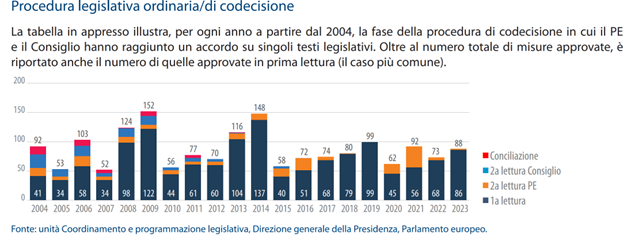
In quel periodo i membri della delegazione della Commissione parlamentare lavorano a diretto contatto con la Presidenza del Consiglio al fine di raggiungere un accordo che soddisfi le due istituzioni concludendo la procedura legislativa. Il successo di questa pratica, che é solo implicita nel Trattato, é provato dalla tabella seguente che presenta lo stadio di adozione delle procedure legislative europee nel periodo 2004-2023 e dal quale si evince il fatto che gli accordi in prima lettura sono ormai la regola da diversi anni.

Nel Parlamento europeo le commissioni parlamentari sono quindi la sede del vero negoziato politico poiché una volta raggiunto l’accordo con i rappresentanti del Consiglio il testo non viene più modificato dalla Plenaria in quanto é considerato un accordo interistituzionale (anche se formalmente é votato come “Posizione” del PE).

Commissioni di serie A e di serie B ?

E’ importante notare che non tutte le 20 Commissioni parlamentari hanno lo stesso peso. Anzi sette commissioni coprono più del 75% dei triloghi legislativi e sono LIBE (21%) ITRE (16%), ECON (11%) ENVI (9%) IMCO (7%) JURI (6%) e EMPL (5%)

Da qui l’importanza per i Gruppi politici in inizio di legislatura di distribuire i propri eurodeputati  nelle commissioni parlamentari responsabili delle politiche che stanno loro più a cuore o, paradossalmente, che possano loro creare dei problemi.

La composizione delle Commissioni in questa legislatura sarà decisa la settimana prossima e la settimana successiva (23 luglio) vi saranno le sedute costitutive e l’elezione degli uffici di Presidenza. A questo proposito il Regolamento del Parlamento prevede che siano i membri di ciascuna commissione a nominare i propri Presidenti, ma per facilitare il compito e, soprattutt evitare che i gruppi politici con più membri facciano la parte del leone i Gruppi politici si sono accordati in via preventiva per ripartirsi le Presidenze delle Commissioni. Cio’ é avvenuto seguendo il cd. metodo D’Hondt che ha pero’ permesso ai gruppi più numerosi di scegliere le Commissioni che consideravano più interessanti per le proprie priorità politiche.

Cosi’

– il PPE dovrebbe avere la Presidenza della Commissione AffariEsteri (AFET), Agricoltura (AGRI), Pesca (PECH), Industria, Ricerca e Energia (ITRE), Affari Costituzionali (AFCO), Controllo di bilancio  (CONT),  e la sotto-commissione Salute (SANT);

– I Socialisti hanno posto come priorità la Commissione Economica e Monetaria (ECON), l’Ambiente, (ENVI), Commercio Internazionale (INTA), Sviluppo Regionale (REGI), Donne e Uguaglianza di Genere (FEMM);

– I Patrioti per l’Europa dovrebbero avere le commissioni Cultura e Istruzione (CULT), Trasporto e Turismo (TRAN);

– il gruppo ECR dovrebbe avere le Commissioni Bilancio (BUDG), Libertà civili (LIBE) e Petizioni (PETI);

– il gruppo  Renew  dovrebbe avere le commissioni Sviluppo (DEVE), Affari giuridici (JURI), e la sottocommissione Sicurezza e Difesa (SEDE);

– I Verdi dovrebbero avere il Mercato interno e la protezione dei Consumatori (IMCO) la sottocommissione Diritti Umani (DROI);

– la Sinistra dovrebbe avere la commissione AffariSociali e Lavoro (EMPL) la commissione sul Fisco (FISC).

Questa ripartizione orientativa rischia pero’ di essere parzialmente rivista in occasione delle riunioni costitutive, vuoi perché la ripartizione non tiene presente la recente creazione di un nuovo gruppo politico a tutela delle Sovranità nazionali vuoi, soprattutto perché i gruppi di maggioranza (PPE, SD e RENEW) hanno considerato che non debbano essere affidate missioni di responsabilità a gruppi il cui programma politico sia di indebolire l’Unione anziché di rafforzarla.

Il primo segnale si é avuto con le prime polemiche relative alla previsione di affidare la Presidenza della Commissione Libertà Civili (LIBE) al gruppo euroscettico ECR. Questo ha portato a un pre-accordo fra ECR e PPE di scambiarsi le presidenze di AGRI e LIBE con la Commissione LIBE con tutta probabilità a un eurodeputato Spagnolo del PPE.

Ma i veri problemi si potranno avere in occasione delle riunioni costitutive della Commissioni preattribuite oltre al gruppo ECR, al gruppo dei “Patrioti”  e dei Sovranisti europei. Nel caso in cui la maggioranza PPE-SD e RENEW volesse applicare il cd “cordone sanitario” il giorno della riunione costitutiva vi saranno dei candidati di “maggioranza” che verrano presentati in alternativa di quelli “preattribuiti” e potranno essere votati dalla maggioranza dei membri di ogni commissione per coprire la prima parte della legislatura. Come si é cercato di dimostrare nelle linee precedenti la scelta finale avrà sicure conseguenze sul funzionamento di organi essenziali per il Parlamento europeo.

VERFASSUNGSBLOG :How Viktor Orbán Challenges the EU’s Common Foreign and Security Policy

09 July 2024

by Peter van Elsuwege

Since the start of the Hungarian Presidency of the Council of the European Union (EU), the Hungarian Prime Minister Viktor Orbán pursued an active foreign policy. He went to Kyiv for a meeting with Ukrainian President Volodymyr Zelenskyy, made a surprise visit to Russian President Vladimir Putin in Moscow, attended an informal summit of the Organisation of Turkic States hosted by Ilham Aliyev, President of Azerbaijan, and then flew to Beijing for a meeting with Chinese President Xi Jinping.

Orbán’s self-declared ‘peace diplomacy’ illustrates – once more – the challenges surrounding the EU’s external representation. He cannot and does not speak on behalf of the EU even though the use of the Hungarian Council Presidency logo may suggest otherwise. His visits are nothing else than an expression of Hungarian national foreign policy. Also in that capacity, however, his actions are problematic in view of Hungary’s obligations under the EU’s Common Foreign and Security Policy (CFSP).

No role for the Council Presidency

In a reaction to Orbán’s visits, both European Council President Charles Michel and High Representative Josep Borrell stressed that the rotating Council Presidency does not represent the European Union. They are right. Article 15, para. 6 TEU explicitly provides that the external representation of the CFSP is the responsibility of the President of the European Council at the Head of State or Government level and of the High Representative of the Union for Foreign Affairs and Security Policy at Ministerial level. Article 17, para. 1 TEU further clarifies that the European Commission represents the Union for all non-CFSP competences. The rotating Council Presidency only has an internal representative function, in the sense that it represents the Council in its relations with the other EU institutions, but it plays no formal role at the international stage.

This is an important change introduced with the Treaty of Lisbon. In pre-Lisbon times, the task of representing the Union in CFSP matters was explicitly granted to the Presidency. This was introduced in Article J. 5 of the Maastricht Treaty and later incorporated in ex Article 18 TEU. Accordingly, the EU representation at the highest political level was left to the Head or State of Government of the country holding the rotating presidency. This sometimes led to diplomatic controversies. The most notable example was the behaviour of Italian President Silvio Berlusconi after the November 2003 EU-Russia Summit held in Rome under the at that time Italian Presidency. At the post-summit press conference, Berlusconi defended Russia’s attacks on Chechnya and the imprisonment of Mikhail Khodorkovsky, obviously against the official position of the European Union. The institutional revisions introduced with the Treaty of Lisbon aimed to avoid such situations. In order to reinforce the coherence of the EU’s external action, the rotating Council Presidency no longer plays a formal role in the external representation of the Union. Hence, it is crystal clear that Viktor Orbán cannot legally represent the EU on the international stage. His visits to Ukraine, Russia, Azerbaijan and China must, therefore, be seen as expressions of Hungarian rather than EU foreign policy.

Foreign policy and the duty of loyalty

Member States are competent to pursue their own foreign policy. Declarations No. 13 and 14 to the Treaty on European Union explicitly provide that the CFSP provisions cannot affect the Member States’ powers in foreign affairs. However, this does not imply that the Member States have unlimited freedom to do whatever they want. It is standard case law of the Court of Justice that also in the exercise of their national competences, Member States are required to comply with their obligations deriving from EU law (see e.g. Case C-619/18, para. 52). This principle also applies with respect to the CFSP, which is an integral part of the EU legal order. Despite the special rules and procedures applicable in this field, several EU Treaty provisions restrain the Member States’ actions at the international level. Article 28 (2) TEU specifies that CFSP decisions “commit the Member States in the positions they adopt and in the conduct of their activity”. Article 29 TEU further provides that “Member States shall ensure that their national policies conform to the Union positions.” Article 24 (3) TEU further provides that the Member States are under an obligation to “support the Union’s external and security policy actively and unreservedly in a spirit of loyalty and mutual solidarity and shall comply with the Union’s action in this area. The Member States shall work together to enhance and develop their mutual political solidarity. They shall refrain from any action which is contrary to the interests of the Union or likely to impair its effectiveness as a cohesive force in international relations.” A concrete expression of the loyalty obligation can be found in Article 32 TEU, which inter alia provides that “[b]efore undertaking any action on the international scene or entering into any commitment which could affect the Union’s interests, each Member State shall consult the others within the European Council or the Council”.

The CFSP-specific loyalty provisions, which reflect the general duty of sincere cooperation included in Article 4 (3) TEU, reveal the problematic nature of Viktor Orbán’s initiatives. With his visit to Moscow, Orbán opposed the EU’s position on Russia’s war of aggression against Ukraine. This includes the suspension of the remaining political, cultural and scientific cooperation with the Russian authorities. Moreover, Russian President Putin, Foreign Minister Sergei Lavrov and many other Russian government officials are put on the EU’s sanctions list.  Orbán’s participation at the informal meeting of the Organisation of Turkic States was equally problematic. This meeting was also attended by the President of the self-declared ‘Turkish Republic of Northern Cyprus’ (TRNC), Ersin Tatar. The EU only recognises the Republic of Cyprus as a subject of international law and repeatedly expressed its concern about the decision of the Organisation of Turkic States to grant an observer status to the TRNC. According to the minutes of the informal meeting attended by Orbán, the Hungarian Prime Minister did not make any reservations regarding the participation of the TRNC. Finally, it appears that Hungary’s unilateral initiatives had not been announced or discussed within the European Council or the Council. Hence, it is obvious that the surprise visits of the Hungarian Prime Minister – which clearly affect the Union’s interests and common positions – violate both the wording and spirit of the EU’s Common Foreign and Security obligations.

Common Foreign and Security Policy as ‘lex imperfecta’

It is well established that Member States are bound to respect their EU law duty of sincere cooperation when acting on the international stage. A failure to respect this obligation may lead to infringement actions before the Court of Justice, with the cases of Commission vs. Greece and Commission vs. Sweden as textbook examples. The question, of course, is to what extent such actions can also be brought in relation to Member States’ violations of the EU’s Common Foreign and Security Policy. As provided under Article 24 (1) TEU, this policy is subject to ‘specific rules and procedures’ implying – amongst others – a limited jurisdiction for the Court of Justice of the EU. Despite the binding nature of the CFSP provisions, ensuring compliance with those rules is not a straightforward exercise. This is why Advocate General Wahl defined the CFSP as lex imperfecta, i.e. “a law that imposes a duty or prohibits a behaviour but does not provide for any penalty for its infringement”. For instance, infringement proceedings under Articles 258 to 260 TFEU seem to be excluded for simple breaches of CFSP rules. However, as argued by Christophe Hillion, a Member States’ systemic failure to comply with its CFSP obligations may well be regarded as a violation of the general principle of sincere cooperation, enshrined in Article 4 (3) TEU, in the sense that it undermines the attainment of the EU’s external action objectives as defined in Article 21 TEU.

Finally, under Article 24 (3) TEU, the Council and the High Representative are given the responsibility to ensure compliance with the principles of mutual political solidarity and loyalty in the EU’s external and security policy. Article 26 (2) TEU further defines that they “shall ensure the unity, consistency and effectiveness of action by the Union”. Apart from public statements that Viktor Orbán has no mandate to speak on behalf of the EU, a more proactive approach could have been envisaged. One of the key lessons of this episode is that trusting the Council Presidency to an EU country which is subject to the surveillance procedure of Article 7 (1) TEU was not a good idea.


SUGGESTED CITATION  van Elsuwege, Peter: How Viktor Orbán Challenges the EU’s Common Foreign and Security Policy, VerfBlog, 2024/7/09, https://verfassungsblog.de/how-viktor-orban-challenges-the-eus-common-foreign-and-security-policy/, DOI: 10.59704/da56a3449b491903.

Chronicle of a Foretold Diplomatic Incident (the Orban visit to Putin)

by Virgilio Dastoli and Emilio De Capitani

President Orban’s initiative to meet with President PUTIN by presenting himself in his capacity as the President of the Council of the European Union is objectionable at least under two perspectives.

The first perspective deals with the fact that according to the Treaty and Article 20 of the Council’s Rules of Procedure, the task of the President of the Council is primarily to organize and supervise “the proper conduct of the debates” as well as to “respect and to enforce the provisions of Annex V concerning the Council’s working methods.” It is thus an internal role within that institution to which is added the duty of dialoguing with the other EU co-legislator the European Parliament.

As such, the President of the Council does not therefore have a role of external representation of the Union, which is instead entrusted to the European Council for aspects of foreign and defense policy (Art. 15 TEU) and to the Commission for other Union policies. According to the Treaty “…The President of the European Council shall, at his level and in that capacity, ensure the external representation of the Union on issues concerning its common foreign and security policy, without prejudice to the powers of the High Representative of the Union for Foreign Affairs and Security Policy.”

These tasks of external representation are provided for in the treaty and reflect the institutional balance that cannot be altered by the institutions themselves. In this respect, European Council President Michel’s statement that Orban violated European law because he acted in the absence of a mandate is, in turn, objectionable, because even in the presence of a mandate the President of the Council is not legitimized by the Treaty itself to play an external political role much less in such a sensitive area as the War in Ukraine where the relevant institutions have already taken the initiatives they deemed appropriate.

By taking such an initiative, President Orban has thus also failed to comply with the principle of loyal cooperation between institutions (Article 13 TEU) and has demonstrated that he is unable to fulfill his neutral role as President of the Council.

It is now up to the other member states and, in particular, to the European Council to which the Treaty has entrusted the task of defining the internal organization of the Council and its Presidencies (Art.236 TFEU) whether to keep him in this function and review, the, at least inappropriate, choice of entrusting the Council Presidency to a Member State under surveillance procedure under Art.7.1 TEU as of 2018.

European Law Blog : The Complex Landscape of Asylum Border Procedures in the new Asylum Procedures Regulation

25 JUNE 2024/ BY VASILIKI APATZIDOU

Blogpost 31/2024

At the heart of the negotiations for the New Pact on Migration and Asylum lies one of its most contentious elements: the regulation of border procedures. During the Council negotiations, the Asylum Procedures Regulation (APR) underwent significant modifications, particularly in the provisions that regulate border procedures, to incorporate perspectives from all Member States. Despite expectations for improvements during trialogues with the Parliament, the final outcome in December 2023 witnessed step back from many of the anticipated safeguards.

Border procedures are perceived in the agreed text as an important ‘migration management tool’ and as a responsibility mechanism, mandating the examination of asylum applications at the borders, while asylum seekers will be subject to the ‘non-entry’ fiction. This blogpost aims to examine the complex landscape of border procedures based on the final text of the APR.

The Arduous Negotiations on Border Procedures

The EU Pact placed a paramount emphasis on the EU’s external borders, introducing a  ‘seamless link’ between all stages of the pre-entry phase, from the screening procedure, to an expanded use of asylum border procedures and where applicable, return border procedures for rejected asylum seekers. 

Border procedures involve the swift processing of asylum claims at border locations, while third-country national are subject to the ‘non-entry’ fiction. The main reason for their implementation is to guarantee the first-entry states’ responsibility by keeping asylum seekers at the external borders and preventing secondary movements within the EU.

Despite being initially regulated in only two provisions within the amended proposal for an APR (Article 41 and 41a APR), the final text includes twelve provisions on  border procedures (Article 43-54 APR), highlighting their contentious nature during the negotiations and the difficulty of Member States in reaching an agreement.

The most difficult and divisive question during the negotiations was whether border procedures should be obligatory or voluntary.   On the one hand, central EU countries sought to make the use of border procedures obligatory to prevent  ‘secondary’ movements of asylum seekers and manage migration at the EU external borders.

On the other hand, southern EU states opposed this, given that their widespread implementation would place a further strain on their resources and overburden their capacities for processing asylum claims. In addition, they argued that whether or not to apply border procedures, as well as the categories of persons to whom these should apply, should remain a prerogative of Member States, that are best placed to decide if a procedure is feasible given their specific circumstances.

Despite years of negotiations, with the APR text being discussed since 2016, the outcome is an extended regulation of border procedures, rendering them mandatory in some cases.

This prolonged negotiation process has resulted in a complex framework with many provisions designed to accommodate the diverse interests of all involved Member States.

The scope of application of border procedures

Despite challenging negotiations on border procedures, the agreed text extends their scope of application (Articles 44-45 APR). Firstly, it renders their use mandatory when certain acceleration grounds are met.

The mandatory application of border procedures is stipulated for those that have a low probability of international protection (20%) according to Union-wide average Eurostat data (Article 45 APR), those who pose potential threats to national security or public order and cases involving applicants who mislead the authorities. Regarding the last category of applicants, the APR text foresees that ‘after having been provided with a full opportunity to show good cause‘, those considered to have intentionally misled the authorities are subject to mandatory border procedures. While this wording aims to guard against arbitrary practices, there still remains a risk of wide interpretation by authorities.

Regarding the first reason, and according to the Council, an effective and meaningful border procedure should ensure that the number of persons that would actually be channeled to the border procedure remains high, and despite proposals from the Parliament to reduce the threshold  to 10%, the recognition rate of 20% remained in the final text with a corrective mechanism introduced during the negotiations with the Parliament (Article 45 and Article 42j APR).

The corrective mechanism allows authorities to deviate from this threshold if there has been a significant change in the applicant’s country of origin since the publication of the relevant Eurostat data. It also allows states to take into account significant differences between first-instance decisions and final decisions (appeals).

For example, if there is a notable discrepancy indicating that many initial rejections are overturned on appeal, this could be a factor in deciding not to apply the border procedure to an applicant from that country. However, this practice introduces a nationality-based criterion for the application of border procedures which may lead to discrimination, and it also raises important issues as there are significant discrepancies in the recognition rates of asylum seekers across European countries.

In addition to these obligatory cases, border procedures may be used at the discretion of authorities to examine the merits or the inadmissibility of an application under certain conditions. Specifically, this discretion applies if any of the circumstances listed in Article 42(1), points (a) to (g) and (j), and Article 42(3), point (b), are met, as well as when there is an inadmissibility ground in accordance with Article 38. This discretionary use could impede harmonization across the EU due to varying interpretations and implementations by different Member States.

Moreover, the regulation broadens the personal scope of border procedures, allowing their application following the screening, and when an application is made a) at an external border crossing point or transit zone (this was also foreseen in the APD), but also b) following apprehension in connection with an unauthorized border crossing of the external border, which means that individuals who are already within the territory of a Member State could be subjected to border procedures, and finally c) following disembarkation after a search and rescue operation (Article 43 APR).

Another important aspect discussed during the negotiations was the application of border procedures to unaccompanied minors with an agreement on excluding them from border procedures always, except for national security grounds (Article 53 (1) APR). Families with minors will be included in border procedures with additional safeguards: de-prioritisation of their examination and always reside in facilities that comply with the Reception Conditions Directive (RCD). Specifically, Article 44 (3) APR foresees that where the number of applicants exceeds the number referred to in the provision that regulates the member State’s adequate capacity level, priority shall be given to applications of certain third-country nationals that are not minor applicants and their family members. To the contrary, following admission to a border procedure, priority shall be given to the examination of the applications of minor applicants and their family members.

Finally, vulnerable individuals will be exempted from border procedures only when it is assessed that the ‘necessary support’ cannot be provided to applicants with special reception or procedural needs (Article 53 (2) APR).

The concept of adequate capacity

In exchange for increased responsibility of frontline states through the wide implementation of border procedures, the APR introduces the concept of ‘adequate capacity’, with two distinct levels identified: the Union-level which is set at 30,000 (Article 46 APR), though the derivation of this figure remains unexplained, and the individual Member State level which is calculated based on numerical factors: by multiplying the number set out in Article 46 (Union-level adequate capacity) by the sum of irregular crossings of the external border, arrivals following search and rescue operations and refusals of entry at the external border in the Member State concerned during the previous three years and dividing the result thereby obtained by the sum of irregular crossings of the external border, arrivals following search and rescue operations and refusals of entry at the external border in the Union as a whole during the same period according to the latest available Frontex and Eurostat data (Article 47 APR).

Only applications subject to the border procedure should be calculated towards reaching the adequate capacity.

Once ‘adequate capacity’ is reached (Article 48), the Commission will be notified and it will have to examine if the state is identified as being under a migratory pressure according to the Asylum and Migration Management Regulation. In such case, states will be able to derogate from the provisions that mandate the use of border procedures, and e.g. choose to keep asylum seekers at the borders and refer them in regular asylum procedures or transfer them within the territory and once again implement regular asylum procedures.

However, such authorisation will not exempt the Member State from the obligation to examine in the border procedure applications made by applicants that are considered as a danger to national security or public order.

The introduction of the concept of ‘adequate capacity’ was designed to render the prescribed use of border procedures cognizant to the needs and migratory pressures on first-entry states and in this way to ensure their buy in. However, the final provisions demonstrate that the calculation of ‘adequate capacity’ is rather complex, while it relies solely on numerical data, overlooking the specific characteristics of arrivals or the actual capacity of first-entry countries.

It seems that, in essense, this concept was added to ensure ‘predictability‘ by making sure that southern states will fulfill their responsibilities by examining a minimum number of applications through border procedures. In addition, this will in practice incentivise Member States to use even more border procedures to reach their ‘adequate capacity’, in detention or other designated spaces created for these procedures, turning the process into a ‘lottery’ largely dependent on the timing of arrivals.

If a person arrives before the ‘adequate capacity’ is reached, they will most probably be subjected to border procedures. Conversely, if they are fortunate enough to arrive once the capacity is reached, their cases will be examined under a regular asylum procedure with more safeguards. Finally, this approach is also potentially hindering harmonisation by prioritising national-level exception measures over solidarity and relocation in times of pressure. 

Rights at Risk

Although border procedures were initially implemented exceptionally in some Member States to address the 2015-2016 refugee ‘crisis,’ this practice has become the ‘norm’ in certain Member States, such as Greece and Italy, where they are routinely applied, even in situations with no notable increase in arrivals. It is expected that their use will rise as border procedures become mandatory for certain categories of asylum seekers.

Border procedures have been described as sub-standard procedures, due to the fast processing of asylum claims, the locations where these procedures are implemented, and the legal fiction of ‘non-entry’, a concept which means that asylum seekers will be considered as not entered into the territory while their claim will be examined in a border procedure. This provision is also maintained in the final text (Article 43 (2) APR).

The legislation creates therefore avenues for disentangling the relation between physical presence of an asylum seeker on the territory and the legal presence.

As scholars have pointed out, this legal fiction, justifies the creation of  ‘liminal’ space or ‘anomalous’ zones where common legal rules do not fully apply. Notably, Article 54 APR, allows their implementation within the territory, justifying the application of the ‘non-entry’ fiction even in locations far away from the actual territorial border. By shifting the border inwards, entire areas are treated as ‘borders’, and asylum seekers in these locations are subjected to a different, often more restrictive, set of rights compared to those who apply for asylum through regular in-country procedures. This practice can imperil several key rights of asylum seekers as it will be described below.

Towards more detention

During border procedures, asylum seekers should be kept at or close to the borders, leading to increased and systematic detention or other area-based restrictions. Within the APR, detention is not prescribed clearly, but it is not precluded either (Article 54 APR). The legal basis for imposing detention during border procedures can be found however in the agreed Reception Conditions Directive, where it is envisaged that detention may be imposed ‘in order to decide, in the context of a procedure, on the applicant’s right to enter the territory’ (Article 8c RCD).

To what extent policies of non-entry undermine the right to liberty and freedom of movement is a matter raised many times in the case law of the CJEU, and in some cases of the ECtHR where the case-law on detention to prevent unauthorized entry (Article 5 (1) (f)) seems to be rather controversial. What is important to note though is that the ‘non-entry’ fiction in conjunction with the absence of clarifying the reception conditions (Article 54 APR) applicable in border procedures may lead to increased and routinised detention practices in EU external states.

The issue of legal aid

The question of free legal assistance in border procedures has been another area of contention during the negotiations. While the European Parliament stressed its importance, the Member States were against expanding it to the first instance procedure due to financial and administrative constraints. A compromise solution was agreed offering free legal counseling for the administrative procedure (interview), excluding representation and allowing flexibility for Member States (Article 16 APR).

As outlined in the new APR (Article 16), legal counseling includes guidance and explanations of the administrative procedure, including information on rights and obligations during the process. Additionally, the legal counsellor will offer assistance with lodging the application as well as guidance on the different examination procedures and the reasons for their application e.g. admissibility rules or when someone is referred to accelerated or border procedures.

However, this form of assistance does not extend to escorting individuals during the asylum interview, preparing them for the interview, or submitting legal memos at the first instance procedure. In contrast, legal assistance and representation which is applicable in the appeal procedure (Article 17 APR) goes further, including the preparation of procedural documents and active participation in the hearing.

Despite the supposed extension of legal aid, highlighted in a dedicated section (Section III), its provision remains in the form of counseling, marking a notable step back from the Parliament’s initial proposal. Furthermore, in practice, limited access both to counselling and legal assistance may occur due to the locations that border procedures take place such as detention or remote locations near the borders. This situation underscores potential challenges in ensuring effective legal support within the border procedures.

The right to asylum and protection from refoulement

Other rights that may be undermined in the context of border procedures are the right to asylum and the protection from refoulement.  These rights may be compromised primarily due to the limited procedural safeguards applicable in border procedures, such as the very short time-limits (as stipulated in Article 51 APR, border procedure shall be as short as possible and a maximum of 12 weeks) combined with the limited access to legal assistance due to the locations where border procedures are taking place (detention or de facto detention) which may significantly impact the overall quality of the asylum procedure.

In addition, implementing border procedures to vulnerable applicants raises concerns that their special procedural needs may not be appropriately addressed. These individuals shall be provided with the necessary support to enable them to benefit from their rights. However, the notion of ‘necessary support’ yet remains undefined in the agreed text. It seems that it is mainly related to the special reception needs and the locations where the border procedures are implemented, assuming that border procedures are appropriate for applicants with special procedural needs unless ‘the necessary support cannot be provided in the locations referred to in Article 54’.

Failure to provide special procedural guarantees to asylum seekers who require them directly impacts the quality and effectiveness of the asylum procedure.

Finally, the right to appeal is modified in the APR. According to Article 68 APR, the appeal will not have suspensive effect when the case is examined under border procedures. Some guarantees should nevertheless be preserved in this case, such as the possibility for the applicant to request a right to remain within a time-limit of at least 5 days and the provision of interpretation, information and free legal assistance (Article 68 (3) a (ii) in conjunction with Article 68 (5) APR). Even though it is positive to at least ensure that these guarantees are applicable in border procedures, the time-limit of 5 days to prepare and lodge an appeal and an application to request the right to remain may not be enough to ensure an effective remedy in practice.

Concluding Observations

The extensive regulation of border procedures in the final APR underscores their role as a crucial ‘migration management tool’. The persistence, during negotiations, to uphold border procedures at any cost resulted in intricate and complex provisions, emphasising their importance in ensuring responsibility of first-entry states. However, by containing asylum seekers at external borders, the EU risks exacerbating existing deficiencies, leading to overcrowd reception and detention centres and consequently violation of human rights. This directly impacts both asylum seekers, that will have to navigate asylum procedures with limited safeguards, and states grappling with overburdened capacities.

As these rules take shape, a focus on rights-based interpretations and increased judicial oversight and monitoring are essential to safeguard the principles of fairness and respect for human rights at the borders.

Verfassungsblog : Why an EU Country under the Surveillance Procedure (Article 7.1 TEU) Should not Chair the Council Presidency

by Virgilio DASTOLI and Emilio DE CAPITANI

In accordance with the Council Decision on the exercise of the Presidency of the Council of the European Union,1) from July 1 of this year the office is to be held by Hungary. This occasion will mark the first time that the Presidency will have been held by a Member State that has been subject to the “surveillance” procedure in Article 7(1) of the Treaty on European Union, having been launched by the European Parliament in September 2018.

As the Court of Justice has recognised,2) by adopting its Resolution, the EP has already triggered the legal consequences foreseen by Protocol 24.

‘[A]s long as the Council or the European Council has not taken a decision in respect of the Member State concerned, a Member State may, by way of derogation from the general rule laid down in that single article, take into consideration or declare admissible to be examined any asylum application lodged by a national of the Member State that is the subject of that procedure.’

Simply put, it means that Hungary is no longer to be considered a “safe country”, and if it should occur, a Hungarian may request asylum in another EU Country. In other words, the general presumption that fundamental rights and values are respected in that Member State is no longer absolute, and precaution should be taken when fundamental rights of individuals are concerned (as is the case in relation to the European Arrest Warrant). In a more general sense, and in the relations with other Member States or EU Institutions, the principle of mutual trust that is the bedrock of intra-EU cooperation is not “blind trust” and cannot be taken for granted.

Within this perspective, it would be sensible to assume that a Member State that does not enjoy the full confidence of the other Member States should not be responsible for a key coordinating role, as is the case when holding the Council Presidency.  As a matter of fact, holding the Council Presidency is anything but a protocolar task. It plans, coordinates and chairs meetings of the Council and most of the Council’s preparatory bodies, i.e. working parties and committees. It suggests compromise solutions with a view to reaching an agreement between the Members of the Council (‘honest broker’). The Presidency should be, by definition, neutral and impartial. It is the moderator for discussions and cannot, therefore, favour either its own preferences or those of a particular Member State.

But holding the Council Presidency also has an essential interinstitutional dimension, because it is the Presidency that represents the Council in its relations with the European Parliament (EP) and negotiates on behalf of the Council to reach agreements on legislative files by protecting and promoting together the EU values that Hungary is openly challenging.

It is not surprising that the European Parliament (which originally triggered the Article 7(1) TEU procedure against Hungary) already one year ago3) sent a Resolution to the Council and the Commission underlining

‘the important role of the presidency of the Council in driving forward the Council’s work on EU legislation, ensuring the continuity of the EU agenda and representing the Council in relations with the other EU institutions” but also questioning “…how Hungary will be able to credibly fulfil this task in 2024, in view of its non-compliance with EU law and the values enshrined in Article 2 TEU, as well as the principle of sincere cooperation’.

Surprisingly, neither the Commission nor the Council have to date furnished any response. Perhaps the reason was that these two institutions were expecting a positive development prior to the end of the legislative term, such as apparently occurred with Poland, (the only other European Country subjected to the Article 7(1) TEU procedure). Yet, unfortunately, in the case of Hungary, the situation has in the meantime rather worsened, to the extent that the European Parliament adopted two new Resolutions, the first on January 18 of this year4) and the second on April 24.5)

These highly detailed texts summarise and update the already formidable list of all Hungarian infringements of the rule of law and of the Budgetary Conditionality Mechanism. The most recent text declares in even stronger words the same concerns as to the suitability of Hungary as President of the Council and declares the EP readiness to take measures to defend the credibility of the Union with respect to the values enshrined in Article 2 TEU as regards cooperation with the Council’.

It remains to be seen if the two most recent EP texts will once again fall on deaf ears on the Council side. However, from a constitutional point of view, the assessment of the EP appears well founded and should have received much greater attention from the Council, notably because by maintaining the Hungarian Presidency the Council is threatening the smooth functioning of the EU in its essential legislative and budgetary functions as envisaged in the post-Lisbon Treaty framework: these functions now fall within the joint responsibility of the European Parliament and of the Council (Article 14(1) and 16(1) TEU), and this co-responsibility requires a great deal more than loyal cooperation between the two institutions (Article 13 TEU).

It would now be both prudent and sensible for the Council to modify its 2016 Decision, by qualified majority, as already provided for in legal doctrine,6)  by foreseeing explicitly that Council Presidency should not be held by a Country under art. 7 Procedure. As a consequence the Hungarian Presidency will be delayed until the Article 7(1) TEU surveillance procedure will have been successfully concluded. It has to be noted that a postponement should not be considered as a sanction against Hungary, but rather a simple precautionary measure to preserve the smooth functioning of the European Union and to avoid a period of interinstitutional bickering between the EU co-legislators, particularly at such a decisive moment for the EU legislature both from an internal and international point of view. Moreover, it wouldn’t be the first time that the Council Presidency has been postponed, and then for much less serious reasons.  As rightly noted by the Meijers Committee,

‘changes in the previously agreed order of Presidencies have not been uncommon.  They occurred on six occasions, for different reasons: three times after the accession of new Member States, in 1995, in 2005 and in 2007; in 2002 at the request of Germany because general elections were scheduled during its upcoming Presidency; in 2009 because of the Treaty of Lisbon; and in 2016 after accession of Croatia and the Brexit Referendum with regard to the UK Presidency, which was scheduled to start in 11 months’ time, as of July 2017. Therefore, it is established legal and political practice to reconsider the order of the Presidency in case of relevant circumstances, even if relatively close to the date that the rotation is scheduled to start’.

It is finally also worth noting that an urgent appeal to postpone the Hungarian Presidency has very recently been submitted to the EU Institutions by the European Movement (IT, ES, FR branches).7) The European Commission President, Ursula Von Der Leyen, has shared it with the competent Members of the College, notably with Vice-President Maroš Šefčovič, who is responsible for interinstitutional relations. The time period until July 1 is rapidly diminishing, and on June 18 the General Affairs Council will decide on a reasoned proposal from the Commission on closing the Article 7(1) TEU procedure against Poland.8) Will it also be the occasion to discuss the issue of the incoming Hungarian Presidency? If so the point could also be submitted for final decision at the European Council Meeting on June 27/28 under the chapter on institutional issues (as the general responsibility on the issue of Council Presidencies falls under the COEUR competence – Article 236 TFEU).

We, the undersigned scholars, experts and citizens, support this call for the postponement of the Hungarian Presidency.

Those who wish to support this initiative can send their contact details here.

Prof. Gábor Halmai, European University Institute, Florence

Prof. Sergio Fabbrini, Luiss University, Rome

Prof. Petra Bard, Radboud University

Prof. Tomacz Tadeus Koncewicz, University of Gdańsk, Department of European and Comparative Law

Prof. Laurent Pech, University College Dublin

Prof. Paul Craig, University of Oxford

Prof. Kim Lane Scheppele, Princeton University

Prof. Catherine Dupré, University of Exeter Law School

Prof. Maria Bergström, Uppsala University, Faculty of Law

Prof. Marie-Laure Basilien-Gainche University Jean Moulin Lyon 3, Institut Universitaire de France

Prof. Henri de Waele, Radboud University Nijmegen and University of Antwerp

Prof. Elspeth Guild, Queen Mary University of London

Prof. Olivier Costa, CNRS, CEVIPOF, Sciences Po, Paris

Dr. Marta Lasek-Markey, Trinity College Dublin

Prof. Stephen Skinner, University of Exeter

Dr. Christine Bicknell, Human Rights and Democracy Forum, University of Exeter Law School

Dr. Carlotta Garofalo, University of Graz

Ounia N. Doukoure, Paris 1 University, Institut Convergences Migrations ; Lille Catholic University

Prof. Marc Valéri, University of Exeter

Prof. Federico Fabbrini, Dublin City University

Prof. Dominique Custos, Caen Normandie University

Prof. Dino G. Rinoldi, Catholic University of the Sacred Heart of Milan

Prof. Nicoletta Parisi, Catholic University of the Sacred Heart of Milan

Prof. Douwe Korff, University of Oxford

Prof. Susanna Cafaro, University of Salento

Prof. Laurence Burgorgue-Larsen, Paris 1 University

Prof. Fred Constant, University of the Antilles

Prof. Jean-Manuel Larralde, Caen Normandie University

Prof. Maria Castillo, University Caen Normandie University

Prof. Maciej Bernatt, University of Warsaw

Prof. Yves Poullet, University of Namur

Prof. Antonio Da Re, University of Padova

Prof. Luciano Corradini, Roma Tre University

Prof. Massimiliano Guderzo, University of Siena

Prof. Massimo Fragola, Università della Calabria

This is a pre-peer reviewed version of an article submitted for publication in the European Law Journal.

References

↑1Council Decision (EU) 2016/1316 of 26 July 2016 amending Decision 2009/908/EU (OJ L 208, 2.8.2016, p. 42) : https://eur-lex.europa.eu/legal-content/EN/TXT/?uri=CELEX%3A32016D1316.
↑2See paras. 39 and 40 of Case C-650/18, Ungary v. European Parliament, June 3 2021, EU:C:2021:426:‘39      In the present case, it should be noted that the adoption of the contested resolution initiates the procedure laid down in Article 7(1) TEU. Under point (b) of the sole article of Protocol (No 24), once that procedure is initiated and as long as the Council or the European Council has not taken a decision in respect of the Member State concerned, a Member State may, by way of derogation from the general rule laid down in that single article, take into consideration or declare admissible to be examined any asylum application lodged by a national of the Member State that is the subject of that procedure.40      It follows that the adoption of the contested resolution has the immediate effect of lifting the prohibition, which is in principle imposed on the Member States, on taking into consideration or declaring admissible to be examined an asylum application made by a Hungarian national. That resolution thus changes, in relations between Member States, the position of Hungary in the field of asylum.’
↑3European Parliament resolution of 1 June 2023 on the breaches of the Rule of Law and fundamental rights in Hungary and frozen EU funds (2023/2691 RSP)OJ C, C/2023/1223, 21.12.2023, ELI: http://data.europa.eu/eli/C/2023/1223/oj
↑4See point 8 of the Resolution “Situation in Hungary and frozen EU funds”  questioning again “..if the Hungarian Government will be able to credibly fulfil this task in 2024, in view of its non-compliance with EU law and the values enshrined in Article 2 TEU, as well as the principle of sincere cooperation;” and  “asking the Council to find proper solutions to mitigate these risks as soon as possible”,  https://www.europarl.europa.eu/doceo/document/TA-9-2024-0053_EN.html.
↑5See Resolution Ongoing hearings under Article 7(1) TEU regarding Hungary to strengthen Rule of Law and its budgetary implications where it regretted ‘that the Council has not yet found a solution to this problem, and that representatives of the Hungarian Government would chair the Council’s meetings concerning democracy, the rule of law and fundamental rights, including meetings related to protecting the EU’s financial interests and budget; underscores that this challenge comes at the crucial moment of the European elections and the formation of the Commission; deplores the failure to find a solution and reiterates its readiness to take measures to defend the credibility of the Union with respect to the values enshrined in Article 2 TEU as regards cooperation with the Council;’  https://www.europarl.europa.eu/doceo/document/TA-9-2024-0367_EN.html.
↑6See the Mejiers Committee “Comment on the exercise and order of the Presidency of the Council of the EU”, published on 19 May 2023, https://www.commissie-meijers.nl/comment/comment-on-the-exercise-and-order-of-the-presidency-of-the-council-of-the-eu/.
↑7Available at:  https://www.movimentoeuropeo.it/images/documenti/VIKTOR_ORB%C3%81N_MUST_NOT_CHAIR_THE_COUNCIL_OF_THE_EUROPEAN_UNION_MEIT-FR-ES.pdf.
↑8Available at: https://data.consilium.europa.eu/doc/document/ST-10716-2024-INIT/en/pdf.

Would the EU buy an used car from this man ?

BRUSSELS, BELGIUM – APRIL 17: Hungarian Prime Minister Viktor Mihaly Orban talks to assembly during a discussion on Day 2 of The National Conservatism Conference at the Claridge on April 17, 2024 in Brussels, Belgium. (Photo by Thierry Monasse/Getty Images)

This rhetorical question dating back from the 1960s, joking on the credibility of President Nixon in the midst of Watergate, springs to mind when one notes that Hungarian President Orban is about to become the President of the Council of the European Union as of July 1 of this year.

Don’t be fooled , this is not a pro-forma appointment; quite the opposite. In that capacity the Hungarian President will be responsible for managing most of the day-to-day work of the Council of the Union at a time when the highest offices of the European institutions will be appointed, the first decisions in the political, legislative and budgetary spheres of the beginning of the legislature will be made, and, in the background, a decisive phase of the Ukraine crisis will be entered and a presidential elections will take place in the United States.

Now, Mr Orban is the President of a Country which is, since six years,  under an EU’s surveillance procedure (Art 7.1 TEU) for risk of serious violation of the values on which the European Union is founded, and for which the transfer of European funds has been frozen for violation of the principle of the rule of law. Above all, we are talking of a country whose government daily puts spokes in the wheels of the European Union by using or threatening its right of veto on decisions such as those for sanctions on Russia or aid to Ukraine (so much so that some EU countries evoked earlier this year the possibility of suspending its right to vote-Article 7.2 TEU).

In a “normal” European Union, a Country with this profile should not be in charge of coordinating other member Countries, and it to would be sensible to postpone the Presidency, at least to a time when the surveillance procedure has been successful closed.

Quite surprisingly, until now, the European Council has not considered sensible to postpone the Hungarian Presidency even if should not be seen as a “sanction” against Hungary but, more, as a simple precautionary measure in the interest of the proper functioning of the Union. Moreover, postponing Council Presidencies is not uncommon and this kind of decision has been taken at qualified majority because of less important reasons (by the way such move would be less courageous and controversial than the one that President Michel’s father took twenty-four years ago, as Belgian foreign minister in the Haider affair…).

At the end of the Day, the obligation of promoting the respect for the values of the Union is binding not only for the EU countries but also for the institutions themselves and the Council should be aware that under the Hungarian Presidency it is more than likely that It may encounter problems in the pursuit of this goal. When EU fundamental values may be at stake precautionary measures are more than needed (as the EP proved when, because of Mr Buttiglione declarations on Homosexuality did’nt approved its Candidature as EU Commissioner for anti-discriminatory policies).

Postponing the Council Presidency was already suggested by the Meijer’s Committee in 2023 and, more recently, by the European Parliament with two resolutions on January 18 and on April 24 has denounced the many persistent Hungarian violations of European law. Will the EP President of the European Parliament, Metsola raise this issue before the European Council meeting already at its next June 17/18th (before the formal Institutional Meeting on June 27/28th )?

The EP resolutions are even more justified by the fact that according to the treaties legislative and budgetary powers are a joint responsibility of the Parliament and the Council (Art.14.1 and 16.1 TEU) and, as it was the EP which triggered the art.7.1 Procedure against Hungary there is a clear risk of interinstitutional tensions in a delicate phase of the EU life, to say the least. The fact remains that a formal proposal to revise the 2009 European Council Decision on Council Presidencies may be made not only by the European Council Presidency but also by the President of the Commission and/or the current (Belgian) Council Presidency or following a request to the Presidency by any COEUR Member.

As simple Citizen I am puzzled by the fact that Hungarian open challenge to EU values has been condemned  not only leftist political forces but also by liberal and EPP forces.  What is the point of these repeated public statements in favor of the values of the Union if at the moment of being consistent with our own words we forget them?

In a way is like condemning someone of being drunk and giving him at the same time the keys of your car so that he can drive you home.

The Council of Europe Convention on Artificial Intelligence, Human Rights, Democracy and the Rule of Law: perhaps a global reach, but an absence of harmonisation for sure

by Michèle DUBROCARD (*)

On 15 March 2024, Ms Marija Pejčinović Burić, the Secretary General of the Council of Europe, made a statement, on the occasion of the finalisation of the Convention on Artificial Intelligence (AI), Human Rights, Democracy and the Rule of Law. She welcomed what she described as an ‘extraordinary achievement’, namely the setting out of a legal framework that covers AI systems throughout their lifecycles from start to end. She also stressed the global nature of the instrument, ‘open to the world’.

Is it really so? The analysis of the scope, as well as the obligations set forth in the Convention raise doubts about the connection between the stated intent and the finalised text. However, this text still needs to be formally adopted by the Ministers of Foreign Affairs of the Council of Europe Member States at the occasion of the 133rd Ministerial Session of the Committee of Ministers on 17 May 2024, after the issuing of the opinion of the Parliamentary Assembly of the Council of Europe (PACE)[1].

I- The scope of the Convention

It is no secret that the definition of the scope of the Convention created a lot of controversy among the negotiators[2]. In brief, a number of States, a majority of which are not members of the Council of Europe [3] but participated in the discussions as observers, essentially opposed the European Union, in order to limit the scope of the Convention to activities related to AI systems only undertaken by public authorities, and exclude the private sector.

Those observer States achieved their goal, presumably with the help of the Chair[4] and the Secretariat of the Committee on Artificial Intelligence (CAI), but they did it in a roundabout way, with an ambiguous wording. Indeed, the reading of both Article 1.1 and Article 3.1(a) of the Convention may lead to think prima facie that the scope of the Convention is really ‘transversal’[5], irrespective of whether activities linked to AI systems are undertaken by private or public actors:

– according to Article 1.1, ‘the provisions of this Convention aim to ensure that activities within the lifecycle of artificial intelligence systems are fully consistent with human rights, democracy and the rule of law.

– according to Article 3.1(a),‘the scope of this Convention covers the activities within the lifecycle of artificial intelligence systems that have the potential to interfere with human rights, democracy and rule of law as follows’.

This impression is confirmed by the explanatory report, which states in par. 15 that ‘the Drafters aim to cover any and all activities from the design of an artificial intelligence system to its retirement, no matter which actor is involved in them’.

However, the rest of Article 3 annihilates such wishful thinking: as regards activities undertaken by private actors, the application of the Convention will depend on the goodwill of States. Better still, a Party may choose not to apply the principles and obligations set forth in the Convention to activities of private actors, and nevertheless be seen as compliant with the Convention, as long as it will take ‘appropriate measures’ to fulfil the obligation of addressing risks and impacts arising from those activities:

Each Party shall address risks and impacts arising from activities within the lifecycle of artificial intelligence systems by private actors to the extent not covered in subparagraph (a) in a manner conforming with the object and purpose of the Convention.

Each Party shall specify in a declaration submitted to the Secretary General of the Council of Europe at the time of signature or when depositing its instrument of ratification, acceptance, approval or accession how it intends to implement this obligation, either by applying the principles and obligations set forth in Chapters II to VI of the Framework Convention to activities of private actors or by taking other appropriate measures to fulfil the obligation set out in this paragraph. Parties may, at any time and in the same manner, amend their declarations’.

How should one interpret such a provision? It seems to allow Parties to submit a reservation on the private sector but, at the same time, it is not worded as a reservation per se. On the contrary, it establishes a sort of equivalence between the principles and obligations laid down in the Convention and ‘other appropriate measures’ to be taken by the Parties when addressing risks and impacts arising from activities related to AI systems undertaken by private actors. In other words, the Convention organizes the modalities of circumvention of the principles and obligations that yet constitute the core of its very object.

The result of such a provision is not only a depreciation of the principles and obligations set forth in the Convention, since it is possible to derogate from them for activities of private actors without derogating from the Convention itself, but it also creates a fragmentation in the implementation of the instrument. The uncertainty stemming from these declarations is aggravated by the possibility, for each Party, to amend its declaration at any time. Since there is no other specification, one could even imagine a situation where a Party could, in the first instance, accept to apply the principles and obligations set forth in the Convention to the private sector, but then, at a later stage, reconsider its initial decision and limit such application to the public sector only.

Instead of establishing a level playing field among the Parties, the Convention legitimizes uncertainty as regards its implementation, in space and time.

On the other hand, Article 3.2 clearly authorizes an exemption, requested this time by the European Union[6], for activities within the lifecycle of AI systems related to the protection of national security interests of Parties. However, according to the provision, such activities should be ‘conducted in a manner consistent with applicable international law, including international human rights law obligations, and with respect for its democratic institutions and processes’.  In the framework of the Council of Europe, such an exemption is particularly surprising in the light of the case-law of the European Court of Human Rights, which has clearly interpreted the concept of ‘national security’[7]. Exempting from the scope of the Convention activities of AI systems related to the protection of national security interests seems therefore at best useless, if not conflicting with the obligations stemming from the European Convention on Human Rights.

In addition to national security interests, Article 3 foresees two more exemptions, namely research and development activities and national defence. Concerning research and development activities regarding AI systems not yet made available for use, Article 3.3 also includes what seems to be a safeguard, since the Convention should nevertheless apply when ‘testing or similar activities are undertaken in such a way that they have the potential to interfere with human rights, democracy and the rule of law’. However, there is no indication of how and by whom this potential to interfere could be assessed. The explanatory report is of no help on this point, since it limits itself to paraphrasing the provision of the article[8].

As regards matters related to national defence, the explanatory report[9] refers to the Statute of the Council of Europe, which excludes them from the scope of the Council of Europe. One can however wonder whether the rules of the Statute of Europe are sufficient to justify such a blanket exemption, especially in the light of the ‘global reach’ that the Convention is supposed to have[10]. Moreover, contrary to the explanations related to ‘national security interests’, the explanatory report does not mention activities regarding ‘dual use’ AI systems, which should be under the scope of the Convention insofar as these activities are intended to be used for other purposes not related to national defence.

II- Principles and obligations set forth in the Convention

According to the explanatory report, the Convention ‘creates various obligations in relation to the activities within the lifecycle of artificial intelligence systems’[11].

When reading Chapters II to Chapter VI of the Convention, one can seriously doubt whether the Convention really ‘creates’ obligations or rather simply recalls principles and obligations already recognized by previous international instruments. Moreover, the binding character of such obligations seems quite questionable.

II-A Principles and obligations previously recognized

A number of principles and obligations enshrined in the Convention refer to human rights already protected as such by the European Convention on Human Rights, but also by other international human rights instruments. Apart from Article 4 that recalls the need to protect human rights in general, Article 5 is dedicated to integrity of democratic processes and respect of rule of law[12], Article 10 is about equality and non-discrimination[13], Article 11 refers to privacy and personal data protection[14], and Articles 14 and 15 recall the right to an effective remedy[15].

Other principles are more directly related to AI, such as individual autonomy in Article 7, transparency and oversight in Article 8, accountability and responsibility in Article 9, and reliability in Article 12, but once again these principles are not new. In particular, they were already identified in the Organisation for Economic Co-operation and Development (OECD) Recommendation on AI, adopted on 19 May 2019[16].

This feeling of déjà vu is reinforced by the wording of the Convention: in most articles, each Party shall ‘adopt or maintain measures’ to ensure the respect of those principles and obligations. As duly noted in the explanatory report, ‘in using “adopt or maintain”, the Drafters wished to provide flexibility for Parties to fulfil their obligations by adopting new measures or by applying existing measures such as legislation and mechanisms that existed prior to the entry into force of the Framework Convention[17].

The question that inevitably comes to mind is what the added value of this new instrument can be, if it only recalls internationally recognized principles and obligations, some of them already constituting justiciable rights.

Indeed, the mere fact that this new instrument deals with the activities related to AI systems does not change the obligations imposed on States to protect human rights, as enshrined in applicable international law and domestic laws. The evolution of the case law of the European Court of Human Rights is very significant in this regard. As we know, the Court has considered, on many occasions, that the European Convention on Human Rights is to be seen as ‘a living instrument which must be interpreted in the light of present-day conditions[18]. Without much risk one can predict that in the future the Court will have to deal with an increasing number of cases involving the use of AI systems[19].

II-B A declaratory approach

One could try to advocate for this new Convention by emphasizing the introduction of some principles and measures which haven’t been encapsulated in a binding instrument, yet. Such is the case, for instance, of the concepts of transparency and oversight, to be linked to those of accountability and responsibility, reliability, and of the measures to be taken to assess and mitigate the risks and adverse impacts of AI systems.

However, the way these principles and measures have been defined and, above all, how their implementation is foreseen, reveal a declaratory approach, rather than the intention to establish a real binding instrument, uniformly applicable to all.

Moreover, the successive versions of the Convention, from the zero draft, to the last version of March 2024, reveal a constant watering down of its content: the provisions on the need to protect health and environment have been moved to the Preamble, while those aiming at the protection of whistleblowers have been removed.

In the light of the EU Artificial Intelligence Act[20], the current situation is almost ironic, since the Convention does not create any new individual right, contrary to the EU regulation, which clearly recognizes, for instance, the human overview as well as the right to explanation of individual decision-making. And yet, the general economy of the AI Act is based on market surveillance and product conformity considerations, while the Council of Europe Convention on AI is supposed to focus on human rights, democracy, and the rule of law[21].

So, what is this Convention about? Essentially obligations of means and total flexibility as regards the means to fulfil them.

obligations of means:

A number of obligations in principle imposed on Parties are in fact simple obligations of means, since each Party is requested to ‘seek to ensure’ that adequate measures are in place. It is the case in Article 5, dedicated to the ‘integrity of democratic processes and respect for rule of law’. It is also the case in Article 15 on procedural safeguards, when persons are interacting with an artificial intelligence system without knowing it, in Article 16.3 in relation to the need of ensuring that adverse impacts of AI systems are adequately addressed, and in Article 19 on public consultation.

On the same vein, other articles include formulations which leave States with considerable room for manoeuvre in applying the obligations: as regards reliability, each Party shall take ‘as appropriate’ measures to promote this principle[22].  As regards digital literacy and skills, each Party shall ‘encourage and promote’ them[23]. Similarly, Parties are ‘encouraged’ to strengthen cooperation to prevent and mitigate risks and adverse impacts in the contexts of AI systems[24].

More importantly, it will be up to Parties to ‘assess the need for a moratorium or ban’ AI systems posing unacceptable risks[25]. One can only deplore the removal of former Article 14 of the zero draft, which provided for the ban of   the use of AI systems by public authorities using biometrics to identify, categorise or infer emotions of individuals, as well as for the use of those systems for social scoring to determine access to essential services. Here again, the Convention is under the standards defined by the AI Act[26].

– the choice of the measures to be adopted:

First, one should note that from the first article of the Convention, flexibility is offered to the Parties as regards the nature of the measures to be adopted, if appropriate. Article 1.2 provides the possibility for each Party ‘to adopt or maintain appropriate legislative, administrative or other measures to give effect to the provisions set out in this Convention’.

Consequently, Parties might consider that their domestic system is fully compliant with this Convention without any change in their regulations. They could even consider that simple recommendations to public or private actors might be sufficient to fulfil their obligations under the Convention.

The wide leeway given to the States also explains the constant reference to the ‘domestic law’ [27]or to the domestic legal system[28] throughout the Convention. In particular Article 6, which  constitutes a chapeau for the whole Chapter III, states that principles included in this Chapter shall be implemented by Parties ‘in a manner appropriate to its domestic legal system and the other obligations of this Convention’. Such a wording is not free from a certain ambiguity, since it might be interpreted as requiring, as part of their implementation, an adaptation of the principles set forth in the Convention to the pre-existing domestic law, and not the opposite.

Here again, with this constant reference to domestic laws intrinsically linked to the ‘flexibility’ given to the Parties, one can only deplore the lack of harmonisation of the ‘measures’ which might be adopted in accordance with the Convention.

the absence of an international oversight mechanism:

It is true that Article 26 of the Convention lays down the obligation for each Party to establish or designate one or more effective mechanisms to oversee compliance with the obligations of the Convention. However, once again, Parties are free to choose how they will implement such mechanisms, without any supervisory control at the international level. The Conference of Parties, composed of representatives of the Parties and established by Article 23 of the Convention, won’t have any monitoring powers. The only obligation foreseen is – in Article 24- a reporting obligation to the Conference of the Parties, within the first two years after the State concerned has become a Party. But after this first report, there is no indication on the periodicity of the reporting obligation. 

Conclusion

Despite the continuous pressure from the civil society[29] and the interventions of the highest authorities in the field of human rights and data protection[30], the final outcome of the negotiations is a weak text, based on very general principles and obligations. Some of them are even under the level of the standards recognized in the framework of the Council of Europe, in the light of the European Convention on Human rights and the case law of the European Court of Human Rights, as well as of the Convention for the Protection of Individuals with regard to Automatic Processing of Personal Data. Moreover, their application won’t be consistent among the Parties, due to a variable-geometry scope and a considerable margin of manoeuvre left to the Parties to implement the Convention.

Why so many concessions, in the context of negotiations held under the umbrella of the Council of Europe, which presents itself as the ‘continent’s leading human rights organisation’? The answer of the Council of Europe representatives is: ‘global reach’. So, should the hope to see States which are not members of the Council of Europe ratify the Convention justify such a lack of ambition?

Yet it is not the first time that an international binding instrument negotiated in the framework of the Council of Europe allows for a fragmented application of its provisions: the Second Additional Protocol to the Convention on Cybercrime[31] already provided some sort of ‘pick and choose’ mechanism in several articles. However, what could be understood in the light of the fight against cybercrime, is more difficult to accept in the framework of a Convention aiming at protecting human rights, democracy and the rule of law in the context of artificial intelligence systems.

It is possible that the negotiators could not achieve a better result, in view of the positions expressed in particular by the United States, Canada, Japan and Israel. In that case, the Council of Europe would have been better advised either to be less ambitious and drop the aim of a ‘global reach’, or wait a few more years until the ripening of the maturation of all minds.

(*)  EDPS official: This text is the sole responsibility of the author, and does not represent the official position of the EDPS

NOTES


[1] The Opinion adopted by the PACE on 18 April 2024 includes several proposals to improve the text. See https://pace.coe.int/en/files/33441/html

[2] See an article published in Euractiv on 31 Jan 2024 and updated on 15 Feb 2024:…(https://www.euractiv.com/section/artificial-intelligence/news/tug-of-war-continues-on-international-ai-treaty-as-text-gets-softened-further/ )

See also the open letter of the representatives of the civil society:

 https://docs.google.com/document/d/19pwQg0r7g5Dm6_OlRvTAgBPGXaufZrNW/edit, and an article of M. Emilio de Capitani: The COE Convention on Artificial Intelligence, Human Rights, Democracy and the Rule of Law. Is the Council of Europe losing its compass? https://free-group.eu/2024/03/04/the-coe-convention-on-artificial-intelligence-human-rights-democracy-and-the-rule-of-law-is-the-council-of-europe-losing-its-compass/

[3] USA, Canada, Japan, Israel.

[4] See an article issued in swissinfo.ch – https://www.swissinfo.ch/eng/foreign-affairs/ai-regulation-is-swiss-negotiator-a-us-stooge/73480128

[5] The terms of reference of the CAI explicitly refers to the establishment of a ‘binding legal instrument of a transversal character’.

[6] See, for instance, an article in Euractiv ‘EU prepares to push back on private sector carve-out from international AI treaty’https://www.euractiv.com/section/artificial-intelligence/news/eu-prepares-to-push-back-on-private-sector-carve-out-from-international-ai-treaty/

[7] National security and European case-law: Research Division of the European Court of Human Rights- https://rm.coe.int/168067d214

[8] Paragraph 33 of the explanatory report : ‘As regards paragraph 3, the wording reflects the intent of the Drafters to exempt research and development activities from the scope of the Framework Convention under certain conditions, namely that the artificial intelligence systems in question have not been made available for use, and that the testing and other similar activities do not pose a potential for interference with human rights, democracy and the rule of law. Such activities excluded from the scope of the Framework Convention should in any case be carried out in accordance with applicable human rights and domestic law as well as recognised ethical and professional standards for scientific research’.

[9] Paragraph 36 of the explanatory report.

[10] In its opinion of 18 April 2024 the PACE suggested to only envisage a restriction. See above note 1.

[11] Paragraph 14 of the explanatory report

[12] these principles are closely linked to freedom of expression and the right to free elections: see in particular Article 10 of the European Convention on Human Rights and Article 3 of Protocol 1

[13] See in particular Article 14 of the European Convention on Human Rights and Protocol 12,

[14] See in particular Article 8 of the European Convention on Human Rights and the case law of the European Court of Human Rights, as well as Article 1 of the Convention for the Protection of Individuals with regard to Automatic Processing of Personal Data.

[15] See in particular Article 13 of the European Convention on Human Rights.

[16] https://legalinstruments.oecd.org/en/instruments/oecd-legal-0449#mainText

[17] Paragraph 17 of the explanatory report.

[18] See Tyrer v United Kingdom 2 EHRR 1 at para. 31

[19] On 4 July 2023, the Third Section of the European Court of Human Rights delivered the first judgment on the compatibility of facial recognition technology with human rights in Glukhin v. Russia:

https://hudoc.echr.coe.int/eng#%22display%22:%5B2%5D,%22itemid%22:%5B%22001-225655%22%5D

[20] See Articles 14 and 86 of the AI Act – https://artificialintelligenceact.eu/the-act/

[21] ‘The Council of Europe’s road towards an AI Convention: taking stock’ by Peggy Valcke and Victoria Hendrickx, 9 February 2023: ‘Whereas the AI Act focuses on the digital single market and does not create new rights for individuals, the Convention might fill these gaps by being the first legally binding treaty on AI that focuses on democracy, human rights and the rule of law’. https://www.law.kuleuven.be/citip/blog/the-council-of-europes-road-towards-an-ai-convention-taking-stock/

[22] Article 12 of the Convention.

[23] Article 20 of the Convention.

[24] Article 25 of the Convention.

[25] Article 16.4 of the Convention.

[26] See Chapter II of the AI Act – https://artificialintelligenceact.eu/the-act/

[27] See Articles 4, 10, 11 et 15.

[28] See Articles 6 and 14.

[29] See in particular the open latter of 5 March 2024:

https://docs.google.com/document/d/19pwQg0r7g5Dm6_OlRvTAgBPGXaufZrNW/edit

[30] See the statement of the Council of Europe Commissioner for Human Rights:

https://www.coe.int/en/web/commissioner/-/ai-instrument-of-the-council-of-europe-should-be-firmly-based-on-human-rights

See also the EDPS statement in view of the 10th and last Plenary Meeting of the Committee on Artificial Intelligence (CAI) of the Council of Europe drafting the Framework Convention on Artificial Intelligence, Human Rights, Democracy and the Rule of Law: https://www.edps.europa.eu/press-publications/press-news/press-releases/2024/edps-statement-view-10th-and-last-plenary-meeting-committee-artificial-intelligence-cai-council-europe-drafting-framework-convention-artificial_en

[31] Second Additional Protocol to the Convention on Cybercrime on enhanced co-operation and disclosure of electronic evidence- https://rm.coe.int/1680a49dab

The COE Convention on Artificial Intelligence, Human Rights, Democracy and the Rule of Law. Is the Council of Europe losing its compass ?

by Emilio DE CAPITANI
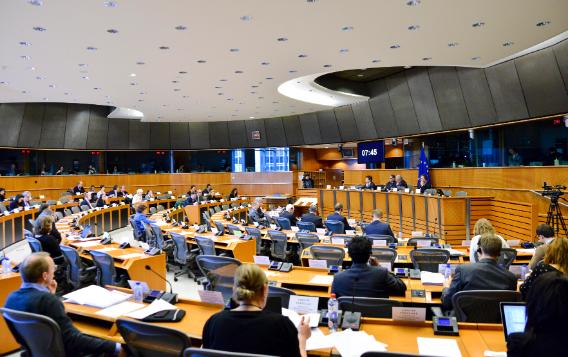
When the Committee of Ministers of the Council of Europe decided at the end of 2021 to establish the Committee on Artificial Intelligence (CAI) with the mandate to elaborate a legally binding instrument of a transversal character in the field of artificial intelligence (AI), such initiative created a lot of hopes and expectations. For the first time, an international convention ‘based on the Council of Europe’s standards on human rights, democracy and the rule of law and other relevant international standards’ would regulate activities developed in the area of AI.  

The mandate of the CAI was supposed to further build upon the work of the Ad Hoc Committee on Artificial Intelligence (CAHAI), which adopted its last report in December 2021, presenting  ‘possible elements of a legal framework on artificial intelligence, based on the Council of Europe’s standards on human rights, democracy and the rule of law’. In this document, the CAHAI underlined the need for the future instrument to ‘focus on preventing and/or mitigating risks emanating from applications of AI systems with the potential to interfere with the enjoyment of human rights, the functioning of democracy and the observance of the rule of law, all the while promoting socially beneficial AI applications’. In particular, the CAHAI considered that the instrument should be applicable to the development, design and application of artificial intelligence (AI) systems, ‘irrespective of whether these activities are undertaken by public or private actors’, and that it should be underpinned by a risk-based approach. The risk classification should include ‘a number of categories (e.g., “low risk”, “high risk”, “unacceptable risk”), based on a risk assessment in relation to the enjoyment of human rights, the functioning of democracy and the observance of the rule of law’. According to the CAHAI, the instrument should also include ‘a provision aimed at ensuring the necessary level of human oversight over AI systems and their effects, throughout their lifecycles’.

So, a lot of hopes and expectations: some experts expressed the wish to see this new instrument as a way to complement, at least in the European Union, the future AI Act, seen as a regulation for the digital single market, setting aside the rights of the persons affected by the use of AI  systems[1]. In its opinion of 20/2022 on the Recommendation for a Council Decision authorising the opening of negotiations on behalf of the European Union for this Council of Europe convention, the EDPS considered that it represented ‘an important opportunity to complement the proposed AI Act by strengthening the protection of fundamental rights of all persons affected by AI systems’. The EDPS advocated that the convention should provide ‘clear and strong safeguards for the persons affected by the use of AI systems’.

Alas, those hopes and expectations were quickly dampened by the way the negotiations were organised, and, above all, by the content of the future instrument itself.

1- the organisation of the negotiations: the non-member States leading, the civil society out

The objective to open the future instrument to States which are not members of the Council of Europe was with no doubt an excellent initiative, considering the borderless character of AI, and the need to regulate this technology worldwide. Indeed, as noted by the CAHAI in its above mentioned report ‘The various legal issues raised by the application of AI systems are not specific to the member States of the Council of Europe, but are, due to the many global actors involved and the global effects they engender, transnational in nature’. The CAHAI therefore recommended that the instrument, ‘though obviously based on Council of Europe standards, be drafted in such a way that it facilitates accession by States outside of the region that share the aforementioned standards’. So, yes on a global reach, but provided that the standards of the Council of Europe are fully respected.

However, the conditions under which those non-member States have participated in the negotiations need be looked at a little more: not only have they been part of the drafting group sessions unlike the representatives of the civil society, but it seems that from the start they have played a decisive role in the conduct of negotiations. According to a report published in Euractiv in January 2023[2], the US delegation opposed the publication of the first draft of the Convention (the ‘zero draft’), refusing to disclose its negotiating positions publicly to non-country representatives.

At the same time, the organisation of the negotiations has set aside the civil society groups, who were only allowed to intervene in the plenary sessions of the meetings, while the text was discussed and modified in the drafting sessions. The next and-in principle- last plenary meeting from the 11th to the 14th of March should start with a drafting session and will end with the plenary session, which implies that the civil society representatives will have less than 24 hours to have a look at the revised version of the convention -if they can receive it on time- and make their last comments, assuming that their voices were really heard during the negotiations.

Yet, representatives of the civil society and human rights institutions have done their utmost to play an active part in the negotiations. In an email to the participating States, they recalled that the decision to exclude them from the drafting group went ‘against the examples of good practice from the Council of Europe, the prior practice of the drafting of Convention 108+, and the CoE’s own standards on civil participation in political decision-making[3]. During the 3rd Plenary meeting of 11-13 January 2023, they insisted on being part of the drafting sessions, but the Chair refused, as indicated in the list of decisions:

‘(…) –Take note of and consider the concerns raised by some Observers regarding the decision taken by the Committee at the occasion of its 2nd Plenary meeting to establish a Drafting Group to prepare the draft [Framework] Convention, composed of potential Parties to the [Framework] Convention and reporting to the Plenary.

– Not to revise the aforesaid decision, while underlining the need to ensure an inclusive and transparent negotiation process involving all Members, Participants and Observers and endorsing the Chair’s proposal for working methods in this regard’.[4]

Despite this commitment, the need of an ‘inclusive and transparent negotiation process’ has not been ensured in the light of the civil society statement of the 4th of July 2023, where again the authors ‘deeply regret(ted) that the negotiating States have chosen to exclude both civil society observers and Council of Europe member participants from the formal and informal meetings of the drafting group of the Convention. This undermines the transparency and accountability of the Council of Europe and is contrary to the established Council of Europe practice and the Committee on AI (CAI) own Terms of Reference which instructs the CAI to “contribute[…] to strengthening the role and meaningful participation of civil society in its work”.’[5]

The influence of non-member States has not been limited to the organisation of meetings. As detailed below, the American and Canadian delegations delegations, among others, threw their full weight behind the choice of systematically watering down the substance of the Convention.

2- A convention with no specific rights and very limited obligations

How should the mandate of the CAI be understood? According to the terms of reference, the Committee is instructed to ‘establish an international negotiation process and conduct work to finalise an appropriate legal framework on the development, design, use and decommissioning of artificial intelligence, based on the Council of Europe’s standards on human rights, democracy and the rule of law and other relevant international standards, and conducive to innovation, which can be composed of a binding legal instrument of a transversal character, including notably general common principles (…)[6].

The objective of including in the convention ‘general common principles’ has been interpreted by the Chair literally, who considered that ‘the AI Convention will offer an underlying baseline of principles in how to handle the technology, on top of which individual governments can then build their own legislation to meet their own specific needs’[7]. Indeed, the last publicly available version -dated 18 December 2023- of the draft Convention only refers to ‘principles’ and not to specific rights[8], even those already existing in the framework of the Council of Europe and beyond. In the context of AI, though, one could have hoped the recognition of certain rights, as the right to human oversight and the right to explanation for AI based decisions.

Such a choice has been criticized by the civil society‘s representatives. In a public statement of the 4th of July 2023, they recalled that ‘while including general common principles for AI regulation as indicated in the CAI Terms of Reference, the Convention should respect the rights established by other Conventions and not reformulate them as mere principles[9].

Unfortunately, the Convention, at least in the version of the 18th of December 2023, does not even expressly include the right to privacy and the right to the protection of personal data. Yet, if data are, as the Chair himself referred to, ‘the oil of the XX1st century’[10], the need to protect our rights in this area is critical.

If one compares the successive versions of the Convention which are publicly accessible, from the zero draft[11], to the version of the 18th of December, one can only deplore the constant watering down of its content. What about ‘prohibited artificial intelligence practices’ referred to in Article 14 of the zero draft? What about the definitions, which included in the zero draft the notion of ‘artificial intelligence subject’, defined as ‘any natural or legal person whose human rights and fundamental freedoms, legal rights or interests are impacted by decisions made or substantially informed by the application use  of an artificial intelligence system’? What about a clear presentation of the risk-based approach, with a differentiation of measures to be applied in respect of artificial intelligence systems posing significant and unacceptable levels of risk (see articles 12 and 13 of the zero draft)?

Moreover, in the version of the 18th of December 2023, a number of obligations in principle imposed on Parties might become simple obligations of means, since the possible -or already accepted- wording would be that each party should ‘seek to ensure’ that adequate measures are in place. It is in particular the case in the article dedicated to the ‘integrity of democratic processes and respect for rule of law’, as well as in the article on ‘accountability and responsibility’ and even in the article on procedural safeguards, when persons are interacting with an artificial intelligence system without knowing it.

According to an article published in Euractiv on 31 Jan 2024 and updated on 15 Feb 2024, even the version of the 18th of December 2023 seems to have been watered down: ‘Entire provisions, such as protecting health and the environment, measures promoting trust in AI systems, and the requirement to provide human oversight for AI-driven decisions affecting people’s human rights, have been scrapped’[12].

3- The worse to come?

One crucial element of the Convention still needs to be discussed: its scope. Since the beginning of the negotiations, the USA and Canada, but also Japan and Israel, none of them members of the Council of Europe, have clearly indicated their wish to limit the scope of the instrument to activities within the lifecycle of artificial intelligence systems only undertaken by public authorities[13]. Moreover, national security and defence should also be out of the scope of the convention.  The version of the 18th of December includes several wordings regarding the exemption of national security, which reflect different levels of exemption.

The issue of the scope has lead the representatives of the civil society to draft an open letter[14], signed by an impressive number of organisations calling on the EU and the State Parties negotiating the text of the Convention to equally cover the public and private sectors and to unequivocally reject blanket exemptions regarding national security and defence.

Today no one knows what the result of the last round of negotiations will be: it seems that the EU is determined to maintain its position in favour of the inclusion of the private sector in the scope of the Convention, while the Americans and Canadians might use the signature of the Convention as blackmail to ensure the exclusion of the private sector.

4- Who gains?

From the Council of Europe perspective, which is an organisation founded on the values of human rights, democracy and the rule of law. the first question that comes to mind is what are the expected results of the ongoing negotiations. Can the obsession to see the Americans sign the Convention justify such a weakened text, even with the private sector in its scope? What would be the gain for the Council of Europe and its member States, to accept a Convention which looks like a simple Declaration, not very far in fact from the Organisation for Economic Co-operation and Development’s Principles on AI[15]?

At this stage, it seems that neither the Americans nor the Canadians are ready to sign the Convention with the inclusion of the private sector, even if an opt-out clause were inserted in the text. The gamble of the Chair and the Secretariat to keep these two observer States on board at the price of excessive compromises might be lost at the end of the day. One should not forget that these States do not have voting rights in the Committee of Ministers.

The second question that comes to mind is why the Chair and the Secretariat of the CAI and, above them, those who lead the Council of Europe have made such a choice. Does it have a link with internal decisions to be taken in the next future, as regards the post of the General Secretary of the organisation, as well as the post of the Director General of Human Rights and Rule of Law? Does the nationality of the Chair have a role to play in this game? In any case, the future Convention might look like an empty shell, which might have more adverse effects than it seems prima facie, by legitimizing practices around the world which would be considered incompatible with the European standards.

NOTES


[1] See in particular ‘The Council of Europe’s road towards an AI Convention: taking stock’ by Peggy Valcke and Victoria Hendrickx, 9 February 2023: ‘Whereas the AI Act focuses on the digital single market and does not create new rights for individuals, the Convention might fill these gaps by being the first legally binding treaty on AI that focuses on democracy, human rights and the rule of law’. https://www.law.kuleuven.be/citip/blog/the-council-of-europes-road-towards-an-ai-convention-taking-stock/

[2] https://www.euractiv.com/section/digital/news/us-obtains-exclusion-of-ngos-from-drafting-ai-treaty/

[3] same article

[4] https://rm.coe.int/cai-2023-03-list-of-decisions/1680a9cc4f

[5] https://ecnl.org/sites/default/files/2023-07/CSO-COE-Statement_07042023_Website.pdf

[6] https://rm.coe.int/terms-of-reference-of-the-committee-on-artificial-intelligence-cai-/1680ade00f

[7] https://www.politico.eu/newsletter/digital-bridge/one-treaty-to-rule-ai-global-politico-transatlantic-data-deal/

[8] with the exception of ‘rights of persons with disabilities and of children’ in Article 18

[9] https://ecnl.org/sites/default/files/2023-07/CSO-COE-Statement_07042023_Website.pdf

[10] https://www.linkedin.com/pulse/data-oil-21st-century-ai-systems-engines-digital-thomas-schneider/

[11] https://www.statewatch.org/news/2023/january/council-of-europe-convention-on-artificial-intelligence-zero-draft-and-member-state-submissions/

[12] https://www.euractiv.com/section/artificial-intelligence/news/tug-of-war-continues-on-international-ai-treaty-as-text-gets-softened-further/

[13] same article

[14] https://docs.google.com/document/d/19pwQg0r7g5Dm6_OlRvTAgBPGXaufZrNW/edit

[15] https://legalinstruments.oecd.org/en/instruments/OECD-LEGAL-0449

The new proposal on the security of EU informations: transforming the EU “Bubble” in an EU “Fortress” ? (3)

3. How the INFOSEC proposal builds a wider, but still incomplete, legal framework for EU Classified informations (EUCI)

 “The core of the proposed Regulation on the security of EU information (hereafter the INFOSEC proposal) concerns the creation and management of EU classified information (EUCI). In doing so, it substantially modifies Article 9 of Regulation 1049/2001, which deals with public access (or not) to so-called “sensitive documents”.

According to that article:

“Sensitive documents are documents originating from the institutions or the agencies established by them, from Member States, third countries or International Organizations, classified as ‘TRÈS SECRET/TOP SECRET’, ‘SECRET’ or ‘CONFIDENTIEL’ in accordance with the rules of the institution concerned, which protect essential interests of the European Union or of one or more of its Member States in the areas covered by Article 4(1)(a), notably public security, defense and military matters.”

Paragraph 3 of the same article also makes clear that: “Sensitive documents shall be recorded in the register or released only with the consent of the originator.”

Paragraph 7 says: “The Commission and the Council shall inform the European Parliament regarding sensitive documents in accordance with arrangements agreed between the institutions.”

It should be noted that Article 9 of Regulation 1049/2001 was a “fast and dirty” solution for a problem which arose in July 2000: Javier Solana, newly appointed Secretary General of the Council, negotiated with the new NATO Secretary General, Mr Robertson, an administrative arrangement with NATO on the exchange of classified information with the Council of the EU. However, that arrangement was challenged before the Court by the European Parliament (EP) and the Dutch government, because they considered that it limited a citizen’s fundamental right of access to documents, and exceptions to such fundamental right should have been framed by law.

At the time, the negotiation of Regulation 1049/01 was under the pressure of a deadline established in the Treaty. The reference to “sensitive” documents was added at the end of the legislative procedure and, because of this, the EP and the Dutch government withdrew their case before the Court.

Unfortunately, it was a Pyrrhic victory – it soon became clear that Article 9 of Regulation 1049/2001 was (and still is) a rather elusive and patchy framework for EU classified information.

A number of points can be made in this regard:

a) It does not regulate how the information should be classified and declassified in the interests of the EU, as opposed to the interests of the originator (whether that be a member State, EU institution, agency or body). Quite the contrary – by transferring the definition of these aspects to the internal security of each institution it paved the way to different standards and the very well-known risk of over classification.

b) It foresees a very weak framework for parliamentary oversight. By making reference to interinstitutional agreements and not codifying in secondary law the EP’s constitutional right to oversee classified information, it places the institution in an ancillary position. It is unfortunate that the EP has not fought until now to obtain treatment comparable to the one reserved for national parliaments with regard to their governments.

The solutions may be different, and special procedures and perhaps even special parliamentary bodies may be needed, but a stronger EP role is more than necessary because this lack of oversight will not be covered at national level – governments will declare that they are barred from revealing the information because it is classified at “European” level! Moreover, the instrument of an “interinstitutional agreement/arrangement” as currently foreseen by Article 295 of the Lisbon Treaty has strong constitutional limitations. As the Council Legal Service itself recognized in 2018: “The wording of the provision (NDR art.295 TFEU), and notably the use of the term ‘arrangements’, points to the fact that IIAs are instruments for regulating the modalities of cooperation and not for the regulation of substantive policy areas.”

It is thus quite surprising that, since the first Interinstitutional Agreement in 2002, the European Parliament has not asked for a sturdier legal basis for its oversight power.

With the adoption of the INFOSEC Regulation the situation will become even worse, because the EP will be obliged to negotiate interinstitutional agreements with all the other EU institutions, agencies and bodies if access to classified information is necessary for fulfilling its own constitutional role. From the outside, 21 years after the first interinstitutional agreement, the fact that the EP is still negotiating the revision of the 2002 interinstitutional agreement on access to classified information in the Common Security and Defence Policy (CSDP) area instead of creating a true legislative legal basis for its oversight may look to some like a form of Stockholm syndrome. To exit from such an impasse would not be wise for the European Parliament to study the more suitable model by looking at the experience of the major EU Member States and, even of the USA ?

c) Article 9 recognises, albeit only in the domain of “sensitive” documents and information, the so-called “originator privilege” or “author rule.” This is an exception to the general philosophy of Regulation 1049/2001, as made clear in Article 4(5):

“A Member State may request the institution not to disclose a document originating from that Member State without its prior agreement.” The point was, and still is, that the EU institutions may only by bound by law and not by the will of an “author”, even if it were an EU member state, a point confirmed in the jurisprudence of the Court of Justice of the EU

What the INFOSEC proposal does is to transform the exception of the “originator principle” in a rule. But, by recognizing to each EU Institution, Agency and Body the power of classify information in the interest of the EU it does not establish a mechanism which may verify that the EU interest is adequately by the classification or if it has been abusively established. For instance, an oversight power may be recognized to the European Commission or to the Ombudsman to decide if a document/information created by the EU Agencies should be declassified.

Clear rules on this point at INFOSEC level, may prevent from happening, other “incidents”, such as the one which occurred between Europol, the Ombudsman and the Commission, in 2015  when the Ombudsman asked to inspect the report of Europol’s Joint Supervisory Body (JSB) on the implementation of the EU-US Terrorist Finance Tracking Programme Agreement ( see  https://www.ombudsman.europa.eu/fr/case/en/42114 )

d) It does not foresee a judicial oversight of classified information. Today it is still up to the originator to decide whether or not to give the Court of Justice access to classified information. This is not a rhetorical question: it has already happened that the Council did’nt answer positively to a Court of Justice request of having access to classified informations.  As Deirdre Curtin remind us in her essay Top Secret Europe: “…in the OMPI case (*) on the blacklisting of terrorists by the UN and within the EU context, the Court said clearly that the Council could not base its decision on information that is not revealed to the Court.” ( Case T-248/08, People’s Mojahedin Organization of Iran v Council (OMPI III) para 73). It is worth recalling that in some Countries such as the USA

e) It does not solve the problem of sharing of “sensitive information” between entities which have a legitimate “need to know.” Instead, as Article 9 is focused on the security of each author of “sensitive information” and does not refer to common legislative standards, this has been done until now by the Council. This institution remains the main creator and exchanger of classified information, and has imposed via bilateral agreements with all the other EU institutions, agencies and bodies its internal security rules which, in turn, mirror the NATO standards. It is because of the legal fragility of this “de facto harmonisation” that the Commission has decided to launch a legislative initiative establishing at secondary law level the principles which should be respected in this domain inside the EU.

However, the solution envisaged in the INFOSEC proposal still does not address the main weaknesses of Article9 of Regulation 1049/2001 nor the weaknesses of the Council Internal Security Rules which are proposed to become the common EU standard. . In fact, in some cases it makes the situation even worse.

A useful example can be seen in the EU security agreements with third countries and international organizations on the exchange of classified information foreseen by articles 55-68 of the INFOSEC proposal.

The proposal requires, as a rule, that these agreements be negotiated and concluded according to Article 218 of the Lisbon Treaty, which will finally give the possibility for the EP to give its consent and to be fully and timely informed of the agreements’ content. But INFOSEC foresees also the possibility of continuing with “executive” arrangements which can be negotiated not only by the Council but also by other EU Institutions, agencies and bodies without associating the EP.  That exclusion of the EP has been , unfortunately, until now the case and dozens of international agreements have been negotiated by the Council using Article 13 of its internal security rules as a legal basis.

Now, if the INFOSEC proposal is adopted not only the Council but also all the other EU Institutions Agencies and bodies will have a legal basis for negotiating and concluding these executive “arrangements”. It would be wise to make clear in the INFOSEC proposal that the arrangements shall foresee that, because of the EU’s constitutional framework, no veto can be exercised over the transmission of classified information to the EP and to the CJEU.

4. Summing up: by endorsing the INFOSEC legislative proposal is the EP shooting on its Foot ?

The new proposal on the security of EU informations: transforming the EU “Bubble” in an EU “Fortress” ? (2)

Notwithstanding all the shortcomings of the Commission’s legislative proposal, the challenge for the European Parliament (EP) and for the Council is now to bring some order to the information management inside the EU. This is particularly important given that the EU’s digital agenda provides the opportunity, as part of an increasingly-integrated public administration, to establish a virtual common working space, to categorise information to be shared, to establish different level of access and diffusion with the external world, within the EU institutions or to be exchanged with the member states.

However, to do so by respecting the principles of transparency, proportionality, efficiency and accountability requires the EP and the Council to share the same political vision. Notwithstanding the repeated public mantra invoking a more democratic and transparent EU, there is no way this requirement can be taken for granted. Suffice to recall that 23 years after the Regulation on access to documents came into force the Parliament, Council and Commission have not yet been able (or willing?) to establish a common platform displaying day by day the EU legislative process, and this is clearly not solely due to technical reasons.

The problem being political more than technical it should now be seen if the EP and the Council could find an interinstitutional agreement on such a complex issue in the next six months, given the political pressure of the end of the legislature. The Commission may have authored the proposal but, as co-legislators, the EP and Council bear all responsibility for its final content before EU citizens and before the Court of Justice.

This EP-Council legislative co-responsibility has been clearly framed at primary law level by the Treaty on European Union, according to which “The European Parliament shall, jointly with the Council, exercise legislative and budgetary functions,” (Article 14(1)) and: “The Council shall, jointly with the European Parliament, exercise legislative and budgetary functions” (Article 16(1)).

Revising and strengthening the Regulation on access to documents

The first issue on the agenda in negotiations on the security of information proposal should be how to strengthen, at the highest level, the aspects dealing with transparency and open administration, bearing in mind the different legislative “cultures” of the EP and the Council. This could be done by amending explicitly, and publicly, the Regulation on access to documents that the Commission is proposing to revise by stealth, through the information security proposal.

The first thing to do is to add to the legislative proposal a complementary legal basis of Article 15 TFEU, according to which the EP and the Council shall define “General principles and limits on grounds of public or private interest” governing the right of access to EU documents. Thereafter articles. 4, 9 and 12 of that Regulation should be amended by taking in account (at last!) the new constitutional situation arising from the entry into force of the Lisbon treaty and of the relevant CJEU jurisprudence in this domain.

The first set of amendments should enforce at secondary law level the fundamental notion of legislative transparency and its impact on legislative preparatory documents and debates.

It is worth recalling that the principle of legislative transparency (which is ignored by the information security proposal), has, since Lisbon, been imposed at primary law level by Article 15(2) TFEU, according to which: “The European Parliament shall meet in public, as shall the Council when considering and voting on a draft legislative act.” Regardless of the different legislative “culture” of the Council, the authors of the Lisbon Treaty also imposed specific obligations of legislative transparency even at the level of the definition of its meeting agendas with (Article 16(8) of the TEU).

With all these provisions, the EU legislative function becomes inherently intertwined with the obligation of transparency (as it should be in a democratic entity). This is consistent with the choice of the authors of the Lisbon Treaty, of modelling the EU legal order upon the constitutional principle of the separation of powers, adding to the administration and the judiciary (provided for by the previous rules in Article 17 and Article 19 TEU) the EU legislative power (Articles 14 and 16 TEU). Thus, the legislative function has become an institutional, democratic and autonomous prerogative of the European Union, directly governed by several principles and rules of EU primary law. Under this constitutional framework, being transparent when acting as legislator has become a self-standing obligation upon the institutions, the scope of which does not depend on the aleatory condition of whether or not an individual has requested access to a legislative preparatory document.

In a way, since Lisbon, the institutions’ obligation to be transparent when acting as co-legislator is a different, even if parallel, regime to the pre-Lisbon access to documents regime. Moreover, if legislative preparatory documents are already public, why should citizens ask for them?

The idea that legislative procedures should be more transparent than non-legislative procedures was already present in the 2001 access to documents Regulation, thanks to specific EP amendments to the original Commission proposal. But, at the time, the very notion of legislative activity was substantially different from the one framed by the Lisbon Treaty. Transposing into secondary law the principle of legislative transparency as required by Article 15(2) TFEU is a long overdue obligation.

This can be easily done through two simple amendments to the Regulation on access to documents.

The first should change title of Article 4, which should become “Exceptions applicable to non-legislative documents.” It is worth recalling that in December 2011 the European Parliament voted, as co-legislator, for just such an amendment. This would have strengthened the principle of legislative transparency, but the EP amendment was not taken on board by the Council. Twelve years later and some months before the European elections it would be timely to convince the Council to stick to its obligation of legislative transparency

The second should amend Article 12(2) so that it reads: “2. In particular, legislative preparatory documents shall be made directly accessible.” This amendment is consistent with the previous one. There should no longer be any reference to Article 4 exceptions, nor to Article 9 on classified information – this has a special regime, as is discussed below.

Strengthening the efficiency of the non-legislative decision making process by amending the text of art.4 of Regulation 1049/01  

The non-legislative decision making process is dealt with in recital 11 and Article 4 of the access to documents Regulation and it already foresees several general exceptions to protect the internal debates in a given institution, agency or body in cases where a document’s disclosure would undermine the protection of one of the protected interests.

Since the adoption of Regulation 1049/01 the Court of justice has already framed more strictly the conditions under which these exceptions should be interpreted.

To quote a recent judgement of CJEU (points 67-70 of Ruling T-163/21, emphasis added) :

“..Since such exceptions derogate from the principle that the public should have the widest possible access to the documents, they must be interpreted and applied strictly… Where an EU institution, body, office or agency to which a request for access to a document has been made decides to refuse to grant that request on the basis of one of the exceptions laid down in Article 4 of Regulation No 1049/2001, it must, in principle, explain how access to that document could specifically and actually undermine the interest protected by that exception, and the risk of that undermining must be reasonably foreseeable and not purely hypothetical

According to the case-law, the decision-making process is ‘seriously’ undermined, within the meaning of the first subparagraph of Article 4(3) of Regulation No 1049/2001 where, inter alia, the disclosure of the documents in question has a substantial impact on the decision-making process. The assessment of that serious nature depends on all of the circumstances of the case including, inter alia, the negative effects on the decision-making process relied on by the institution as regards disclosure of the documents in question…”

The simplest solution would be to stick to the CJEU jurisprudence and amend Article 4 as follows (the proposed amendments are in bold):

Article 4 Exceptions applicable to non-legislative documents

1. The institutions shall refuse access to a document where disclosure would undermine the protection of:

(a) the public interest as regards:

– public security,
– defence and military matters,
– international relations,
– the financial, monetary or economic policy of the Community or a Member State;

(b) privacy and the integrity of the individual, in particular in accordance with Community legislation regarding the protection of personal data.

2. The institutions shall refuse access to a document where disclosure would undermine the protection of:

– commercial interests of a natural or legal person, including intellectual property,
– court proceedings and legal advice,
– the purpose of inspections, investigations and audits,

unless there is an overriding public interest in disclosure.

The EU Institution, Agency or body must, in principle, explain how access to a requested document could specifically and actually undermine the interest protected by the exception at stake, and the risk of that undermining must be reasonably foreseeable and not purely hypothetical.

3. Access to a document, drawn up by an institution for internal use or received by an institution, which relates to a matter where the decision has not been taken by the institution, shall be refused if disclosure of the document would seriously undermine the institution’s decision-making process, unless there is an overriding public interest in disclosure.

4. Access to a document containing opinions for internal use as part of deliberations and preliminary consultations within the institution concerned shall be refused even after the decision has been taken if disclosure of the document would seriously undermine the institution’s decision-making process, unless there is an overriding public interest in disclosure.

The decision-making process is ‘seriously’ undermined, within the meaning of the first subparagraph of Article 4(3) of Regulation No 1049/2001 where, inter alia, the disclosure of the documents in question has a substantial impact on the decision-making process. The assessment of that serious nature depends on all of the circumstances of the case including, inter alia, the negative effects on the decision-making process relied on by the institution as regards disclosure of the documents in question.

4. As regards third-party documents, the institution shall consult the third party with a view to assessing whether an exception in paragraph 1 or 2 is applicable, unless it is clear that the document shall or shall not be disclosed.

5. A Member State may request the institution not to disclose a document originating from that Member State without its prior agreement.

6. If only parts of the requested document are covered by any of the exceptions, the remaining parts of the document shall be released.

7. The exceptions as laid down in paragraphs 1 to 3 shall only apply for the period during which protection is justified on the basis of the content of the document. The exceptions may apply for a maximum period of 30 years. In the case of documents covered by the exceptions relating to privacy or commercial interests and in the case of sensitive documents, the exceptions may, if necessary, continue to apply after this period.”

One fundamental aspect ignored in the Commission’s proposal is a minimal framework for implementing art.13.2 TEU according to which “The institutions shall practice mutual sincere cooperation.” at least in the most common and frequent cases of procedures associating several agencies or, even, EU institutions.

A sensible solution would be to define a first list of these procedures, describe in advance the possible workflow and, without prejudice to the “nuclear option” of launching judicial procedures before the CJEU in case of conflicts of interpretation or failure to act, to define a “mediation mechanism” preventing or solving the conflicts in a transparent and friendly way.

This issue should be further examined by the co-legislator. At first sight, in the case of EU Agencies the role of Mediator may be played by the European Commission and in the case of the EU institutions it may be the case of the EU Ombudsman.

In case of unsuccessful mediation the way to the CJEU will still be possible.